


Listen to the article
Chattanooga Police Chief John Chambers took a stand against misinformation during Tuesday’s city council meeting, presenting data that contradicts recent claims about the department’s enforcement practices toward Hispanic residents.
“We’re not going to subjectively or bias our enforcement efforts. That is not something we are doing, and that is not something that we will ever do,” Chambers told council members in a direct address aimed at clearing up what he described as misconceptions about police practices.
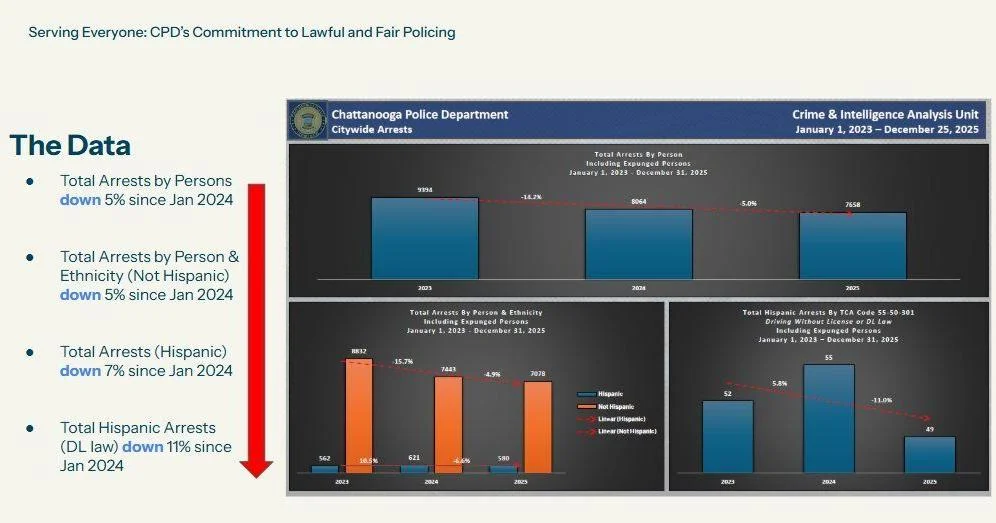
The chief presented a comprehensive analysis of arrest statistics spanning the past three years, highlighting a notable downward trend in overall arrests, including those involving Hispanic residents. According to Chambers, 2025 marked a three-year low for arrests of Hispanic adults specifically for driving without a license.
“That is completely contrary to what is being assumed by the release and analysis of other data centers,” Chambers explained. “These are the facts, and we can’t change this. This is what is going on.”
His presentation directly challenged a recent report claiming a sharp increase in ICE detention rates in Chattanooga. Chambers argued that such comparisons are fundamentally flawed due to significant changes in law enforcement protocols and legislation.
“When you see this increase, and you’re mixing past protocols with previous law versus new protocols and new law, you cannot compare those two data sets,” he emphasized. “It is being misconstrued as something that it is not.”
The issue of policing in immigrant communities has become increasingly contentious in Chattanooga, reflecting similar tensions playing out across the country. Immigration enforcement policies have sparked heated debates nationwide, with law enforcement agencies often caught between state mandates and community concerns.
Chambers expressed particular concern about how misinformation affects vulnerable residents’ willingness to seek help from law enforcement. The fear generated by false narratives, he suggested, creates dangerous situations where people might not call police when needed.
“The result of misinformation is that you increase the level of fear, and then you decrease their opportunity to feel like they can call for help when they need it,” Chambers said. “That is a tragedy, because nobody wants to see children suffer because they don’t have support or someone to protect them–because they don’t have someone to stand up for them, or because they don’t have access to the support they should have.”
The chief’s comments come amid growing scrutiny of police interactions with immigrant communities across Tennessee and the broader Southeast. Several advocacy groups have published reports suggesting disproportionate enforcement against Hispanic residents, though Chambers maintains these analyses fail to account for legal and procedural changes.
Chattanooga, like many mid-sized American cities, has seen significant demographic changes in recent decades, with a growing Hispanic population that has contributed to the city’s cultural and economic landscape. Community leaders have emphasized the importance of building trust between law enforcement and all residents regardless of immigration status.
Chambers acknowledged the emotional toll that enforcing certain laws takes on officers, presenting a humanizing perspective on police work rarely highlighted in public discussions.
“Even though we wear uniforms, we are humans, and that is a difficult thing to do repeatedly,” Chambers said. “We do not have a choice. The law doesn’t allow us to apply our opinions or our thoughts or beliefs into how we enforce the law.”
He concluded with a passionate defense of impartial law enforcement, referencing past instances where subjective policing damaged community relations.
“That is something we have experienced in our country and our city, and I will fight like hell to keep it from ever happening,” Chambers vowed.
The Chattanooga Police Department has indicated it will continue to share arrest data publicly in an effort to maintain transparency and rebuild community trust based on factual information rather than misconceptions.
Fact Checker
Verify the accuracy of this article using The Disinformation Commission analysis and real-time sources.

22 Comments
It’s good to see the Chattanooga police addressing misinformation concerns and providing transparent data on arrest trends. Balancing public trust and effective law enforcement is an ongoing challenge, but open communication is key.
Absolutely, transparency and data-driven decision-making are critical for maintaining community trust. Curious to see if this will help address any underlying issues or perceptions.
The decrease in Hispanic arrests is an interesting data point that warrants further investigation. Addressing misconceptions with facts is a responsible approach.
Agreed. Understanding the underlying factors behind this trend could provide valuable insights into improving community-police relations.
The decrease in Hispanic arrests is an encouraging sign, though the reasons behind it would be interesting to understand further. Addressing misconceptions with facts is the right approach.
Agreed, the data presented seems to contradict the claims made in the earlier report. Digging into the underlying causes could provide valuable insights.
Kudos to the Chattanooga police for their commitment to fair and unbiased enforcement practices. Addressing misinformation concerns head-on is a responsible approach.
Absolutely. Transparent data and open communication can go a long way in building community trust and understanding, which is crucial for effective law enforcement.
The Chattanooga police’s efforts to address misinformation and provide factual data are commendable. Maintaining open communication and evidence-based practices is essential for effective law enforcement.
Absolutely. Proactively addressing community concerns and misconceptions with data can go a long way in building trust and understanding.
It’s good to see the Chattanooga police taking a proactive approach to addressing misinformation and providing transparent data on arrest trends. This is a responsible way to build community trust.
Kudos to the Chattanooga police chief for taking a stand against misinformation and presenting data-driven analysis. Transparency and accountability are crucial for maintaining public trust.
The decrease in Hispanic arrests is an interesting data point that deserves further analysis. Addressing misconceptions with facts is a prudent approach for the Chattanooga police.
Agreed. Understanding the underlying factors behind this trend could provide valuable insights for improving policing practices and community relations.
It’s encouraging to see the Chattanooga police taking a proactive stance on addressing misinformation. Maintaining public trust is essential for effective policing.
It’s important for law enforcement to be responsive to community concerns and provide factual information to counter misinformation. This seems like a positive step in that direction.
Absolutely. Addressing misconceptions head-on with data and clear communication can go a long way in building trust and understanding between the police and the community.
The decrease in Hispanic arrests is an interesting data point that deserves further analysis. Ensuring fair and equitable policing is crucial for maintaining public confidence.
Kudos to the Chattanooga police for proactively addressing this issue. Maintaining public trust requires ongoing transparency and a commitment to fair, unbiased enforcement practices.
Transparency and data-driven decision-making are essential for effective law enforcement. This appears to be a constructive approach to addressing community concerns.
Agreed. Proactively addressing misinformation with facts and open dialogue can help build bridges between the police and the public they serve.
The Chattanooga police chief’s presentation seems like a step in the right direction. Addressing misconceptions with data is important for maintaining trust and accountability.