


Listen to the article
Disconnected Health Systems Causing Serious Patient Harm, Canadian Physician Survey Finds
Nearly all physicians across Canada report that fragmented and disconnected health systems are impeding their ability to deliver proper patient care, with many citing serious adverse health consequences for patients, according to a new national survey.
The latest Physician Pulse survey, a joint initiative by the Canadian Medical Association (CMA) and Abacus Data, reveals that 92% of practicing physicians say disconnected health systems affect their ability to provide care at least sometimes, with two-thirds (66%) reporting this happens often.
These findings, based on responses from 645 practicing physicians surveyed between April 6-13, 2026, highlight significant structural challenges within Canada’s healthcare infrastructure that continue to plague the system despite years of calls for better integration.
Perhaps most alarming is that nearly half of all physicians surveyed (48%) report having seen patients experience serious adverse health consequences—including disease progression or missed diagnoses—directly resulting from these disconnected systems. Among physicians who frequently encounter system fragmentation issues, this figure rises to an even more concerning 60%.
“These aren’t just administrative inconveniences,” explains Dr. Maria Chen, a healthcare policy expert not affiliated with the study. “When critical patient information can’t be easily shared between providers, we see tangible harm occurring. Test results get missed, treatments are delayed, and patients fall through the cracks.”
The survey highlights how the inability to share patient records, test results, or clinical notes between different parts of the healthcare system has become not just an operational challenge but a growing patient safety issue.
Healthcare integration has been a long-standing challenge in Canada’s provincially managed system, with electronic health record systems often operating in silos. Despite billions invested in digital health infrastructure over the past decade, interoperability remains problematic across most regions.
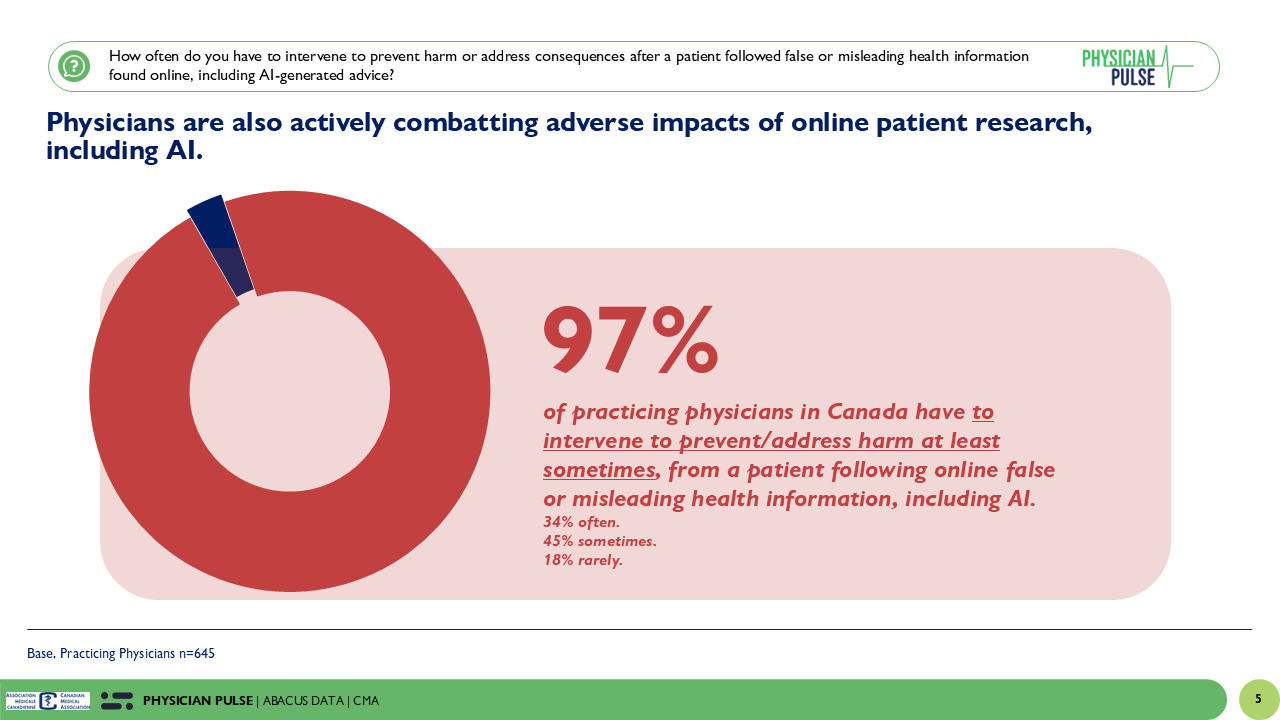
Beyond system fragmentation, Canadian physicians also report being increasingly burdened with countering health misinformation. An overwhelming 97% of physicians have had to intervene to prevent harm or address consequences after patients followed false or misleading health information found online, including AI-generated advice. This happens “often” for 34% of physicians and “sometimes” for another 45%.
“The proliferation of medical misinformation, particularly with the rise of AI-generated content that can appear authoritative, creates additional work for already strained physicians,” notes healthcare communications researcher Dr. James Wilson. “Doctors now routinely spend valuable appointment time debunking myths patients have encountered online.”
These dual challenges—fragmented systems and widespread misinformation—are compounding pressures on Canada’s healthcare system at a time when physician burnout rates are already at historic highs.
Industry experts suggest that addressing system fragmentation will require coordinated investment across provinces, potentially through federal leadership in establishing interoperability standards. Some provinces, including Alberta and Ontario, have made recent progress in connecting different parts of their health systems, but nationwide integration remains distant.
The CMA has previously advocated for a national health information backbone that would enable seamless sharing of critical health data while protecting patient privacy. According to the organization, such infrastructure would improve care coordination, reduce costly duplicative testing, and potentially save lives.
The Physician Pulse survey series aims to provide timely insights on emerging healthcare issues in Canada. Survey data were weighted by region of practice using 2024 statistics from the Canadian Institute for Health Information to ensure results are representative of the national physician population.
As Canada continues to grapple with healthcare system reform in the wake of pandemic-related strains, these findings underscore the urgent need for improved integration of health information systems—not just as a matter of efficiency, but as a critical patient safety issue.
Fact Checker
Verify the accuracy of this article using The Disinformation Commission analysis and real-time sources.

14 Comments
This survey highlights the urgent need for comprehensive healthcare reform in Canada. Improving system integration and communications should be a top priority for policymakers.
It’s disheartening to see how widespread these issues are across Canada’s healthcare system. Patients deserve better coordinated and more reliable care.
I hope this spurs meaningful action from the government and medical community to address these systemic problems. Patients’ well-being must come first.
Two-thirds of physicians often encountering problems due to disconnected systems is extremely troubling. This points to deep-seated flaws that need urgent attention.
The survey findings underscore the crucial importance of addressing systemic weaknesses in Canada’s healthcare infrastructure. Patient safety must be the paramount concern.
Agreed. Decisive action from policymakers and healthcare leaders is needed to rectify these problems and restore public confidence.
This is a complex challenge, but the stakes are too high to delay solutions. Improving system coordination and combating misinformation should be top priorities.
Disconnected systems and misinformation are a toxic combination that is harming patients. Comprehensive reforms are clearly essential to fix these deep-rooted issues.
The fact that nearly half of doctors have seen serious harm to patients from these integration failures is a damning indictment of the current state of healthcare in Canada.
Clearly bold steps are needed to overhaul the system and ensure seamless, high-quality care delivery. Lives are at stake here.
The prevalence of serious adverse events due to disconnected systems is alarming. Misinformation is also a major challenge – healthcare providers need better tools to combat the spread of dangerous falsehoods.
Absolutely. Tackling both the structural and informational barriers will be key to restoring public trust and improving patient safety.
This is deeply concerning. Fragmented healthcare systems can have devastating consequences for patient outcomes. I hope the Canadian government acts quickly to address these structural issues and improve care coordination.
Agreed. Proper integration and information sharing between different providers is critical to ensure patients receive timely and effective treatment.