


Listen to the article
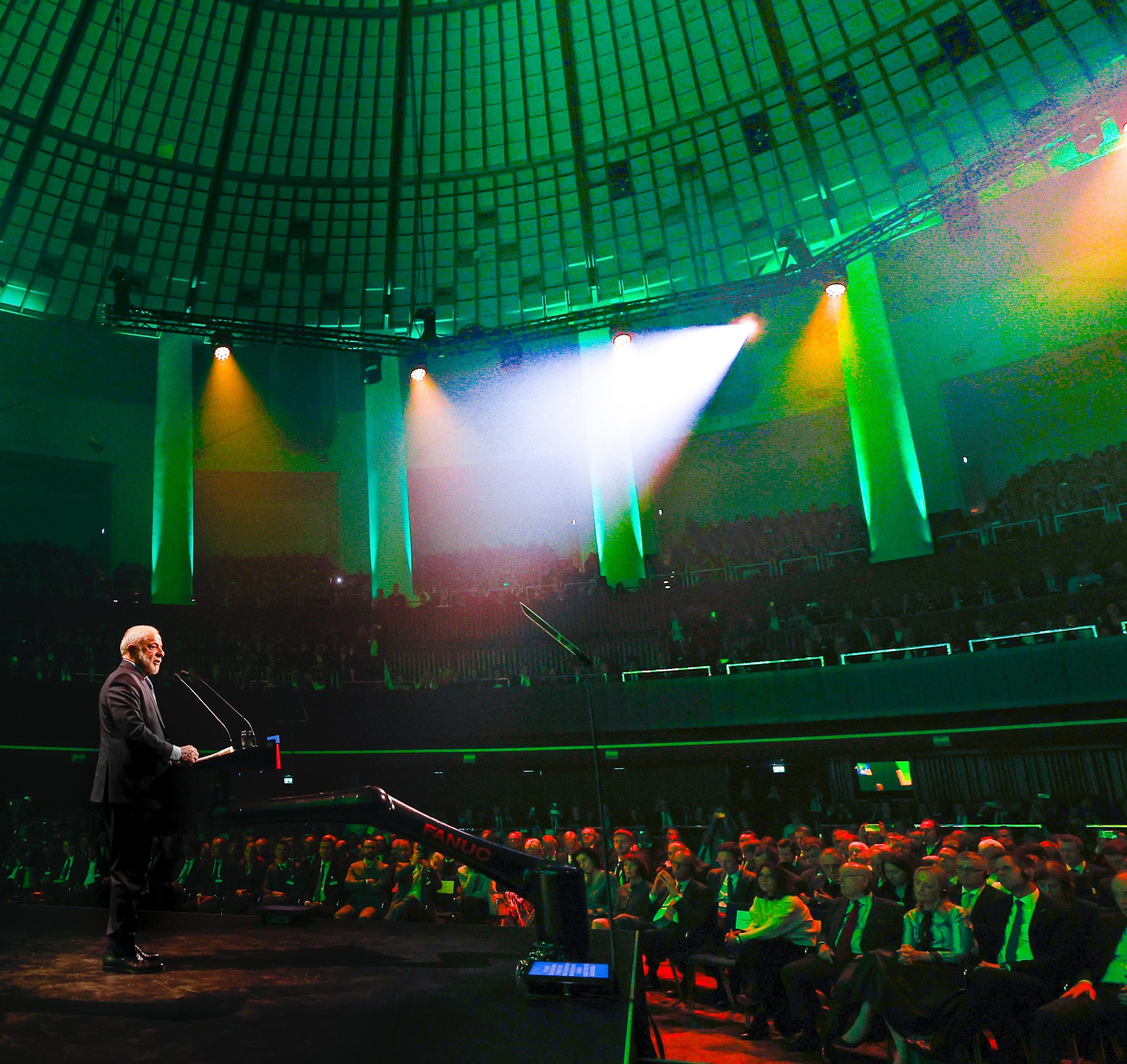
Brazil’s President Lula defended his country’s clean energy credentials and criticized trade barriers at the opening of the Hannover Fair in Germany on Sunday, as the Mercosur-European Union trade agreement prepares to partially take effect next month.
Speaking at the prestigious industrial fair, where Brazil is this year’s featured country, Lula highlighted the strategic importance of the partnership between the South American and European blocs while addressing ongoing tensions over environmental and agricultural policies.
“The invitation to the Hannover fair consolidates Brazil’s position as a reliable partner in a world of instability and uncertainty,” Lula said in his address, which included pointed criticisms of U.S. President Donald Trump and ongoing global conflicts.
The Brazilian leader celebrated the impending implementation of the Mercosur-EU trade agreement, scheduled to provisionally enter into force on May 1. “In less than two weeks, the agreement that creates a market of almost 720 million people and a GDP of $22 trillion will come into force,” he said. “There are numerous unexplored complementarities. Brazil can help the European Union reduce energy costs and decarbonize.”
However, Lula expressed frustration with what he perceives as European misconceptions about Brazilian environmental practices. “It is essential that the bloc takes into account the electricity mix used in our country,” he stated, referring to Brazil’s substantial renewable energy portfolio, which includes significant hydroelectric capacity and a growing solar and wind sector.
The president specifically challenged European restrictions on Brazilian biofuels, saying: “We are still fighting false claims about the sustainability of our agriculture. Creating barriers to access to biofuels is counterproductive from an environmental and energy point of view.”
Despite the partial implementation of the trade agreement, which focuses on tariff reductions, the full accord faces continuing resistance within Europe. The portion taking effect in May covers trade provisions, while chapters on political cooperation and environmental governance remain pending approval. European agricultural protectionism continues to be a significant obstacle, with farmers across the continent voicing concerns about competition from South American producers.
According to the Brazilian Trade and Investment Promotion Agency (ApexBrasil), the agreement is projected to increase EU GDP by at least €77.6 billion by 2040, with annual exports expected to rise by 39%. For Mercosur nations, ApexBrasil identifies potential European market opportunities worth approximately $43.9 billion in annual imports, with particular focus on machinery and transport equipment sectors.
Beyond trade matters, Lula used the platform to critique global governance structures. He criticized the World Trade Organization’s ineffectiveness, calling for its reformation with greater representation for developing nations. “The effective incorporation of the interests of the Global South is an essential condition for multilateral arrangements to be legitimate and relevant,” he argued.
The Brazilian president also delivered a forceful rebuke of the UN Security Council for failing to prevent ongoing conflicts. “It is not possible that people have not understood that the five members of the UN Security Council [are there] to maintain peace, harmony, and prevent a repeat of the Second World War. And today the world is experiencing the greatest number of conflicts in its history since the Second World War,” Lula stated.
In a thinly veiled reference to Trump, Lula warned that the world cannot “bow to the behavior of a president who thinks that by email or Twitter he can tax products, punish countries, and wage wars.”
The Hannover Fair, running until Friday, will feature numerous meetings between Brazilian and German delegations focused on establishing partnerships and addressing trade issues. According to the Brazilian National Confederation of Industries (CNI), Sunday’s meetings between government and industry representatives addressed the Mercosur-EU agreement, double taxation avoidance, and projects involving digitalization, artificial intelligence, decarbonization, and biofuels.
The CNI projects that the $20 billion trade flow between Brazil and Germany could double over the next five years, underscoring the economic significance of this diplomatic engagement.
Following his participation in the first day of the fair on Monday, where he will speak alongside German Chancellor Friedrich Merz and meet with business leaders, Lula will continue his European tour with a visit to Lisbon on Tuesday.
Fact Checker
Verify the accuracy of this article using The Disinformation Commission analysis and real-time sources.

8 Comments
The trade barriers and environmental tensions between different countries are concerning. Hopefully Lula’s comments can help build more constructive dialogue on these complex issues.
Agreed, open dialogue and cooperation are key. Economic integration also needs to go hand-in-hand with environmental protection.
The scale of the Mercosur-EU market, covering 720 million people and $22 trillion GDP, is impressive. Unlocking the complementarities between the regions could yield significant benefits.
Interesting to hear Lula defending Brazil’s clean energy credentials. The Mercosur-EU trade deal could open up new opportunities for collaboration on sustainable development.
It’s good to see Brazil taking a leading role at the Hannover Fair. Strengthening ties with Europe could benefit both regions’ economic and sustainability agendas.
Lula’s criticisms of Trump and ongoing global conflicts point to the complex challenges leaders are navigating. Diplomacy and trade deals like Mercosur-EU will be crucial going forward.
Interesting to hear Lula highlight the strategic importance of the Mercosur-EU partnership. Reducing energy costs and decarbonization efforts could be areas of fruitful collaboration.
Consolidating Brazil’s position as a reliable partner is an important goal, especially in the current unstable geopolitical climate. The Mercosur-EU deal could be a valuable step in that direction.