


Listen to the article
In an era of digital misinformation, a recent incident outside a shopping mall has highlighted how rapidly false information can transform into public panic. During a recent rainfall, dozens of people stood hesitantly under shelter, afraid to venture into what they believed was chemically harmful precipitation – a fear stemming not from scientific evidence but from unverified social media claims.
This scene exemplifies a growing crisis in information consumption, according to observers tracking the spread of misinformation. The past week has seen numerous unfounded claims circulating widely across social platforms – assertions that India was planning to attack Pakistan on March 21, that Earth is dome-shaped, and that satellites never actually reach the Moon or Mars.
What makes these situations particularly troubling is not merely the existence of misinformation but the speed and scale of its spread. While factual information typically moves slowly and methodically through verification channels, misinformation travels rapidly, often engineered with emotional triggers that make it inherently more shareable.
“Truth by its nature is very slow and without the sensational elements that fuel mass gossip,” notes media analyst Rahul Sharma, who studies information flow patterns. “Misinformation, by contrast, is fast, emotional, and packed with provocative content that algorithms naturally amplify.”
Social media platforms’ algorithms bear significant responsibility in this dynamic. These systems are designed to reward engagement, prioritizing content that generates strong emotional reactions – fear, outrage, or curiosity – regardless of accuracy. This creates an environment where verified information struggles for attention while shocking claims receive disproportionate visibility.
Digital influencers have learned to exploit these mechanics. By crafting messages with psychological triggers – phrases like “Emergency! Share fast!” or “Before it gets deleted” – content creators bypass critical thinking processes and activate immediate emotional responses in viewers. These tactics transform casual browsing into reflexive sharing, allowing false information to reach exponentially larger audiences.
The consequences extend far beyond momentary confusion. When an unverified claim about chemically harmful rain circulates, it creates real-world anxiety and behavioral changes. Similarly, when self-proclaimed experts predict war or catastrophe, they may gain fleeting digital popularity while inflicting lasting psychological harm on vulnerable audiences.
For many Indians, particularly in regions with limited access to diverse information sources, social media has evolved from being merely one information channel to becoming the primary authority on truth. This shift has created a dangerous vulnerability to manipulation, where even brief video clips can generate disproportionate levels of panic.
Perhaps most concerning is how this phenomenon undermines established knowledge systems. Scientific consensus developed through decades of rigorous research can now be challenged by 30-second videos from individuals with no relevant expertise. The intellectual architecture that society relies upon for progress becomes increasingly fragile as audiences prioritize emotional resonance over factual accuracy.
Media literacy experts point out that responsibility extends to all participants in the digital ecosystem. While platform design and influencer tactics contribute significantly to the problem, individual users’ sharing behaviors ultimately determine how far misinformation spreads.
“Every impulsive share and unverified forward strengthens an ecosystem that values speed over accuracy and emotion over reason,” says digital ethics researcher Priya Mehta. “The problem of misinformation isn’t something imposed on us – it’s co-created through our collective online behaviors.”
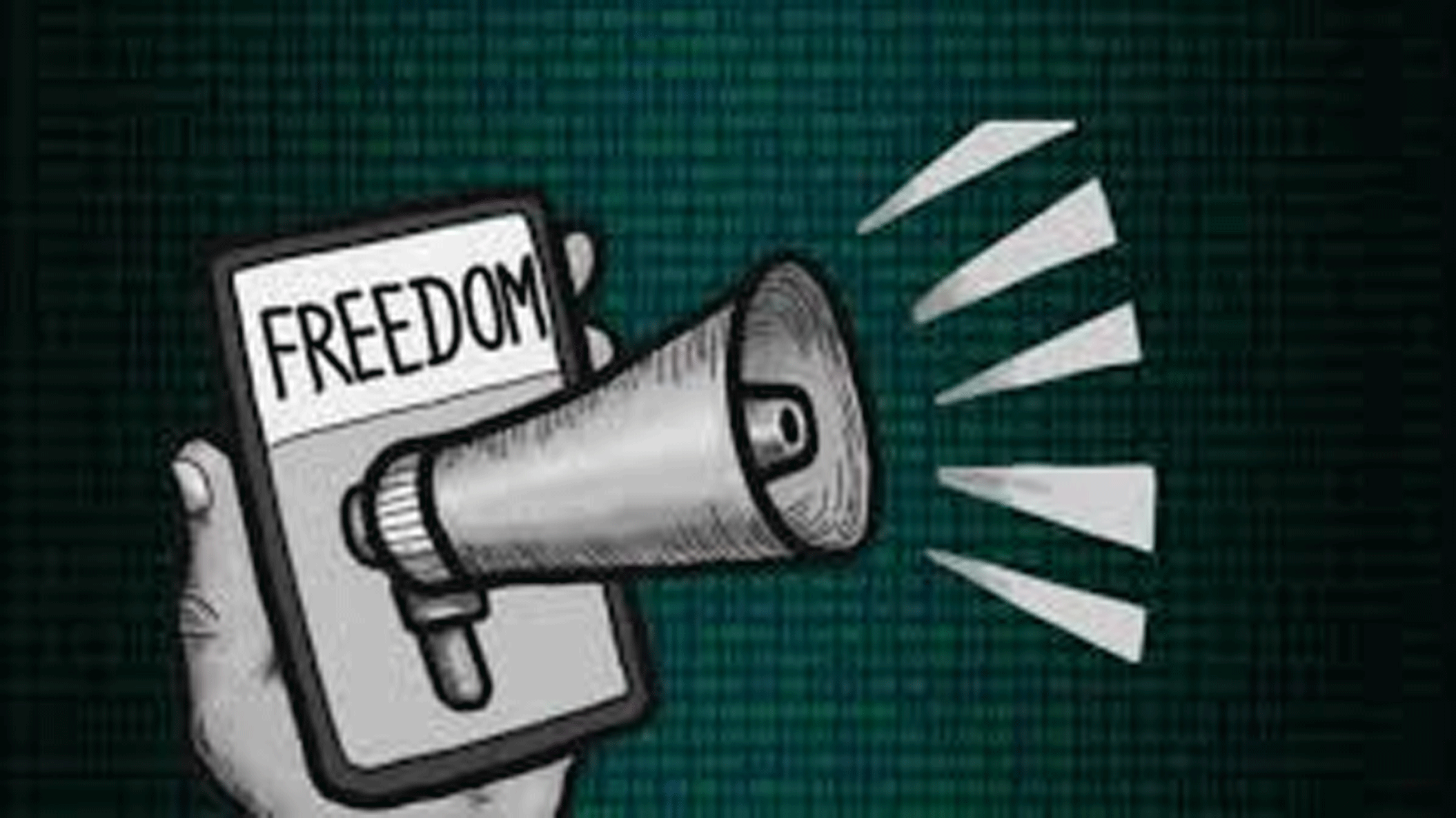
The tension between freedom of expression and responsible communication grows increasingly complex in this environment. While democratic societies rightly protect free speech, the rapid evolution of digital platforms has created scenarios where false narratives can generate widespread panic almost instantaneously, potentially affecting public health and safety.
Addressing this challenge requires a multi-faceted approach. Media literacy programs in educational institutions need strengthening, while digital platforms must continue refining their moderation practices. However, meaningful change ultimately depends on individual users developing greater discipline in information sharing.
As one information security expert put it: “In today’s environment, the truly educated mind isn’t the one that knows the most, but the one that can filter the best.”
Without concerted efforts to improve this filtering capacity across society, one of democracy’s greatest strengths – the free exchange of ideas – risks becoming one of its most significant vulnerabilities.
Fact Checker
Verify the accuracy of this article using The Disinformation Commission analysis and real-time sources.

12 Comments
This incident with the fear of chemically harmful rain highlights how quickly unverified social media claims can spiral into public panic. Fact-checking and responsible reporting are essential to prevent these kinds of situations.
I agree. Building public trust in authoritative, science-based information sources is crucial to combating the spread of misinformation, especially around sensitive topics like public health and safety.
Interesting perspectives on the balancing act between free speech and misinformation control. It’s a complex issue without easy solutions, but you’re right that building public trust in authoritative information is crucial.
Agreed. Fostering a culture of media literacy and fact-checking, while respecting free expression, will be an ongoing challenge in the digital age.
Fascinating article on the challenges of balancing free speech and misinformation in the digital age. It’s a tricky balance, but ensuring access to accurate, verified information is so critical. What can be done to combat the rapid spread of false claims online?
Promoting media literacy and critical thinking skills could help people identify misinformation. Stronger platform policies and enforcement around verifying content sources may also be needed.
The rapid spread of misinformation is a real challenge, with emotionally-charged claims often outpacing the slower pace of verified information. More robust digital literacy education could empower people to critically evaluate what they see online.
Absolutely. Teaching critical thinking skills and source verification is key. Platforms also need to do more to identify and limit the reach of deliberately misleading content.
The rapid spread of misinformation, often engineered with emotional triggers, is a concerning trend. Promoting media literacy and strengthening platform policies around content verification seem like important steps to address this challenge.
Agreed. Ensuring access to accurate, science-based information is crucial, especially on sensitive topics that can impact public health and safety. It’s a complex issue, but one that demands concerted attention.
This article highlights the delicate dance between protecting free speech and preventing the spread of harmful misinformation. It’s a difficult balance, but finding ways to empower critical thinking and verified information is so important.
Definitely. Misinformation can have very real consequences, as we saw with the fear of chemically tainted rain. Equipping the public with the tools to discern truth from fiction online is a key part of the solution.