


Listen to the article
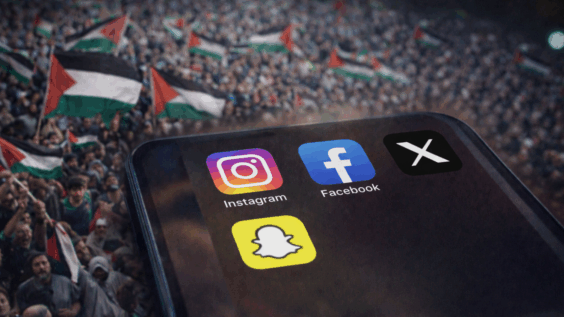
Sydney Synagogue Attack Sparks Global Divide in Arab and Muslim Social Media
The deadly attack during a Hanukkah celebration near Sydney’s Bondi Beach has ignited a fierce debate across Arab and Muslim social media platforms, revealing deep divisions in how violence against Jewish communities is perceived and discussed globally.
Hours after the assault, social media exploded with competing narratives ranging from unequivocal condemnation to conspiracy theories and, in some cases, attempts to justify the violence through the prism of the Israel-Gaza conflict.
At the center of this polarized discussion stands Ahmed al Ahmed, a Syrian-Australian Muslim who heroically intervened during the attack. Al Ahmed confronted and disarmed one of the assailants, suffering serious injuries in the process. His courageous actions quickly became symbolic, with his identity as a Muslim who saved Jewish lives triggering intense discussion about interfaith relations.
“My son has always been brave,” said Malakeh Hasan al Ahmed, Ahmed’s mother, in comments widely shared across social platforms. His intervention sparked an outpouring of admiration, with some users creating pop culture-style tributes featuring al Ahmed as a superhero.
Noor Dahri, a prominent counterterrorism expert, framed the incident as a stark contrast between ordinary Muslims and extremists, writing: “This is the difference between Muslims and Islamists. Muslims save lives. Islamists take innocent lives.”
Many Arab and Muslim voices responded with clear condemnation of the attack and expressed solidarity with the Jewish community. Sal Naseem, an author and public servant, told The Media Line: “I saw the news in Bondi and just felt sick. Seeing the violence inflicted on the Jewish community in what should have been a moment of joy during Hanukkah.”
Naseem rejected ambiguity around moral judgment, stating: “I understand, as a Muslim, that there can be a perceived pressure to speak up at times like this, but that isn’t something I feel. I think it’s very easy to condemn evil wherever and whenever we see it.”
Muhammad Chaudhry, a senior supplier development auditor, praised al Ahmed’s actions as transcending religious and ethnic divisions: “He acted out of pure humanity, without asking who the victim was or who the perpetrators were. That, to me, is a true reflection of his character and a remarkable achievement.”
However, alongside these expressions of solidarity, misinformation spread rapidly on social platforms. Some accounts promoted conspiracy theories claiming the attack was staged or a “false flag” operation. Others alleged that one attacker was secretly Jewish under the fake name “David Cohen,” or that Israeli intelligence had engineered the attack to divert attention from Gaza.
More troubling were posts that attempted to reframe the attack by focusing on the political views of the victims. One verified account claimed that Rabbi Eli Schlanger, identified among those killed, had supported Israeli military actions in Gaza, arguing that his political stance somehow made the attack more understandable.
Some Palestinian and Arab voices warned that online discourse was sliding from legitimate criticism of Israel into outright antisemitism. Ahmed Fouad Alkhatib, a Palestinian American analyst, criticized what he called “two types of antisemites” – those who remain silent when Jews are attacked and those who express hatred regardless of circumstances.
The debate spilled onto Instagram, where content creators engaged in heated exchanges. Elica Le Bon, an Iranian dissident, questioned why some focused more on Ahmed al Ahmed’s heroism than on the victims, suggesting this emphasis revealed discomfort in confronting antisemitism.
The polarization extended within Arab communities as well. Khaled Hassan, an Egyptian intelligence analyst, highlighted how “Saudi influencers are attacking Emirati influencers for standing with the Jewish community,” demonstrating the charged nature of expressing basic sympathy for Jewish victims.
Amjad Taha, an Emirati expert in Middle East affairs, criticized what he perceived as silence from Muslim organizations in the UK regarding the attack, contrasting this with their mobilization around other political issues.
As investigations continue, the digital response to the Bondi attack reveals a fractured moral landscape where grief competes with geopolitics, and empathy is filtered through ideological lenses. Naseem perhaps best summarized the core truth emerging from this tragedy: “Hatred isn’t restricted to any color or faith, and neither is heroism.”
The Bondi attack has become more than a crime – it’s a mirror reflecting unresolved tensions that shape how violence against religious communities is processed, explained, and mourned globally. In this digital aftermath, Ahmed al Ahmed’s courageous intervention stands as a powerful counterpoint to hatred, transcending the bitter divisions that continue to swirl around this tragedy.
Fact Checker
Verify the accuracy of this article using The Disinformation Commission analysis and real-time sources.

10 Comments
This attack is a tragic reminder of the ongoing tensions and violence that plague so many communities around the world. But Ahmed’s actions show that even in the darkest of times, there are still those who choose compassion over hate.
The response from Arab-Muslim social media highlights the complex dynamics at play. It’s encouraging to see condemnation of the violence, but also concerning to see attempts to justify it. We must remain vigilant against all forms of extremism.
It’s heartening to see the Arab-Muslim community rally around Ahmed al Ahmed and condemn the violence. His story provides a much-needed counterpoint to the divisive rhetoric that can dominate social media discourse.
I’m glad to see the Arab-Muslim community condemning this violence and honoring Ahmed’s courageous intervention. It’s a powerful symbol of unity in the face of hate.
Agreed. We need more stories like this to counter the divisiveness and conspiracy theories that can spread so quickly online. Ahmed’s example is a reminder of our shared humanity.
While the attack was horrific, I’m struck by how Ahmed’s story has resonated globally. It speaks to the possibility of interfaith cooperation and understanding, even in the most tense situations.
Absolutely. This is the kind of story we need more of – one that brings people together rather than driving them apart. Ahmed’s actions are truly inspirational.
While the debate on social media reflects deep divisions, Ahmed al Ahmed’s heroism is a powerful reminder that individual acts of courage can transcend those divides. His story gives me hope for a more just and peaceful future.
The social media response highlights the complex and often polarizing nature of these issues. But Ahmed’s courage and selflessness are a powerful testament to the possibility of unity and understanding, even in the face of great adversity.
A tragic attack, but Ahmed al Ahmed’s heroism is truly inspiring. His brave actions to defend innocent lives, despite the tensions, show the power of compassion to bridge divides.