


Listen to the article
Philippines Presidential Office Refutes Fabricated Reports of Marcos’s Cancer Diagnosis
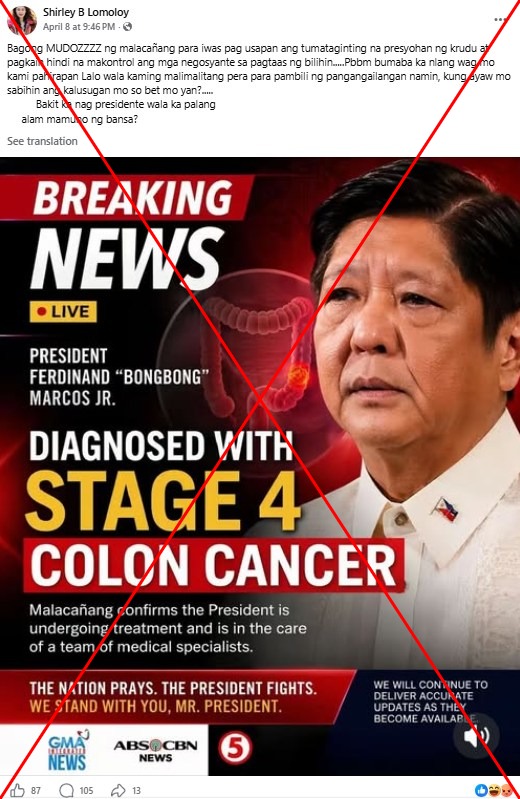
Social media rumors concerning President Ferdinand Marcos Jr.’s health status have been debunked by the Philippine presidential office following widespread circulation of a fabricated graphic claiming the president has stage 4 colon cancer. The false information, which featured logos from major Philippine news organizations GMA News, ABS-CBN News, and News5, gained significant traction online with over 30,000 shares on Facebook.
The misleading graphic stated: “Breaking news: President Ferdinand ‘Bongbong’ Marcos Jr. diagnosed with stage 4 colon cancer,” and claimed, “Malacanang confirms the President is undergoing treatment and is in the care of a team of medical specialists.” The accompanying post suggested this was a diversionary tactic by the government to distract from economic concerns, stating in Tagalog: “Malacanang’s new scheme to avoid talk about the staggering prices of fuel and food because they can no longer control businessmen from hiking the price of goods.”
This latest wave of speculation builds upon earlier health rumors that began in January when Marcos was hospitalized for colon inflammation. The speculation intensified after the president missed an April 6 event with returning overseas Filipino workers, though presidential press officer Claire Castro quickly clarified that Marcos was simply attending other scheduled meetings and engagements.
Despite the swift denials, the false information continued circulating, with many social media users accepting the fabricated news at face value. Comments reflected a willingness to believe the claims, with one user writing, “His reign of evil is about to end,” while another stated, “He is trying to evade accountability by hiding behind an illness.”
Fact-checking efforts confirmed the fraudulent nature of these claims. Thorough searches of the official websites of GMA News, ABS-CBN News, and News5 revealed no reports about any such presidential health announcement. Miranda Grapilon, editorial head of ABS-CBN News Digital, explicitly condemned the graphic on April 16, telling AFP: “The graphic is clearly the work of fake news purveyors. None of our news platforms carried any report pertaining to a supposed cancer diagnosis of the president, or a supposed confirmation of treatment by Malacanang.”
Visual analysis further exposed the forgery, as the fake graphic lacked the design consistency and formatting typically found in legitimate news graphics produced by these media organizations. The fabricated image originated from an account with a history of publishing sensationalist content.
Presidential spokesperson Claire Castro firmly refuted the health rumors on April 14, telling AFP: “Those circulating claims that he is seriously ill are definitely spreading disinformation.”
This incident highlights the ongoing challenge of combating misinformation in the Philippines’ digital landscape, where fabricated news can rapidly gain traction through social media channels. Health-related rumors about public figures, particularly high-ranking officials like President Marcos, can significantly impact public perception and political discourse.
This is not the first instance of health misinformation targeting the Philippine president. AFP has previously fact-checked similar false claims about Marcos’s medical condition, indicating a pattern of health-related disinformation that continues to circulate despite official denials and corrections from both government and media organizations.
The persistence of these rumors underscores the need for enhanced media literacy and critical evaluation of news sources, particularly when claims involve unverified information about prominent public figures.
Fact Checker
Verify the accuracy of this article using The Disinformation Commission analysis and real-time sources.

7 Comments
Interesting, it’s always concerning to see false health claims about political leaders. I hope the Philippine government is able to clearly and transparently address these rumors to maintain public trust.
This is a concerning case of misinformation, but I’m glad the presidential office was quick to refute the false claim. Maintaining trust in institutions during challenging times is critical for any democracy.
While I understand public interest in a leader’s health, spreading unverified claims can be irresponsible. I hope the Philippine government continues to provide timely, accurate updates on the president’s condition.
Misusing news outlet logos to lend credibility to false claims is a tactic we’ve seen before. I hope the Philippine authorities investigate the origin of this misinformation campaign.
Spreading disinformation about a leader’s health can be a way to sow political discord. Transparency and fact-checking are essential to counter these kinds of attempts.
Fabricated graphics like this are a real problem, as they can spread misinformation rapidly online. It’s good the presidential office quickly refuted this claim – transparency around public officials’ health is important for democracy.
Agreed, it’s crucial that the public receives accurate, verified information from official sources on matters like this, rather than unsubstantiated rumors.