


Listen to the article
Trump Administration Defends Mathematically Impossible Claims on Drug Price Cuts
President Donald Trump’s repeated assertions about slashing prescription drug prices by percentages ranging from “500%” to “1,500%” have drawn criticism from experts who point out these claims defy basic mathematics. Despite this, Trump’s administration officials continue attempting to defend these statements with equally problematic calculations.
Since last year, Trump has made numerous claims about dramatic reductions in medication costs. However, as critics have noted, these statements make no mathematical sense. A 100% price reduction would mean drugs cost nothing, while reductions exceeding 100% would require pharmaceutical companies to pay consumers to take their medications—a scenario that clearly isn’t happening in the U.S. healthcare market.
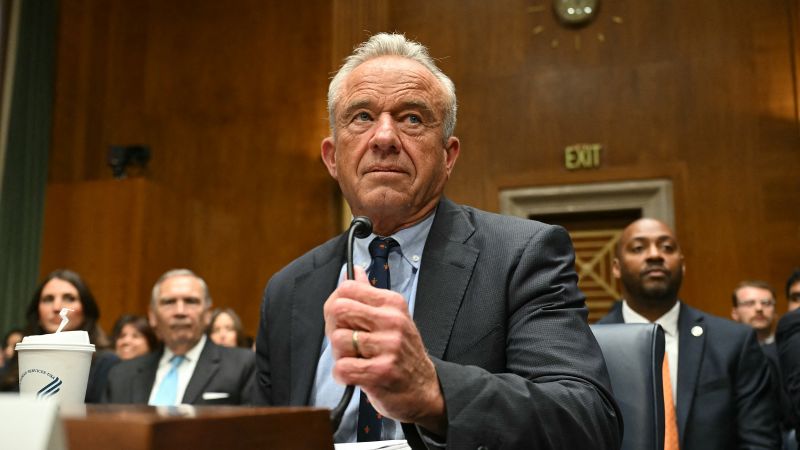
Health Secretary Robert F. Kennedy Jr. became the latest administration official to defend these claims during a Senate hearing Wednesday. When Democratic Senator Elizabeth Warren questioned Trump’s assertion of “600%” reductions, Kennedy responded: “President Trump has a different way of calculating. If you have a $600 drug and you reduce it to $10, that’s a 600% reduction.”
Mathematicians and economists quickly pointed out this statement is factually incorrect. A price drop from $600 to $10 represents a 98.3% reduction, not 600%. There is no valid mathematical calculation that supports Kennedy’s explanation.
Undeterred, Kennedy repeated similar claims during a White House event with Trump the following day, suggesting that if a drug price rose from $100 to $600 (actually a 500% increase), then dropping from $600 to $100 would be a “600% savings.” Trump endorsed this explanation, interjecting “That’s right,” but the actual calculation shows an 83.3% reduction.
This isn’t the first time Trump officials have attempted to explain away the president’s percentage claims. Dr. Mehmet Oz, administrator for the Centers for Medicare and Medicaid Services, tried a different approach at an October event where Trump claimed drug prices were “coming down 400%, 200%, 600%.”
Oz cited a specific fertility drug’s price reduction from $242 to $10, then oddly claimed, “I don’t know what the math is on that. We can’t even calculate it. It’s a lot. It’s too high to calculate without a more studied approach.” In reality, the calculation requires only basic arithmetic and represents a 95.9% reduction.
When pressed by NBC’s Kristen Welker days later, Oz offered another problematic explanation: “The president does the calculation by saying, ‘Okay, if a drug was $100 and you reduce it to $50, it’s 100% cheaper, because you’re taking $50 off and left with only $50.'” This explanation also fails mathematically, as a price reduction from $100 to $50 is simply a 50% decrease.
The White House communications team has employed additional strategies when confronted about these claims. When CNN requested clarification on Trump’s assertions of “1,000% to 1,500%” price decreases in September, spokesperson Kush Desai sidestepped the specific percentages, instead stating that “President Trump has correctly identified how Americans pay several times more for the same exact drugs as their peers in other wealthy nations.”
A White House official later suggested anonymously that the 1,000% figure referred to international price disparities, citing an example where a certain drug cost $521 in the U.S. versus $45 in Australia. However, bringing the U.S. price in line with Australia’s would represent a 91.4% decrease, not 1,000%.
The pharmaceutical industry and healthcare economists continue to observe these claims with concern, noting that while drug pricing reform remains an important policy issue, the administration’s use of mathematically impossible figures clouds meaningful discussion about achievable reductions in medication costs for American consumers.
Fact Checker
Verify the accuracy of this article using The Disinformation Commission analysis and real-time sources.

6 Comments
Interesting claims about drug pricing from the Trump administration. While ambitious targets could be admirable, the math needs to add up for them to be credible. I’m curious to see if they can provide transparent, fact-based evidence to support their assertions.
I agree, the numbers cited seem dubious and require rigorous justification. Simplistic calculations won’t suffice – the public deserves a clear, data-driven explanation of any purported price reductions.
The article highlights the administration’s ongoing struggle to back up its sweeping claims about drug price cuts. While reducing costs is a worthy goal, the math has to make sense. I hope they can provide a more credible, fact-based approach.
Precisely. Exaggerated or fanciful statistics do little to build public trust. A transparent, evidence-based strategy is needed to tackle this complex issue effectively.
This is a tricky issue – drug pricing is notoriously complex, with many stakeholders and moving parts. While the administration’s aims may be admirable, their claims need to be grounded in sound analysis, not political rhetoric.
Well said. Unsubstantiated boasts about 500% or 1,500% reductions undermine the credibility of their efforts. The public deserves a sober, factual discussion of the challenges and any genuine progress made.