


Listen to the article
INEC’s Timeline Dispute Over Viral X Account Comment Falls Apart Under Scrutiny
The Independent National Electoral Commission (INEC) has found itself embroiled in controversy after its forensic analysis of a viral social media comment was contradicted by digital evidence. The commission had claimed that a comment linked to an X account allegedly belonging to its chairman was posted before the original post it was responding to—a timeline INEC described as “physically impossible.”
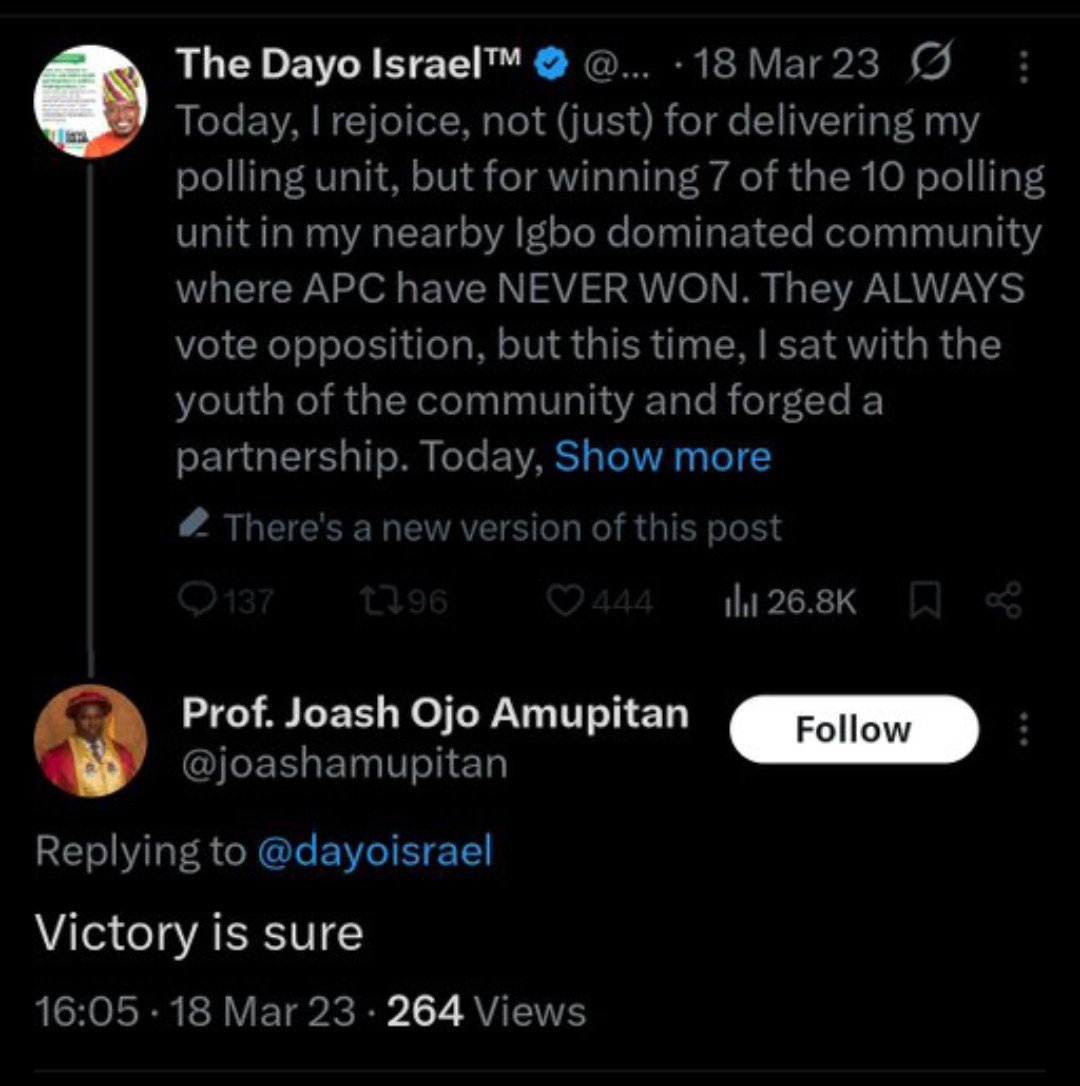
The controversy centers around an account previously known as @joashamupitan, which responded to a post by former APC National Youth Leader Dayo Israel with the comment “victory is sure.” Israel’s original post had celebrated an APC victory in an Igbo-dominated community in Lagos, making the reply appear politically charged and inappropriate for an electoral commission official.
In response to the public backlash, INEC released a six-page forensic report distancing its chairman from the account. The report claimed that timestamp analysis showed the “victory is sure” reply was posted 13 minutes before Israel’s original message—a sequence the commission declared technically impossible on any digital platform.
However, independent verification by The FactCheckHub has exposed a critical flaw in INEC’s analysis. A review of the post’s edit history reveals that Israel’s original message was posted at 4:02 pm and later edited at 4:18 pm. The controversial reply was consistently recorded at 4:05 pm across multiple screenshots and archives—meaning it was made after the original post but before the edit.
The 13-minute gap INEC cited in its forensic report actually represents the difference between the reply timestamp (4:05 pm) and the edited version timestamp (4:18 pm), not the original post. This timeline completely undermines INEC’s claim that the sequence was “physically impossible” and raises questions about the thoroughness of the commission’s investigation.
Adding another layer to the controversy, the account in question was renamed to @Sundayvibe00 on April 10, 2026, subsequently locked, and labeled as a parody account—actions that some observers view as an attempt to distance the account from official connections after the public scrutiny began.
The incident comes at a sensitive time for INEC, which has faced increasing public scrutiny over its neutrality in Nigeria’s polarized political environment. Electoral commissions worldwide are expected to maintain strict impartiality, with their officials refraining from statements or actions that could suggest political favoritism.
Social media experts note that authentication of official accounts has become increasingly important for public institutions. While parody accounts are common on platforms like X (formerly Twitter), confusion can arise when such accounts appear to represent government officials or agencies, potentially undermining public trust in these institutions.
Digital forensics specialists point out that timestamp analysis must account for edit histories on social media platforms, as posts can be modified after initial publication while maintaining their original posting dates—a factor that appears to have been overlooked in INEC’s analysis.
The controversy highlights the challenges facing electoral bodies in the digital age, where social media interactions can quickly become political flashpoints. For INEC, an institution whose credibility relies on perceived neutrality, ensuring accurate and comprehensive investigations of potential improprieties is essential to maintaining public confidence.
As Nigeria prepares for future electoral cycles, this incident serves as a reminder of how digital footprints can be subject to misinterpretation—sometimes by the very institutions tasked with ensuring transparency and accuracy in public discourse.
Fact Checker
Verify the accuracy of this article using The Disinformation Commission analysis and real-time sources.

8 Comments
The details provided in the summary raise questions about the reliability of INEC’s forensic report. Accurate timestamps are critical for investigating such sensitive social media activity related to elections.
I agree. Any irregularities in the handling of digital evidence could undermine public confidence in the electoral commission’s impartiality.
If the digital evidence truly contradicts INEC’s forensic report, then this raises serious questions about the commission’s competence and impartiality. Transparent and credible elections are fundamental to democracy.
I share your concern. Any doubts about the electoral authority’s handling of evidence could erode public trust, which would be detrimental to the democratic process.
The revelation that INEC’s timeline analysis was flawed is concerning. Maintaining integrity in the electoral process is crucial, so it’s important this issue is thoroughly examined and any necessary reforms are implemented.
This seems like a complex issue with potential political implications. I hope further investigation can shed light on what exactly happened with the timestamp discrepancy and whether there were any improper actions by INEC or other parties.
This is an interesting development in the INEC controversy. It seems the timeline analysis by the commission was flawed and the digital evidence contradicts their claims. I wonder what other factors might have influenced this discrepancy.
Yes, it’s concerning if a government agency’s forensic analysis turns out to be inaccurate. Transparency and accountability are crucial for public trust in electoral processes.