


Listen to the article
Trump’s State of the Union Address Marred by Numerous False Claims
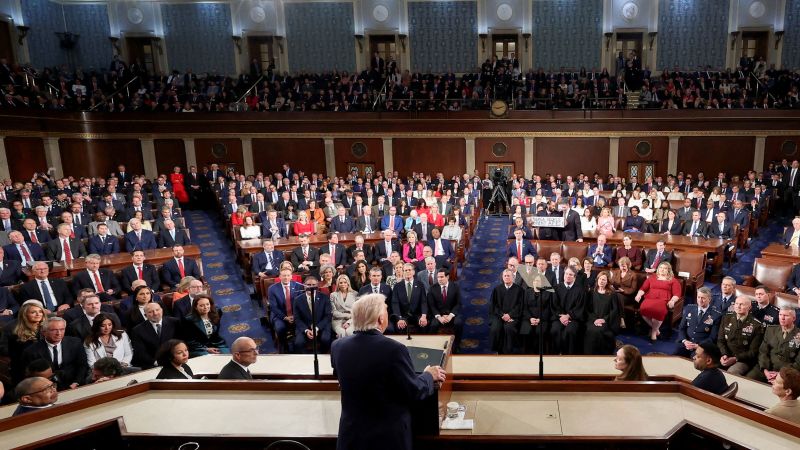
President Donald Trump’s State of the Union address on Tuesday night contained a litany of false or misleading statements, many of which have been long-debunked claims familiar from his rallies, interviews, and social media posts. Fact-checkers identified inaccuracies on topics ranging from the economy and immigration to foreign affairs and crime statistics.
The economy emerged as the area where Trump most frequently made inaccurate statements. He overstated economic performance during his current term, exaggerated inflation rates inherited from the Biden administration, presented misleading gas price figures, and falsely claimed that foreign countries pay tariffs that are actually paid by US importers.
One of Trump’s most notable fabrications was his claim of securing “$18 trillion in investments” pouring into the US from around the globe. This figure has no basis in reality. Even the White House’s own website listed a lower figure of $9.7 trillion for “major investment announcements” during Trump’s term—a number that itself was found to include vague pledges and statements that don’t constitute actual investment commitments.
On gas prices, Trump claimed they are “now below $2.30 a gallon in most states, and in some places, $1.99 a gallon.” The truth falls far short of this assertion. According to AAA data, no state had an average gas price below $2.37 per gallon on the day of the speech, and only two states had averages below $2.50. Gas prices have indeed fallen during his presidency—from a national average of $3.12 per gallon on inauguration day to $2.95 on Tuesday—but nowhere near the levels Trump claimed.
Trump’s statement about inheriting “inflation at record levels” from the Biden administration similarly distorted reality. The year-over-year inflation rate in December 2024, Biden’s last full month in office, was 2.9%, rising slightly to 3.0% in January 2025 when Trump took over. The current rate of 2.4% reflects a decrease during Trump’s term, but his claim about inheriting “the worst inflation in the history of our country” is patently false. The all-time high inflation rate in US history was 23.7%, set in 1920.
While selectively highlighting decreases in prices for a small number of grocery items like eggs, chicken, butter, and fresh fruits, Trump omitted that overall grocery prices have increased by an average of 2.1% since January 2025. Most grocery products have become more expensive during his presidency, not cheaper.
On immigration, Trump repeated several false claims, including that the Biden administration allowed “11,888 murderers” to enter the US. This figure actually refers to non-citizens who entered the US over multiple decades—including during Trump’s first administration—who were later convicted of homicide and remain on Immigration and Customs Enforcement’s “non-detained docket,” which includes individuals serving prison sentences.
Trump also made an unsupported claim about migrants coming “from prisons and mental institutions” without providing evidence. This rhetoric echoes his campaign trail assertions that foreign countries deliberately emptied prisons and mental institutions to send undesirable citizens to the US.
In discussing foreign affairs, Trump claimed to have ended “eight wars” during his first ten months in office, a clear exaggeration. Several conflicts on his list weren’t actually wars or weren’t resolved during his presidency. For example, the dispute between Egypt and Ethiopia wasn’t a war but a diplomatic disagreement about a dam project. The supposed war between Serbia and Kosovo didn’t actually occur during Trump’s presidency.
On NATO, Trump exaggerated US contributions, claiming America was “paying for almost all of NATO” before his intervention. While the US is the largest contributor, it provided about 72% of total NATO defense spending in 2016, which fell to about 63% by 2024—substantial but not “almost all.” Trump also incorrectly suggested that NATO members are currently meeting a 5% GDP defense spending target, when in reality most members have until 2035 to reach this goal.
Trump’s claims about US elections were particularly misleading. He falsely stated that “cheating is rampant in our elections,” despite overwhelming evidence that fraud makes up a minuscule percentage of votes cast. He referred to “crooked mail-in ballots,” though research shows fraud with mail-in voting is extremely rare.
Regarding crime, Trump claimed he inherited “rampant crime” from the Biden administration, but crime rates were actually at historic lows when Trump returned to office. According to crime data expert Jeff Asher, “The US violent crime rate in 2024 was the lowest since 1969 and the property crime rate was the lowest since 1961.”
Trump also falsely claimed that after his takeover of law enforcement in Washington, DC, the capital became “one of the safest cities in the country” with “almost no crime anymore.” Data shows DC had the ninth-highest murder rate and 12th-highest violent crime rate among the 50 largest US cities in 2025.
Throughout his address, Trump demonstrated a pattern of embellishment, selective data presentation, and outright falsehoods that undermined the credibility of his statements on issues of national importance.
Fact Checker
Verify the accuracy of this article using The Disinformation Commission analysis and real-time sources.

10 Comments
This is a good example of why we need a free and robust press to fact-check political rhetoric. Exaggerating economic performance or making unsubstantiated claims about foreign investment can have real consequences. It’s crucial that the public has access to accurate information.
Absolutely. An informed electorate is the foundation of a healthy democracy. Fact-checking efforts like this help citizens make more informed decisions.
While I’m not surprised to see Trump making false claims, it’s still disappointing. As someone who follows commodity and energy markets, I’m particularly interested in the details around his statements on inflation and gas prices. Curious to see how those claims hold up under scrutiny.
Same here. Accurate data on energy and commodity prices is crucial for businesses and consumers alike. I’ll be following this story closely to see how the fact-checkers address those specific claims.
It’s concerning to see the president making statements that don’t align with the facts, especially on economic issues. Exaggerating investment figures or misrepresenting inflation could have real implications. I hope this prompts a broader discussion about the importance of honesty and transparency in government.
Agreed. Political leaders should be held accountable for the accuracy of their statements, particularly on topics that directly impact people’s lives and livelihoods. Fact-checking efforts are an important part of maintaining a healthy democracy.
As someone with an interest in the mining and energy sectors, I’m particularly interested in the details around Trump’s claims about foreign investment and the economy more broadly. It’s critical that we have access to reliable, fact-based information to make informed decisions.
Absolutely. Fact-checking is essential, especially when it comes to issues that can significantly impact industries and markets. I’ll be keeping a close eye on how this story develops.
Interesting to see the fact-checking on Trump’s State of the Union address. While presidents often put their own spin on economic data, it’s important to have independent verification of the claims made. I’m curious to learn more about the specific false or misleading statements identified.
Agreed, it’s important to hold all politicians accountable, regardless of party affiliation. I’ll be keeping an eye out for more detailed analysis of the inaccuracies in Trump’s speech.