


Listen to the article
Community Group Challenges Cornell University’s “PFAS-Free” Turf Claims in Ongoing Legal Battle
A local environmental group is appealing a New York State court decision that allowed Cornell University to proceed with installing synthetic turf despite evidence it contains toxic PFAS chemicals. Zero Waste Ithaca announced the appeal after independent testing revealed significant levels of PFAS in materials that Cornell had publicly claimed were “PFAS-free.”
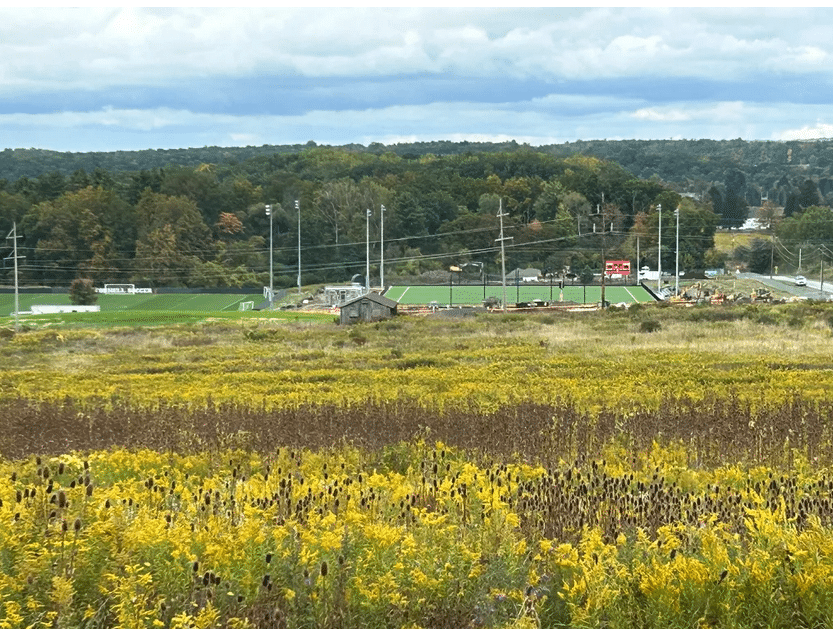
The dispute centers on a synthetic turf installation along Game Farm Road in Ithaca. The Town of Ithaca Planning Board initially approved the project with a “Negative Declaration,” indicating they believed the installation would have no significant environmental impact. This approval came despite community objections and what critics describe as incomplete chemical testing.
Laboratory reports commissioned by Zero Waste Ithaca following the project’s approval tell a different story than Cornell’s claims. Three accredited lab tests detected total fluorine at 53 parts per million, with specific PFAS chemicals present in the turf blades at concentrations reaching thousands of parts per million.
“This high level of deference creates a dangerous loophole,” Zero Waste Ithaca said in a statement. “It reinforces a system that rewards unverified claims over independent scrutiny.”
At issue is the court’s decision to defer to the Planning Board’s original judgment rather than consider new scientific evidence. The court ruled its role wasn’t to re-evaluate scientific merits but only to determine whether the Planning Board’s decision was “reasonable” based on information available at the time of approval.
This judicial approach has sparked concern among environmental advocates who note that Cornell’s initial testing used an EPA method that screens for only about 40 PFAS compounds—a tiny fraction of the more than 14,000 chemicals in this class. Critics point out that Cornell’s testing methodology failed to detect polymer-bound PFAS commonly found in plastic turf materials.
The case highlights a significant disparity between detection thresholds and safety standards. Federal drinking water regulations now limit some PFAS chemicals to concentrations measured in parts per trillion—orders of magnitude lower than the levels reportedly found in Cornell’s turf materials.
PFAS, or per- and polyfluoroalkyl substances, have earned the nickname “forever chemicals” due to their extraordinary persistence in the environment and human body. These synthetic compounds have been linked to numerous health problems including cancer, liver damage, decreased fertility, and increased risk of asthma and thyroid disease.
Environmental health experts have increasingly raised concerns about synthetic turf fields as potential sources of PFAS exposure, particularly for student-athletes who have regular, direct contact with these surfaces. Degrading turf materials can release these chemicals into dust, which may be inhaled or ingested, and into runoff water that can contaminate local watersheds.
The court’s unwillingness to consider the independent test results because they were submitted after project approval has prompted critics to question the effectiveness of New York’s environmental review system. Zero Waste Ithaca argues the case exposes fundamental flaws in how agencies and courts defer to institutions like Cornell without conducting independent evaluations.
This isn’t the first time Cornell’s synthetic turf projects have faced legal challenges. A similar ruling occurred regarding another Cornell turf installation at the Meinig Fieldhouse, where the court again sided with agency discretion despite scientific disagreements.
As Zero Waste Ithaca prepares its appeal, the case raises broader questions about environmental oversight, institutional accountability, and the burden of proof when it comes to potentially toxic materials in public spaces. For Ithaca residents, the outcome could set an important precedent for how community health concerns are balanced against institutional development projects.
The controversy also comes as municipalities across the country are increasingly scrutinizing synthetic turf installations and adopting more stringent requirements for PFAS testing and disclosure before approving such projects.
Fact Checker
Verify the accuracy of this article using The Disinformation Commission analysis and real-time sources.

14 Comments
The revelation that Cornell’s “PFAS-free” turf actually contains significant levels of these persistent chemicals is a troubling development. Synthetic turf fields are becoming increasingly common, so we need much stronger oversight and transparency around their safety.
I hope the appeal process leads to a more rigorous assessment of the environmental and health impacts of this installation. Public trust is at stake.
The dispute over Cornell’s synthetic turf installation highlights the need for rigorous, independent testing and verification of claims about the environmental safety of such products. Relying on incomplete data from the university itself is clearly not enough.
I hope the appeal by Zero Waste Ithaca leads to a more thorough investigation and a resolution that prioritizes public health over institutional interests.
This situation raises important questions about the influence universities can wield over local planning decisions, especially when it comes to potential environmental hazards. Kudos to the community group for pushing back and demanding accountability.
The presence of toxic PFAS chemicals in supposedly “PFAS-free” turf is very concerning. I’m glad an independent review is underway to get to the bottom of Cornell’s claims.
This dispute raises important concerns about the accountability of institutions like Cornell when it comes to making claims about the safety of their facilities. Independent testing appears to contradict the university’s assurances, which is very concerning.
The community group’s decision to appeal the court ruling is commendable. Holding powerful organizations responsible for potential environmental harms is critical for protecting public health.
This is an important story about the ongoing battle over the use of synthetic turf containing PFAS chemicals. It’s concerning to see a major university like Cornell apparently making misleading claims about the safety of its playing field materials.
Independent testing revealing significant PFAS levels in the turf is very troubling. The public deserves full transparency on the chemical composition of athletic facilities.
While I appreciate Cornell’s efforts to provide safe athletic facilities, the apparent discrepancy between their claims and the independent test results is troubling. Transparency and rigorous, unbiased assessment should be the top priorities in such cases.
I hope the appeal process leads to a thorough re-evaluation of the synthetic turf installation and a resolution that prioritizes the well-being of the local community.
The battle over Cornell’s synthetic turf installation highlights the ongoing challenges we face in ensuring the safety of new products and materials, especially when powerful institutions are involved. Independent testing and community oversight are essential.
I’m glad to see the local environmental group taking action to hold Cornell accountable. Maintaining public trust requires open, transparent processes and a commitment to protecting human health and the environment.