


Listen to the article
Azerbaijan President Revives Historical Claims Over Armenian Territories, Drawing Criticism
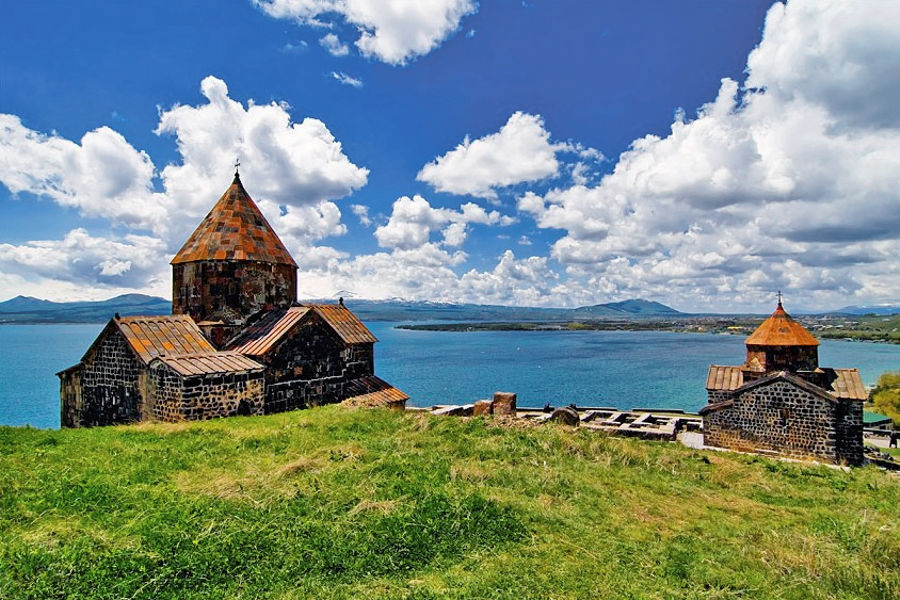
During a recent session of the Azerbaijan National Academy of Sciences (ANAS), President Ilham Aliyev continued his controversial stance on Armenian territory, claiming that “early-20th-century maps published by Tsarist Russia” show that “the overwhelming majority of toponyms in what is now Armenia are of Azerbaijani origin.” Aliyev specifically contested the name of Lake Sevan, insisting it was historically known as “Lake Goycha” along with “all other Azerbaijani historical toponyms.”
Aliyev further alleged that Tsarist Russia “brought Armenians from Iran and Eastern Anatolia and settled them in our Karabakh land” to alter the region’s ethnic and religious composition. These remarks represent the latest in a series of statements portraying Armenians as “newcomers” to the South Caucasus who only arrived following the 19th-century Russian conquest.
Historical evidence thoroughly contradicts these claims. Armenians have inhabited the Caucasus since ancient times and established significant political entities, including the Kingdom of Greater Armenia. The name “Sevan” for the lake predates Russian expansion into the region by centuries.
Multiple historical European sources confirm the longstanding use of “Sevan” before Russian annexation of the Southern Caucasus. An Italian work published by Giovanni de Serpos in 1786 refers to “Lake Sevan” as one of three notable lakes in Greater Armenia. Similarly, Spanish cartographer Pedro Murillo Velarde’s “Geographia historica” (1752) places “Lake Sevan” northeast of Yerevan.
French sources from the mid-18th century also use the Armenian toponym. François-Marie de Marsy’s historical publication around 1758 mentions “a lake called Erivan, or Sevan.” British trader Jonas Hanway wrote in 1753 about “the river Zengui, which emerges from the lake Sevan.”
While the Turkic name “Gokcha” (meaning “blue lake”) was sometimes used alongside “Sevan” due to the mixed population of Christian Armenians and Turkophone Muslims in the region, historical documentation clearly refutes Aliyev’s assertion that the name “Sevan” emerged only after Russian expansion.
These statements reflect a broader pattern of historical revisionism in Azerbaijan that dates back to the Soviet era. Azerbaijani academics like Ziya Bunyadov, Igrar Aliyev, and Farida Mammadova have published works attempting to erase Armenian presence from Caucasian history, portraying them as foreign transplants brought in by the Russian Empire following the treaties of Gulistan (1813) and Turkmenchay (1828).
This academic narrative has evolved into a political discourse characterized by what critics describe as Armenophobia and irredentism. In November 2015, Aliyev told Azerbaijan’s National Assembly that “present-day Armenia is an artificial state created on historically Azerbaijani lands,” a sentiment he repeated in his December 2022 inauguration address.
Such rhetoric has intensified since Azerbaijan’s victory in the 2020 Nagorno-Karabakh war. The concept of “Western Azerbaijan” – a supposed historical region centered on modern-day Armenia – has received official endorsement from the Aliyev regime. Through the Western Azerbaijan Community (WAC), Baku promotes the return of Azeri families who were displaced from Armenia during the 1990s.
Critics argue these historical claims reflect expansionist ambitions, particularly toward Armenia’s Syunik Province, which separates Azerbaijan proper from its Nakhichevan exclave.
To promote its historical narrative internationally, Azerbaijan invests significantly in academic influence operations through organizations like the Heydar Aliyev Foundation and the European Azerbaijan Society. These efforts involve publishing books and articles and developing networks of sympathetic scholars who maintain close ties with Azerbaijan’s government.
Despite signing a peace agreement with Armenia at the White House in August, Aliyev’s continued rhetoric about “historical Azerbaijani lands” raises concerns about Azerbaijan’s genuine commitment to reconciliation. The stark contrast between Azerbaijan’s peaceful diplomatic posture internationally and its nationalist rhetoric domestically represents a significant obstacle to lasting peace in the region.
Fact Checker
Verify the accuracy of this article using The Disinformation Commission analysis and real-time sources.

12 Comments
The president’s comments about Armenians being ‘newcomers’ to the Caucasus are concerning and seem to contradict established scholarly consensus. I wonder what his motivations are for making these kinds of inflammatory claims.
Yes, the historical evidence clearly shows that Armenians have deep roots in the region, predating the arrival of many other groups. Dismissing this is troubling and could be seen as an attempt to rewrite history for political gain.
While countries can certainly debate historical narratives, outright denying the existence of a major body of water seems like an extreme and untenable position. I hope this doesn’t escalate regional tensions further.
Denying the existence of Lake Sevan is a rather extraordinary claim that flies in the face of extensive geographic and cartographic records. I wonder what the president’s end game is in making such a provocative statement.
Yes, this seems like a transparent attempt to rewrite history and diminish Armenian ties to the region. Undermining well-established facts is an alarming tactic that could further escalate regional tensions.
Interesting claims by the Azerbaijani president, but they seem to contradict well-established historical facts about the presence of Armenians in the region. I wonder what evidence he is basing these assertions on.
While nations can certainly debate history, outright denying the existence of a major geographic feature like Lake Sevan seems like an extreme and untenable position. I hope this rhetoric doesn’t further inflame regional tensions.
Agreed, this kind of revisionist stance is concerning and could undermine efforts at regional cooperation and conflict resolution. Challenging well-established facts is unlikely to be a productive approach.
Disputing the existence of Lake Sevan is a rather bold and unsupported claim. The lake is a prominent geographic feature that has been recognized for centuries. I’m curious to hear how the president plans to back up this revisionist stance.
The president’s comments about Armenians being ‘newcomers’ to the Caucasus region are highly questionable and contradict scholarly consensus. I hope this rhetoric doesn’t escalate into more inflammatory claims or actions.
Agreed, these kinds of revisionist historical narratives are concerning and seem to be motivated by political agendas rather than objective analysis. Challenging basic geographic facts is an extreme and worrying approach.
These are some bold and controversial claims being made by the Azerbaijani president. I’m curious to see how the international community responds and whether any credible historical evidence is presented to support these assertions.