


Listen to the article
U.S. Economy Shows Signs of Strain Despite Trump’s Optimistic Projections
President Donald Trump’s bold economic promises for 2026 are facing significant headwinds as recent data reveals job losses, rising fuel prices, and market volatility in the first months of the year.
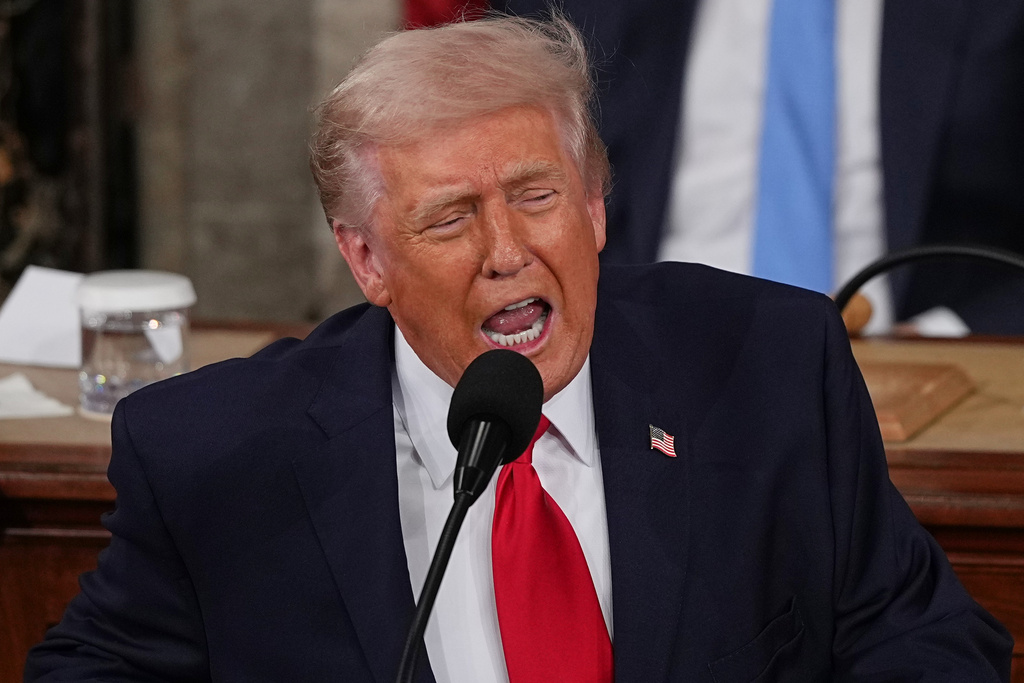
In his State of the Union address less than two weeks ago, Trump confidently declared that “the roaring economy is roaring like never before.” However, recent economic indicators paint a more concerning picture, creating a widening gap between the president’s optimistic rhetoric and economic realities—a discrepancy that could play a decisive role in this year’s midterm elections as Republicans fight to maintain control of both chambers of Congress.
The employment situation has deteriorated notably in recent weeks. After initially celebrating January’s addition of 130,000 jobs with an enthusiastic social media post declaring “The Golden Age of America is upon us!!!”, the administration now faces a more sobering reality. February’s employment report showed the economy shed 92,000 jobs, while previous months’ figures were revised downward, with December now showing a loss of 17,000 positions.
A troubling trend has emerged: without the healthcare sector’s contributions, the economy would have lost approximately 202,000 jobs since Trump took office in January 2025. The White House has attempted to highlight construction job gains outside the housing sector as evidence of potential future growth, but the overall employment picture remains concerning.
Further undercutting the administration’s narrative is the rising unemployment rate among U.S.-born workers—a key demographic in Trump’s economic agenda. Despite his emphasis on prioritizing native-born Americans for jobs, their unemployment rate has climbed from 4.4% to 4.7% over the past year, suggesting his immigration policies have not delivered the promised employment boost to this group.
Energy prices present another challenge to the administration’s economic messaging. Trump has repeatedly emphasized the importance of keeping fuel costs low as a key inflation-fighting strategy, telling a Texas audience in February that “Slashing energy costs is among the most important actions we can take to bring down prices for American consumers.”
However, the recent military actions against Iran beginning February 28 have disrupted this narrative. Gasoline prices have surged 19% over the past month to a national average of $3.45, according to AAA. Goldman Sachs has warned that persistent higher oil prices could drive inflation from January’s 2.4% to 3% by year-end—a concerning prospect for an administration that has made price stability a centerpiece of its economic policy.
The White House is gambling that the Iran conflict will be short-lived or that tanker traffic through the strategic Strait of Hormuz can be maintained. Energy Secretary Chris Wright attempted to reassure Americans on CNN’s “State of the Union,” stating that the price surge is “a weeks, not a months thing.”
The stock market, frequently touted by Trump as evidence of economic success, has also shown signs of weakness. The Dow Jones Industrial Average has dropped 5% over the past month, despite the president’s continued references to it reaching the 50,000 milestone. While stocks remain higher than when Trump took office—continuing a trend that began under President Biden—the recent decline raises questions about the administration’s emphasis on expanded market participation through initiatives like “Trump accounts” for children.
Market sentiment has become increasingly divided along socioeconomic lines. Joanna Hsu, director of the University of Michigan’s consumer sentiment surveys, noted that February saw a “sizable” increase in confidence among stock owners that was “fully offset by a decline among consumers without stock holdings.”
One bright spot for the administration is increased productivity, with business sector labor productivity climbing 2.8% in the fourth quarter of 2025. However, these gains have not translated to higher worker compensation, as labor’s share of income fell to record lows last year, according to Mike Konczal of the Economic Security Project.
Perhaps most challenging for Trump’s economic narrative is the direct comparison with his predecessor. Despite repeatedly characterizing the Biden era as one of “stagflation,” the data tells a different story. The U.S. economy grew at 2.8% during Biden’s final year in office, outpacing the 2.2% growth under Trump in 2025. Inflation, as measured by the Federal Reserve’s preferred personal consumption expenditures price index, remained constant at 2.6% in both 2024 and 2025.
While Trump has successfully avoided the inflation spikes that plagued portions of Biden’s presidency, he has thus far failed to deliver on his promises of stronger growth and robust job creation—metrics that will likely face increasing scrutiny as the midterm elections approach.
Fact Checker
Verify the accuracy of this article using The Disinformation Commission analysis and real-time sources.
