


Listen to the article
Health Expert Challenges Viral Video Linking Kitchen Salt Storage to Thyroid Issues
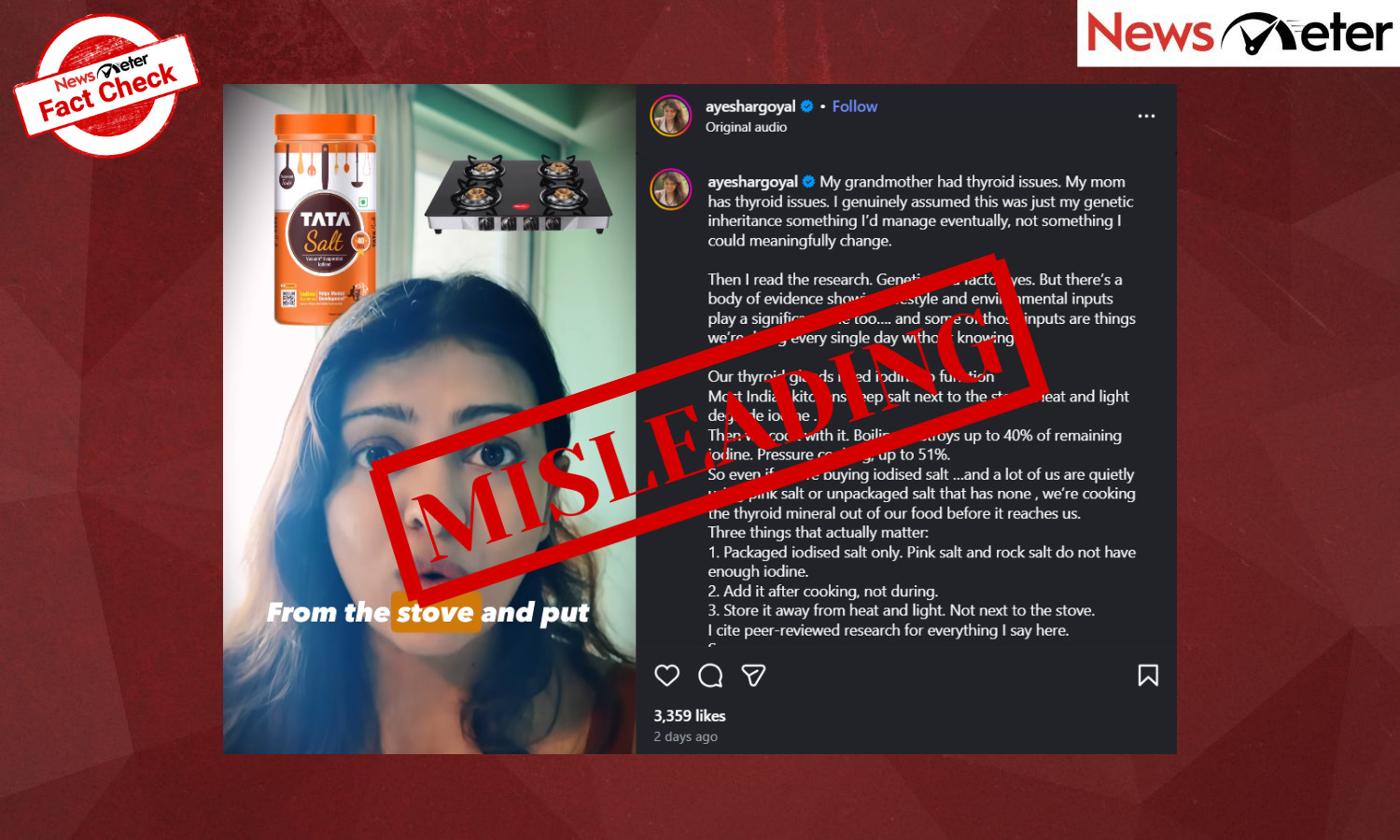
A viral Instagram video claiming improper salt storage contributes to thyroid problems among Indian women has been deemed misleading by health experts and chemists. The video, posted by creator Ayesh Raje Goyal, has sparked concern by suggesting that storing salt containers near stoves destroys essential iodine needed for thyroid function.
In the widely-shared clip, Goyal claims, “Have you ever wondered why so many women in India have thyroid issues? Turns out where you keep the salt in your kitchen might have something to do with it.” She references research suggesting that iodine is destroyed by high heat, implying that salt containers placed near cooking areas lose their nutritional value.
The video further advises viewers to use iodised salt, store it away from heat sources, and add it after cooking rather than during the cooking process. Goyal also warns against using Himalayan pink salt, noting its minimal iodine content.
While citing two peer-reviewed studies on iodine loss during cooking and heat effects on iodised salt, the video misrepresents the actual chemistry involved, according to experts consulted by NewsMeter.
Dr. R Koteshwar Rao, Assistant Professor in the Department of Chemistry at Osmania University in Hyderabad, explained the fundamental misunderstanding in the viral claim: “In iodised salt, iodine does not exist as molecular iodine. It exists as potassium iodate or potassium iodide, and those compounds do not evaporate at normal temperature and pressure conditions.”
Dr. Rao emphasized that potassium iodide has a boiling point of approximately 1,300 degrees Celsius, making it impossible for it to evaporate at room temperature or even near a typical kitchen stove. The distinction is critical—iodine doesn’t simply drift out of a salt container sitting near a heat source as the video suggests.
Scientific research does confirm that iodine can be lost from salt, but through a more specific pathway. Heat, light, and moisture together can trigger chemical reactions that convert potassium iodate or potassium iodide into free molecular iodine, which can then escape. This process requires moisture or acid impurities in the salt to initiate the conversion.
The first study cited in the video (Rana and Raghuvanshi, 2013) examined iodine loss during various cooking methods common in Indian kitchens. The research found varying degrees of iodine loss depending on cooking method and duration—ranging from 6.58% during shallow frying to 51.08% during pressure cooking for 26 minutes.
The study recommended avoiding salt storage in “hot and humid conditions near the cooking area,” with humidity being the critical factor enabling the chemical reaction that leads to iodine loss.
The second referenced study (Deresa et al., 2023) tested salt samples under constant light exposure at room temperature for three weeks. It found significantly higher iodine loss in light-exposed samples compared to those kept in dark conditions. However, these were controlled laboratory conditions, not typical kitchen environments with intermittent heat and light exposure.
Regarding Himalayan pink salt, the creator’s warning about its low iodine content is accurate. A 2020 study in the Foods journal analyzed 31 pink salt samples and found iodine content below 0.1 mg per kilogram—far less than the approximately 71 mcg of iodine provided by a quarter teaspoon of iodised table salt. With adults requiring about 150 mcg of iodine daily, Himalayan pink salt cannot adequately substitute for iodised salt as a dietary iodine source.
Health experts recommend storing iodised salt in sealed containers in cool, dark, and dry places away from cooking areas. Adding salt toward the end of cooking or after cooking is also advisable to minimize iodine loss.
The crucial distinction missed by the viral video is that proper storage should focus more on keeping salt dry and sealed rather than simply distant from heat sources. An open container in a humid kitchen environment creates the combined conditions—moisture, heat, and light—that drive significant iodine loss. A properly sealed container, even if relatively near a stove, carries much lower risk of iodine depletion.
While the viral video raises legitimate concerns about iodine preservation in salt, it incorrectly identifies the mechanism of loss, potentially misleading viewers about proper salt storage practices in their kitchens.
Fact Checker
Verify the accuracy of this article using The Disinformation Commission analysis and real-time sources.

12 Comments
Interesting findings on the nuanced impact of heat on iodized salt. The video seems to oversimplify the issue, but it’s good that experts are pushing back to provide more balanced information. Proper storage and cooking techniques are important for preserving essential nutrients.
Agree, the video raises valid concerns but the experts provide helpful clarification on the science behind iodine loss and how to best preserve it in cooking. A measured approach is warranted here.
As someone who follows mining and commodities news, I’m curious how this might impact the iodine supply and market. Iodine is an important mineral, so any shifts in consumer behavior or regulations around its usage could have ripple effects.
That’s a good point. Changes in iodized salt consumption or storage practices could potentially affect demand and pricing for iodine as a commodity. It’s worth monitoring how this plays out in the mining and chemicals sectors.
I appreciate the measured, fact-based approach the experts are taking to address this viral video claim. While the concerns around iodine loss are valid, the science is more complex. Providing accurate, nuanced information is important for public health.
This highlights the importance of getting information from reliable sources, not just viral social media posts. While iodized salt is important, the impacts are more complex than that video suggests. It’s good to see the fact-checking effort to provide the full picture.
Absolutely, fact-checking is crucial to combat misinformation, especially around health and nutrition topics that can have real impacts. Kudos to the experts for taking the time to clarify the nuances here.
From a mining and commodities perspective, I wonder if this story could have any impact on the iodine market, given its importance in various industrial and medical applications. It’s worth keeping an eye on how consumer perceptions and behaviors might shift as a result.
That’s a good point. Any significant changes in iodized salt usage or consumer awareness around iodine could potentially affect demand and pricing for this critical mineral. It’s an angle worth monitoring, especially for investors and producers in the mining and chemicals sectors.
As someone who closely follows the mining and energy sectors, I’m curious to see if this story has any impact on the iodine supply chain or extraction/production processes. Iodine is an essential mineral with a range of industrial and medical uses.
Good observation. Any significant shifts in iodized salt consumption or consumer perceptions around iodine could potentially influence demand and pricing for this important commodity. It’s definitely an angle worth tracking in the mining and chemicals industries.
This is an interesting case study in the challenges of combating misinformation, even around fairly technical topics like food chemistry. Kudos to the experts for taking the time to provide a more nuanced, fact-based perspective.