


Listen to the article
Indian Pilgrims’ Bus Crash Image Revealed as AI-Generated, Not Actual Accident
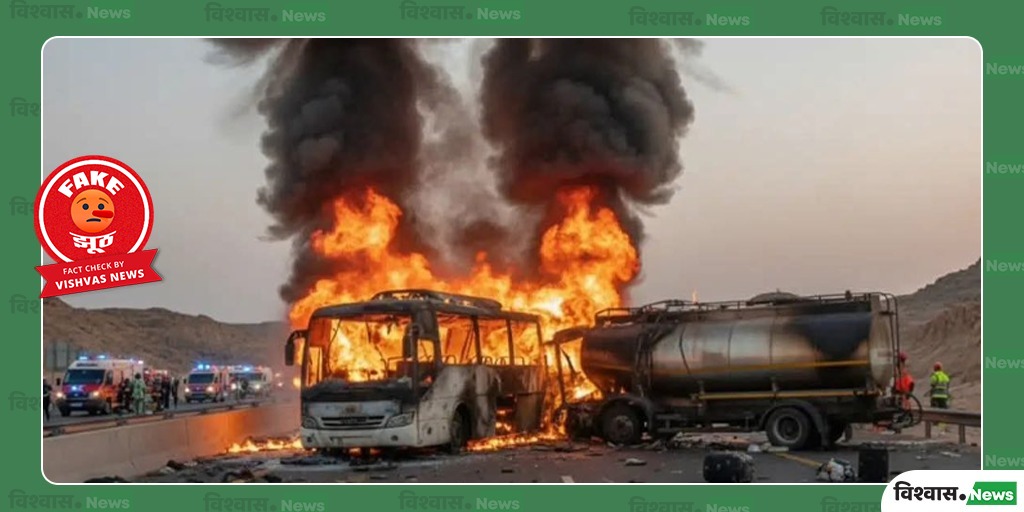
A widely circulated image purportedly showing the aftermath of a tragic bus crash in Saudi Arabia that killed dozens of Indian pilgrims has been confirmed as artificially generated, according to an investigation by Vishvas News.
The convincing image, which depicts a bus engulfed in flames after an alleged collision with a tanker, was shared extensively across social media platforms and even appeared in multiple news reports covering the incident. The realistic nature of the image led both casual social media users and professional media outlets to believe it represented actual documentation of the accident.
Vishvas News launched its investigation after receiving multiple verification requests through its tipline and email. When researchers performed reverse image searches, they found the image had been used in several news reports about the Saudi bus accident, but none could trace the original source of the photograph.
Further investigation revealed the image was initially shared on November 17 by a verified X (formerly Twitter) user who describes themselves as a researcher, but who provided no source attribution for the image.
To verify the authenticity of the image, investigators employed multiple AI detection tools. Google DeepMind’s SynthID, which is designed to detect AI-generated content, indicated a strong likelihood the image was artificially created, highlighting specific sections in blue that showed telltale signs of AI generation.
Additional verification tools including Hive Moderation, Decopy AI, the University of Buffalo’s DeepFake-O-Meter, and VeraAI all returned similar results, confirming the high probability that the image was AI-generated rather than a genuine photograph. According to Hive’s analysis, the image was likely created using a tool called Flux.
The actual incident referenced in the image was tragically real. According to the BBC and official statements from the Telangana government, 45 Indian pilgrims died when their bus caught fire near Medina in Saudi Arabia. The pilgrims were traveling from Mecca to Medina when the accident occurred. The police commissioner of Hyderabad, VC Sajjanar, confirmed that the bus was carrying 46 passengers, with only one survivor who was admitted to intensive care.
Most of the victims were from Hyderabad in the southern Indian state of Telangana, according to official statements.
This incident highlights the growing challenge of AI-generated images in news reporting. As artificial intelligence tools become more sophisticated, they can produce increasingly convincing fabrications that appear authentic to both casual viewers and professional news organizations. The rapid spread of this particular image through legitimate news channels demonstrates how easily such content can infiltrate mainstream reporting during breaking news situations.
Media organizations are increasingly implementing verification protocols to identify AI-generated content, but as this case demonstrates, such images can still slip through existing safeguards, particularly during fast-developing news stories where visual confirmation is sought quickly.
The proliferation of such realistic AI-generated imagery poses significant challenges for news consumers seeking reliable information during critical events, underscoring the importance of digital literacy and verification skills in today’s media landscape.
Fact Checker
Verify the accuracy of this article using The Disinformation Commission analysis and real-time sources.

9 Comments
While AI technology continues to advance, it’s important that we remain critical consumers of information and prioritize the verification of visual content, especially when it involves sensitive or tragic events. Fact-checking is a vital safeguard against the spread of misinformation.
This is quite concerning. Sharing AI-generated images as real documentation undermines trust in media and can spread misinformation. I’m glad the fact-checkers were able to identify this as an artificial image and clarify the situation.
The realistic nature of the image made it difficult to discern as AI-generated, highlighting the challenge of detecting synthetic media these days. Rigorous verification processes are crucial to upholding journalistic integrity.
Absolutely. With the rapid advancement of AI, the ability to create highly realistic images and video is becoming increasingly accessible. Fact-checking and source verification are essential to prevent the spread of misinformation.
This case is a stark reminder of the potential for AI-generated media to be misused and the need for heightened vigilance in the digital age. Fact-checkers play a crucial role in maintaining the integrity of information.
The use of an AI-generated image in this case is concerning and underscores the need for greater transparency and accountability in the media landscape. Fact-checkers play a crucial role in ensuring the integrity of information shared with the public.
This case highlights the importance of maintaining a healthy skepticism towards online content, even when it appears to be credible. Fact-checking and source verification should be standard practice for anyone sharing or reporting on visual media.
The widespread sharing of this AI-generated image demonstrates how quickly misinformation can spread, even when the content appears convincing. Proactive efforts to educate the public on media literacy and verification techniques are essential.
It’s disappointing to see such a tragic event being exploited through the use of an AI-generated image. This underscores the importance of carefully examining the sources and authenticity of visual content, especially when reporting on sensitive incidents.