


Listen to the article
In a political landscape charged with electoral tensions, recent claims about Rahul Gandhi’s statements regarding the Bharatiya Janata Party (BJP) and Trinamool Congress (TMC) in West Bengal have sparked controversy on social media platforms.
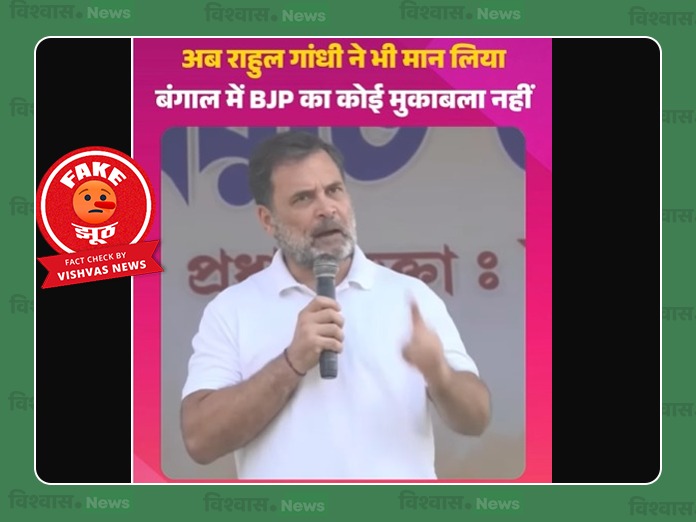
A video circulating online shows Congress MP and Opposition Leader Rahul Gandhi apparently stating that “TMC cannot compete with BJP” in West Bengal, leading some users to claim that Gandhi has acknowledged BJP’s dominance in the state. The clip gained significant traction on social media as West Bengal continues its assembly election process.
An investigation by fact-checkers, however, has revealed that the viral clip is selectively edited, removing crucial context from Gandhi’s original statement. The complete footage from Gandhi’s April 14 rally in Malda shows him saying: “Don’t forget that the TMC cannot compete with the BJP. If any party can stand against the BJP and defeat it, then that party is Congress.”
Gandhi further elaborated in his speech that the TMC is unable to counter what he described as BJP’s electoral tactics, including “vote theft” and “spreading violence” in the state. “The BJP knows that the Trinamool Congress cannot defeat them, and that only Congress can topple them,” he added.
The first phase of voting for the West Bengal Assembly elections concluded on April 23, 2026, with an impressive 91.78% voter turnout reported by the Election Commission. The second phase is scheduled for April 29, with results expected on May 4. The state has 294 assembly seats in total, with 152 constituencies having voted in the first phase.
Amba Prasad, co-in-charge of the Congress party in West Bengal who was present at the Malda rally, confirmed the manipulation of Gandhi’s statement. “Rahul Gandhi had said that the TMC cannot defeat the BJP. He also said that only Congress can defeat the BJP. By removing that part of the video, propaganda is being spread against the Congress,” she stated.
The edited video has primarily been shared by accounts with political affiliations. One Facebook user who shared the clip identifies as a resident of Binnaguri, West Bengal, with over 5,000 followers, and regularly posts content aligned with specific political ideologies.
This incident highlights the growing challenge of manipulated media during election periods. In West Bengal, where political rivalries run deep and the electoral stakes are high, selective editing of political statements can significantly impact public perception.
The ongoing assembly elections in West Bengal are particularly significant as they represent a critical test for all major political forces in the state – the ruling TMC led by Chief Minister Mamata Banerjee, the BJP which has been making inroads in recent years, and the Congress-Left alliance trying to reclaim political relevance in a state they once dominated.
As voting continues across West Bengal, the Election Commission has called for responsible sharing of political content and urged voters to verify information before believing or sharing it on social media platforms.
Fact Checker
Verify the accuracy of this article using The Disinformation Commission analysis and real-time sources.

10 Comments
This seems like a complex political situation in West Bengal. I’m curious to learn more about the dynamics between the Congress, TMC, and BJP parties and how they are positioning themselves for the upcoming elections.
You’re right, the political landscape in West Bengal appears to be quite fluid and contentious. It will be interesting to see how the various parties strategize and position themselves as the elections unfold.
This fact check highlights the need for diligent reporting and transparency around political statements. Selectively editing clips to create a misleading narrative is a concerning practice that erodes public trust.
Well said. Maintaining journalistic integrity and providing the full context is essential, particularly during election seasons when political tensions are high.
The edited video clip is a good example of how misinformation can spread quickly online. It’s important to rely on authoritative and fact-based sources when it comes to political news and analysis.
Absolutely. Fact-checking is crucial, especially for high-stakes political issues. We should always be skeptical of claims that seem too sensational or lack proper context.
Interesting fact check on the Rahul Gandhi statement. It’s important to get the full context and not rely on edited clips that could be misleading. What do you think this says about the political dynamics in West Bengal?
Yes, it’s a good reminder to be cautious about taking social media claims at face value without verifying the original sources. Proper fact-checking is crucial, especially during election seasons.
The details in this fact check provide a more nuanced understanding of Rahul Gandhi’s comments. It’s a good reminder that we should be cautious about drawing conclusions from partial information or unverified claims.
Exactly. Responsible reporting and critical thinking are key to cutting through the noise and getting to the heart of complex political issues.