


Listen to the article
Fake Images of IDF Soldier Repairing Vandalized Christian Statue Spread Online
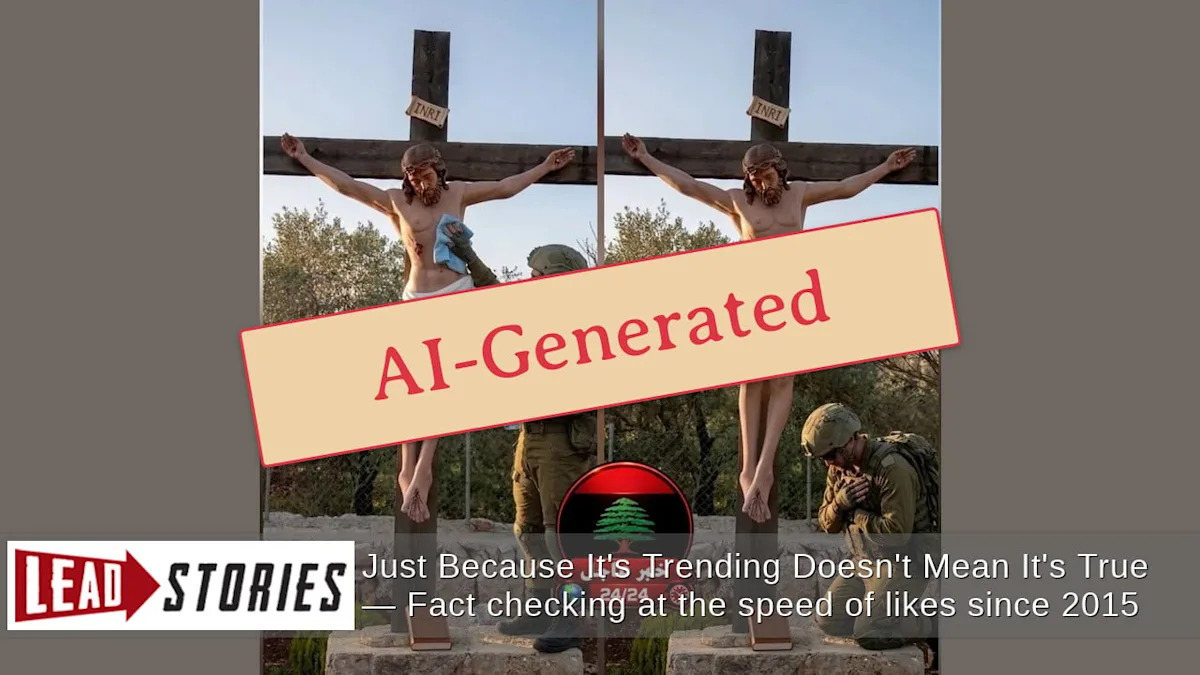
Digitally manipulated images purporting to show an Israel Defense Forces (IDF) soldier repairing and revering a Christian crucifixion statue he had previously vandalized are circulating on social media, analysis has confirmed. The AI-generated photos began spreading after genuine images of an IDF soldier defacing a Christian monument in southern Lebanon sparked international outrage.
The fabricated images appeared on X (formerly Twitter) on April 20, with one user claiming: “Israel made the same IDF soldier that was vandalizing the statue of Jesus in Lebanon to put it back…. before they sent him to trial.” The post featured two side-by-side images showing a soldier cleaning the statue and kneeling reverently at its base.
Digital forensic analysis conducted using Google Gemini confirmed both images contain SynthID watermarks – invisible markers embedded in content created using Google’s AI tools. These watermarks are undetectable to the human eye but can be identified through specialized software analysis.
The original, genuine photo of an IDF soldier vandalizing the crucifixion statue was posted on April 19 by Palestinian journalist Younis Tirawi. The incident occurred in the town of Debel in southern Lebanon, as confirmed by local social media accounts that shared an earlier, undated photo of the intact monument.
Comparative analysis of these authentic images reveals noticeable differences in the surrounding environment. In Tirawi’s documentation of the vandalism, vegetation behind the chain-link fence appears overgrown, and the statue’s paint shows signs of weathering compared to earlier photos from the Debel community’s social media.
The AI-generated images appear to have used the original Debel photo as a reference point but added fabricated elements, including a concrete platform, a book, a leafless tree in the background, and the soldier in different poses. These manipulated images lack several distinctive features visible in the authentic photographs while introducing new elements not present in the original location.
Israeli Prime Minister Benjamin Netanyahu publicly condemned the actual vandalism incident in strong terms. “Yesterday, like the overwhelming majority of Israelis, I was stunned and saddened to learn that an IDF soldier damaged a Catholic religious icon in southern Lebanon,” Netanyahu stated. “I condemn the act in the strongest terms. Military authorities are conducting a criminal probe of the matter and will take appropriately harsh disciplinary action against the offender.”
The incident has heightened tensions in a region already fraught with religious and political complexities. The Israeli military’s operations in southern Lebanon have faced intense scrutiny in recent months, and the desecration of religious symbols risks further inflaming sectarian sensitivities.
This case highlights the growing challenge of AI-generated misinformation in conflict zones, where fabricated images can rapidly spread and potentially exacerbate already volatile situations. Social media platforms continue to grapple with the proliferation of such content, which can be difficult for average users to identify as manipulated.
Digital literacy experts recommend verifying images through multiple credible sources before sharing and looking for inconsistencies in lighting, shadows, and contextual details that might suggest manipulation. As AI technology advances, the ability to create convincing fake imagery becomes more sophisticated, making critical evaluation of visual media increasingly important in public discourse.
The criminal investigation into the actual vandalism continues as military authorities determine appropriate disciplinary actions against the soldier involved in the original incident.
Fact Checker
Verify the accuracy of this article using The Disinformation Commission analysis and real-time sources.

7 Comments
It’s troubling to see how easily AI can be used to create convincing yet false imagery. I appreciate the in-depth analysis that confirmed these photos were synthetically generated, not real events. Diligent fact-checking is crucial to counter the spread of disinformation.
It’s disturbing to see how AI can be leveraged to create deceptive imagery and spread disinformation. I appreciate the diligent fact-checking that confirmed these photos as synthetic rather than real events. Reliable information is crucial, especially on sensitive topics.
Manipulation of images and spreading false narratives is a serious issue. I appreciate the Fact Check team investigating this and providing transparency around the origins of these doctored photos. Maintaining integrity of information is crucial.
This is a concerning case of disinformation. It’s important we verify the authenticity of images and information, especially around sensitive religious and political topics. I’m glad the digital forensic analysis was able to confirm these were AI-generated fakes.
While it’s positive the IDF soldier’s original vandalism was condemned, creating false imagery to try and mitigate the damage is deeply problematic. Fact-checking and calling out AI-generated disinformation is the right approach here.
The use of AI to fabricate images and spread misinformation is very concerning. I’m glad the Disinformation Commission was able to thoroughly investigate and expose these fake photos as digitally manipulated content. Maintaining truth and accuracy is vital.
The use of AI to manufacture false images and narratives is deeply concerning. I’m glad the Disinformation Commission took the time to thoroughly investigate and expose these as digitally manipulated fakes. Maintaining journalistic integrity is vital.