


Listen to the article
False Trump Social Media Post About Jesus Originated as Satirical Comedy
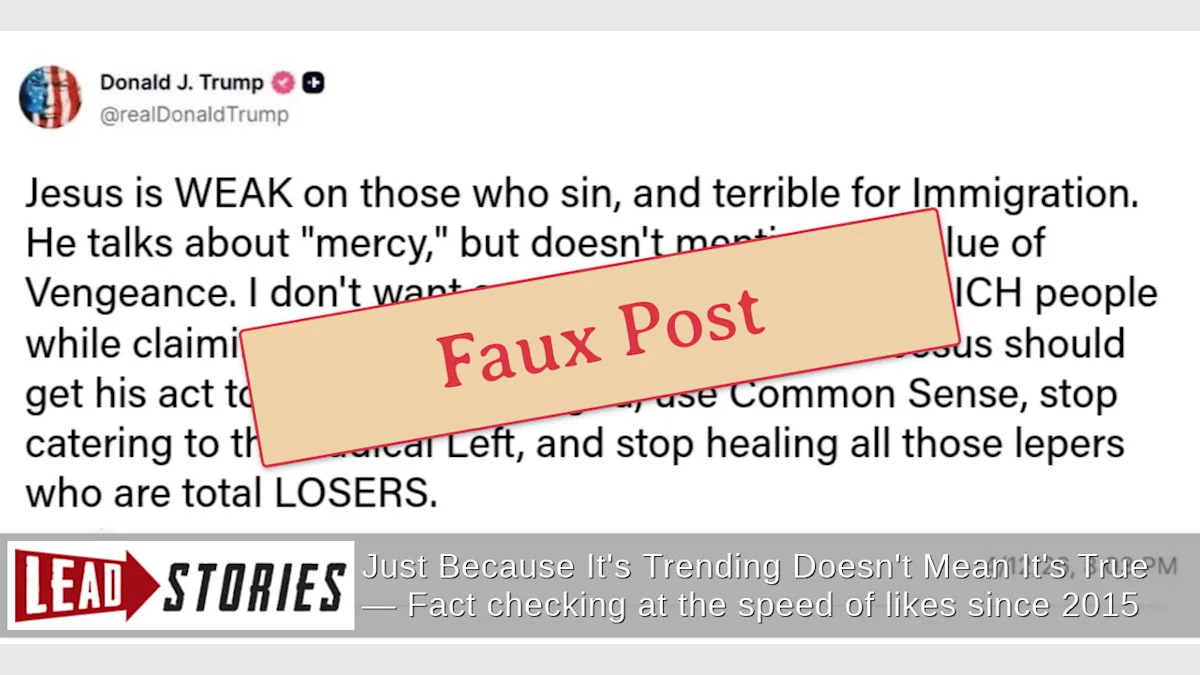
A social media post allegedly showing former President Donald Trump calling Jesus “WEAK on those who sin, and terrible for Immigration” has been confirmed as fabricated content. The post, which gained traction across multiple platforms, never appeared on Trump’s official Truth Social account but was instead created as satirical content by comedian Matt Ruby.
The fabricated post began circulating widely after being shared on Facebook by an account under the name Sharif Ceasar on April 15, 2026. The image showed what appeared to be a Truth Social post from Trump criticizing Jesus for talking about “mercy” without mentioning “the value of Vengeance” and for “catering to the Radical Left.”
Investigation into the post’s origins reveals it was first conceived by comedian Matt Ruby, who explicitly framed it as speculative content in his Substack newsletter published on April 13, 2026. Ruby introduced the mock statement by writing he was “looking forward to him posting this soon,” clearly indicating it was not an actual Trump statement but rather his own satirical prediction.
Ruby later shared the same concept on his X (formerly Twitter) account before creating a visual mockup of a Trump Truth Social post on his comedy account on Threads on April 15. The Threads post was clearly labeled as comedy and not intended to be mistaken for authentic content.
The satirical post appears to have been inspired by a genuine public disagreement between Trump and Pope Leo XIV regarding policies related to Iran. Trump did criticize the Pope in an actual Truth Social post, calling him “very liberal” and suggesting he was performing poorly in his role, while defending his own policy positions.
After Ruby shared his satirical creation, other social media users began circulating the image without the comedy disclaimer, leading many to believe it was an authentic statement from the former president. This pattern of fabricated Trump posts going viral has become increasingly common on social media platforms.
Media searches through major news databases including Google News and Yahoo! News returned no results for any authentic Trump post criticizing Jesus in this manner. Had such a controversial statement actually been made by the former president, it would undoubtedly have generated significant coverage across mainstream news outlets.
This incident highlights the ongoing challenge of misinformation on social media platforms, where satirical content can quickly lose its context when shared across different networks. It also demonstrates how mock-ups of social media posts can be crafted to appear authentic, particularly when they mimic the writing style and platform formatting of the purported author.
The episode serves as a reminder for social media users to verify the authenticity of controversial posts before sharing them further, particularly when they contain inflammatory or unexpected statements from public figures. Checking the original source and looking for coverage from reputable news organizations remains an important step in distinguishing between genuine statements and satirical or fabricated content.
Fact Checker
Verify the accuracy of this article using The Disinformation Commission analysis and real-time sources.
