


Listen to the article
Misinformation Poses Growing Threat to Women’s, Children’s and Adolescent Health
Misinformation and disinformation have emerged as significant barriers to advancing women’s, children’s, and adolescents’ health worldwide, according to public health experts. In today’s digital landscape, false narratives can spread faster than evidence-based guidance, undermining vaccination efforts, distorting sexual and reproductive health information, and weakening trust in healthcare systems globally.
The consequences of this information crisis are increasingly evident in public health outcomes. Nearly 20 million infants missed at least one dose of DTP-containing vaccines in 2024, including 14.3 million “zero-dose” children who received no routine vaccinations whatsoever, according to joint reporting from WHO and UNICEF. WHO Director-General Dr. Tedros Adhanom Ghebreyesus has explicitly warned that misinformation about vaccine safety, combined with significant reductions in aid funding, threatens decades of hard-won progress in global health.
The impact extends beyond immunization. Across social media platforms, poor-quality reproductive health advice discourages contraceptive use, while misleading mental health content can lead vulnerable individuals toward unsafe self-treatment options. False claims about HPV vaccine safety have significantly hampered uptake rates in many regions, leaving young people unprotected against preventable cancers.
“What makes this challenge particularly insidious is how targeted misinformation can exploit existing fears and concerns,” said a public health official familiar with the issue. “When combined with algorithms that amplify controversial content, harmful health narratives can quickly gain traction in communities already hesitant about certain medical interventions.”
Despite these challenges, promising solutions are emerging. In Ghana, UNICEF has partnered with the Ghana Health Service to establish a Misinformation Task Force that conducts daily monitoring, analysis, and rapid response to vaccine rumors. This initiative employs trusted community spokespeople, locally informed message design, and behavioral science approaches to counter false information effectively.
Similarly, Moldova has implemented a youth-centered strategy to address HPV misinformation. UNICEF and local partners work directly with adolescents to co-create accurate health messages, strengthen peer education networks, and rebuild trust around vaccination. These examples highlight how effective responses must incorporate listening to community concerns, rapid analysis of misinformation trends, credible evidence, trusted messengers, and local ownership of solutions.
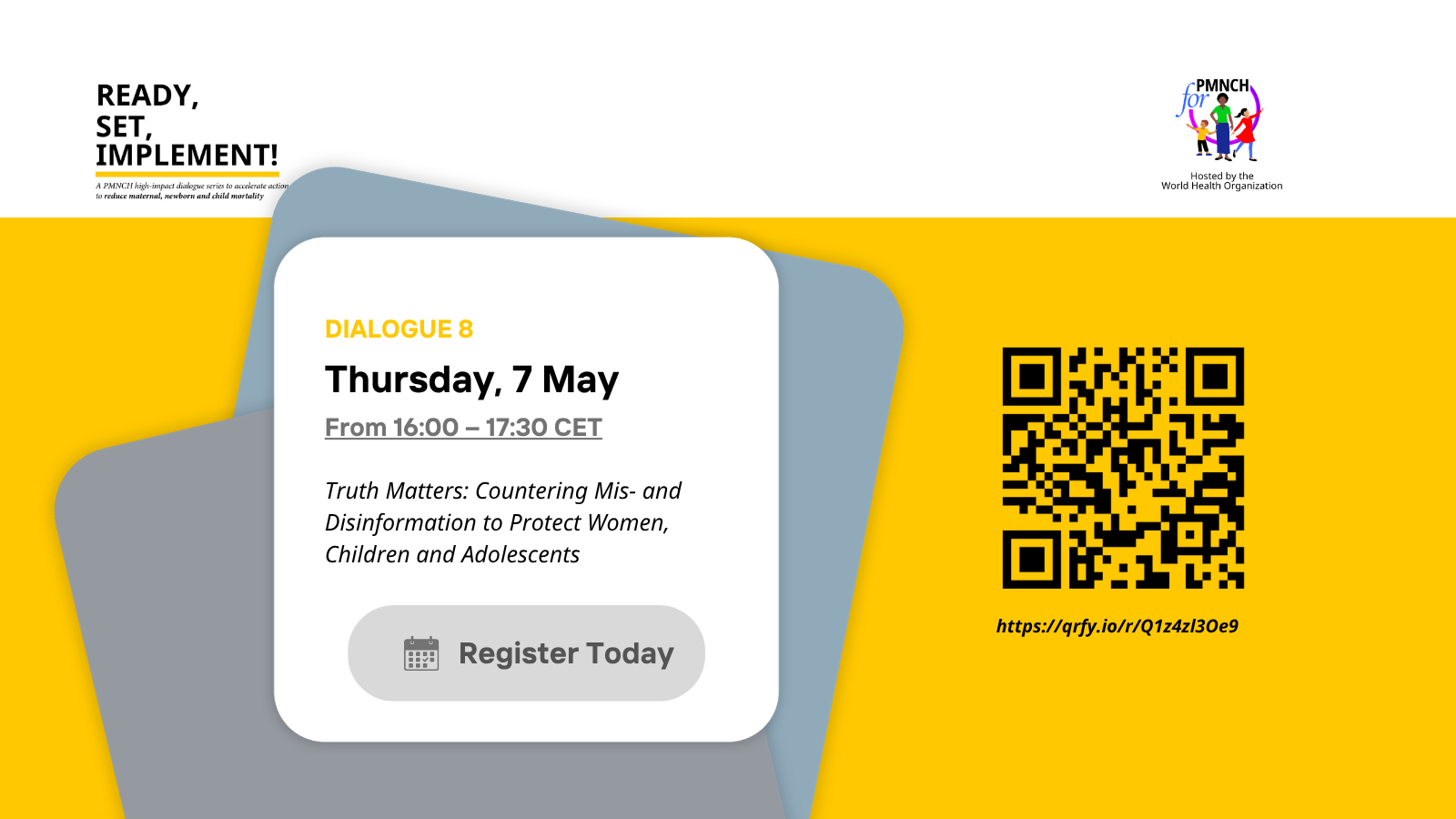
To address these challenges more systematically, the Partnership for Maternal, Newborn & Child Health (PMNCH) is launching PMNCH FactCheck, a new initiative designed to support partners with rapid verification of health information, expert-reviewed content, and actionable response tools. The initiative will be formally introduced at an upcoming Ready, Set, Implement dialogue that brings together public health leaders, technical experts, and country practitioners.
The virtual session will examine how mis- and disinformation specifically affect women’s, children’s, and adolescents’ health across multiple domains, including sexual and reproductive health rights, immunization programs, adolescent health services, and maternal mental health support. Participants will explore practical response models and share country experiences on strategies that help build trust, improve public communication, and protect health outcomes.
“We’ve seen how quickly false narratives can undermine public health efforts, but we’ve also witnessed the power of community-led, evidence-based responses,” noted a representative involved with the PMNCH initiative. “The key is combining rapid fact-checking with culturally appropriate, trusted channels of communication.”
The dialogue will showcase specific country approaches to rumor monitoring, trusted messaging development, peer engagement strategies, and rapid response systems. It aims to identify practical lessons for partners working to strengthen implementation and protect trust in health systems during an era of information overload.
Health experts emphasize that addressing health misinformation requires multifaceted approaches involving healthcare providers, community leaders, digital platforms, media, and government agencies working in concert. With coordinated efforts to promote health literacy and establish reliable sources of information, public health organizations hope to reverse concerning trends in preventive health measures and rebuild confidence in essential health services.
Fact Checker
Verify the accuracy of this article using The Disinformation Commission analysis and real-time sources.

25 Comments
The cost guidance is better than expected. If they deliver, the stock could rerate.
Uranium names keep pushing higher—supply still tight into 2026.
Good point. Watching costs and grades closely.
Production mix shifting toward Disinformation might help margins if metals stay firm.
Silver leverage is strong here; beta cuts both ways though.
Good point. Watching costs and grades closely.
Good point. Watching costs and grades closely.
Nice to see insider buying—usually a good signal in this space.
Good point. Watching costs and grades closely.
I like the balance sheet here—less leverage than peers.
I like the balance sheet here—less leverage than peers.
The cost guidance is better than expected. If they deliver, the stock could rerate.
Good point. Watching costs and grades closely.
Good point. Watching costs and grades closely.
I like the balance sheet here—less leverage than peers.
Good point. Watching costs and grades closely.
Good point. Watching costs and grades closely.
Exploration results look promising, but permitting will be the key risk.
Interesting update on Truth Matters: Implementing Strategies to Counter Misinformation Affecting Women, Children and Adolescents. Curious how the grades will trend next quarter.
Good point. Watching costs and grades closely.
Good point. Watching costs and grades closely.
Silver leverage is strong here; beta cuts both ways though.
Good point. Watching costs and grades closely.
Good point. Watching costs and grades closely.
I like the balance sheet here—less leverage than peers.