


Listen to the article
Trump Administration Escalates Crackdown on Antifascism as Eight Protesters Found Guilty on Terrorism Charges
The Trump administration’s campaign to criminalize antifascism reached a significant milestone last week when a federal jury in Texas convicted eight protesters on domestic terrorism charges linked to their alleged association with the antifascist movement, commonly known as “antifa.”
The case, centered on a July 2025 demonstration outside an Immigration and Customs Enforcement (ICE) detention facility near Fort Worth, represents the first major test of the administration’s expanding efforts to use anti-terrorism statutes against political dissent.
According to court records, protesters gathered at the ICE facility to show solidarity with detainees. While several demonstrators had firearms, a common sight in Texas where open carry is legal, most reportedly left their weapons in vehicles before joining what they intended to be a peaceful protest.
During the demonstration, at least one person was armed when police arrived. In disputed circumstances, a shot was fired, striking a police officer. Prosecutors characterized the incident as a coordinated attack by antifa operatives, though ultimately only one person was convicted of attempted murder among the more serious charges.
This verdict marks the first time in American history that individuals have been convicted on domestic terrorism charges specifically connected to antifascism. It also represents the first instance where the US government has explicitly accused defendants of crimes for participation in what prosecutors described as an “Antifa cell.”
Notably, the government’s case did not require linking defendants to a formal organization. While the State Department maintains a list of foreign terrorist organizations, no domestic equivalent exists because such designations are considered protected under the First Amendment. Despite this constitutional protection, Trump designated antifa as a domestic terrorist organization in September.
Legal experts warn the case could establish a dangerous precedent for government suppression of constitutionally protected protest activities. “This is really testing how far they can go in criminalizing constitutionally protected protests,” said one attorney familiar with the proceedings who requested anonymity.
Beyond its legal implications, the Texas case exemplifies the administration’s use of information warfare tactics to manufacture domestic enemies, a strategy that has been building for nearly a decade.
A Decade of Disinformation
Antifascism has existed for decades in the US and even longer in Europe, but only gained widespread visibility following Trump’s 2016 election. Almost immediately, it became the target of a coordinated disinformation campaign.
After the deadly far-right attack at the 2017 “Unite the Right” rally in Charlottesville, Virginia, Trump and his allies began promoting the concept of a violent “alt-left,” attempting to create a false equivalence with right-wing extremists who had murdered a protester. This narrative persisted despite overwhelming evidence that violent extremism in America remains predominantly a right-wing phenomenon.
The disinformation effort evolved over subsequent years into a comprehensive campaign involving elected officials, government agencies, think tanks, social media influencers, and right-wing media outlets. The strategy operated on two fronts: associating antifascism with chaos, violence, and anti-American sentiment, while simultaneously expanding the definition of antifascism to encompass virtually any liberal or left-wing activism.
Years of coordinated messaging portrayed Democrats and liberal activists as “radical leftists” while elevating acts of civil disobedience and property damage to the same threat level as deadly extremist violence. When isolated incidents of property destruction occurred during largely peaceful protests, conservative media would feature dramatic footage for days, while right-wing social media accounts circulated images—both authentic and fabricated—falsely attributing responsibility to immigrants, socialists, feminists, or transgender individuals.
Conversely, when right-wing extremists committed violent acts, these same networks would exploit the initial uncertainty to spread baseless claims about “antifa” involvement, creating a reflexive mental association between antifascism and violence in the public mind.
Manufacturing Enemies
The campaign has sometimes included sophisticated deception tactics. Court documents reveal instances of extremists dressing in black to impersonate antifascists while inciting violence. Fake social media accounts posing as antifascist organizers have been created to suggest violent plots.
These fabrications have generated real-world consequences, with concerned citizens showing up armed to “defend” communities against non-existent “busloads of antifa terrorists.” Even local law enforcement agencies have occasionally been duped, diverting resources to counter manufactured threats.
Despite the manufactured nature of these threats, Trump administration officials have cited public alarm as evidence that antifascism is terrorizing American communities and requires a severe government response.
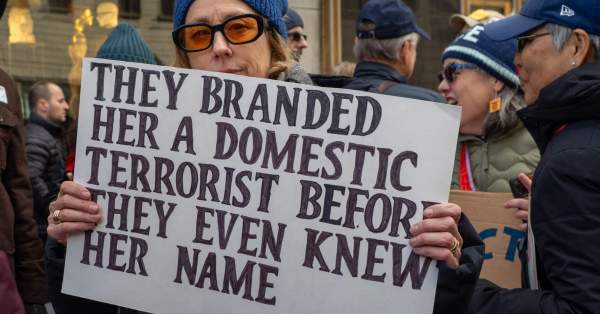
The administration appears to be expanding this strategy, most notably in justifying the use of deadly force against protesters. Both Renee Good and Alex Pretti—killed by federal law enforcement earlier this year during peaceful ICE protests—were immediately labeled as “domestic terrorists” by administration officials, despite engaging in constitutionally protected activities.
This circular logic creates a self-reinforcing narrative: if people who challenge ICE are terrorists (as claimed), and if Good and Pretti were terrorists (as claimed), then they must have attacked ICE officers (as implied), which means they must have been antifa, which makes them terrorists—and therefore, their deaths were justified.
This demonstrates the insidious power of disinformation, which functions not by creating new realities but by distorting existing ones: redefining terminology, recasting lawful dissent as threatening, and ultimately transforming citizens into enemies of the state.
Fact Checker
Verify the accuracy of this article using The Disinformation Commission analysis and real-time sources.

14 Comments
This case is deeply concerning and raises serious questions about the administration’s respect for civil liberties and the rule of law. Using anti-terror laws against protestors, no matter their political affiliation, is a dangerous abuse of power that must be condemned.
I agree, this sets a very dangerous precedent. We cannot allow the government to selectively apply anti-terrorism statutes to target and suppress political dissent. That is the hallmark of an authoritarian regime, not a democracy.
The use of anti-terror statutes against peaceful protestors is a deeply troubling development. It smacks of political intimidation and an attempt to stifle legitimate dissent. We must be vigilant in defending civil liberties and the right to peaceful assembly.
Absolutely. This case is a worrying escalation in the administration’s broader campaign to demonize and criminalize its political opponents. We cannot allow such blatant violations of constitutional rights to go unchallenged.
While the details of this incident are still unclear, the administration’s apparent efforts to paint lawful protestors as ‘domestic terrorists’ is very concerning. We must remain vigilant against any misuse of the law to suppress dissent and free speech.
Precisely. Criminalizing protest in this way is a dangerous erosion of democratic freedoms. The government should be protecting the right to peaceful assembly, not trying to crush it.
This case is deeply troubling and raises serious concerns about the administration’s respect for the First Amendment. Weaponizing anti-terrorism statutes against peaceful protestors is a blatant abuse of power that threatens the very foundations of our democracy.
I completely agree. This is a dangerous escalation in the administration’s ongoing efforts to demonize and criminalize its political opponents. We must stand united in defending the right to free speech and peaceful assembly, regardless of one’s political beliefs.
The administration’s apparent efforts to criminalize lawful protest and dissent are highly disturbing. Using anti-terror laws against citizens exercising their constitutional rights is a gross violation of civil liberties that should alarm all Americans, regardless of political affiliation.
Well said. This case is a clear example of the administration’s authoritarian tendencies and its willingness to abuse the law for political purposes. We must remain vigilant and resist any such attempts to undermine our democratic freedoms.
This case highlights the administration’s concerning pattern of casting its political opponents as ‘enemies of the state.’ Weaponizing anti-terrorism laws against citizens exercising their constitutional rights is a grave abuse of power that deserves widespread condemnation.
I couldn’t agree more. We must stand firm against such undemocratic and authoritarian tactics, which pose a serious threat to the foundations of our society.
This case highlights the concerning trend of the government criminalizing peaceful protest and dissent. Using anti-terrorism laws against political activists is a dangerous overreach that threatens civil liberties. We should be wary of attempts to demonize and target citizens who are exercising their constitutional rights.
I agree, the use of anti-terror statutes against protesters is deeply troubling. It sets a worrying precedent and risks stifling legitimate political expression.