


Listen to the article
Russia Launches Disinformation Campaign Against Ukrainian Olympic Team, Officials Say
Ukraine has accused Russia of orchestrating a sophisticated disinformation campaign targeting its Winter Olympics team, with fake news stories garnering over a million views across multiple social media platforms.
“Russians have rolled out an information campaign to discredit Ukraine,” said Kyiv’s center for countering disinformation on Thursday. Ukraine’s sports minister Matviy Bidny echoed these concerns, telling AFP, “With such fakes, Russia is trying to discredit Ukrainians and undermine international support for Ukraine.”
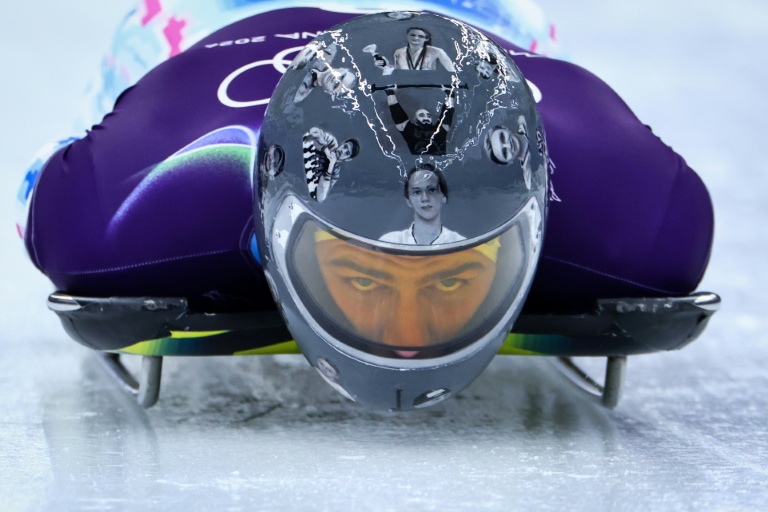
The campaign comes amid heightened tensions between the two nations, with one particularly egregious example focusing on Ukrainian skeleton racer Vladyslav Heraskevych, who was disqualified from competition Thursday for wearing a helmet displaying images of athletes killed in the ongoing Russia-Ukraine war.
One widely shared post digitally manipulated a Reuters news story about Heraskevych, adding fabricated claims that his brother recruited soldiers for the war and that a Hungarian athlete wore a sticker declaring “we’re all fed up with U(kraine).” Similar claims appeared on Russian-language accounts on X, formerly known as Twitter.
Other false narratives circulating online included allegations that Ukrainian team members were housed separately due to “toxic” behavior, that doping controls had been relaxed to allow them to take “psychoactive substances,” and that 52 of their translators had absconded.
Pablo Maristany de las Casas, an analyst at the Institute for Strategic Dialogue think tank, identified these posts as part of “Operation Overload,” a Russian-aligned campaign that was also active during the Paris 2024 Summer Olympics. The operation employs sophisticated tactics, including impersonating credible media outlets such as Euronews, and even mimicking organizations like the Israeli intelligence agency Mossad and the Italian health ministry.
“The campaign aims to discredit not just Ukrainian athletes but also refugees,” Maristany de las Casas explained, with a central message that “Ukrainians are sowing chaos.”
The disinformation effort has extended to creating fake videos that appear to feature legitimate news outlets. Canadian broadcaster CBC released a fact-check after discovering that the first 15 seconds of a genuine CBC social media video featuring chief correspondent Adrienne Arsenault had been spliced with an AI-generated version of her voice. In the manipulated video, the reporter appeared to claim that Ukrainian athletes were accommodated “as far away as possible” from other teams because they were “extremely toxic” at the Paris Olympics.
CBC fact-check producer Avneet Dhillon clarified that the original video made no mention of Ukraine or Ukrainian athletes. The International Olympic Committee confirmed to AFP that Ukrainian athletes were housed in the same facilities as other teams, calling the video “absolutely false and an attempt at deliberate misrepresentation.”
Provereno Media, an Estonia-based fact-checking organization, traced the origin of this particular video to a Russian-language Telegram channel called “Odessa for Victory,” where it began circulating on February 5. The organization noted that the posts, amplified by bot networks, have been viewed over one million times and subsequently picked up by pro-Kremlin media outlets citing CBC as the source.
Ukraine’s Center for Countering Disinformation characterized the campaign as “coordinated” with “completely falsified” stories first appearing on Russian-language Telegram channels before being “amplified by a network of propaganda accounts.”
The spread of these fabricated stories demonstrates the evolving nature of information warfare, with AFP fact-checkers noting that some claims had already begun circulating on Slovak-language Facebook accounts, showing how disinformation can quickly cross linguistic and national boundaries in the digital age.
Fact Checker
Verify the accuracy of this article using The Disinformation Commission analysis and real-time sources.

10 Comments
As someone who follows the mining and commodities markets, I’m curious to see if this Russia-Ukraine tension has any impact on the supply and demand dynamics in those sectors. Geopolitical instability often creates ripple effects across global trade and resource flows.
That’s a good point. Disruptions to Ukrainian mining or energy exports could potentially affect global commodity prices, especially for critical minerals. It’s an issue worth monitoring closely in the coming months.
This is a concerning development, but not entirely unexpected given the broader tensions between Russia and Ukraine. It’s a stark reminder of how information warfare can be used as a weapon, even in the context of international sporting events. Kudos to the Ukrainian authorities for calling out these tactics.
Agreed. Maintaining transparency and integrity in the Olympics is crucial, especially in the face of such blatant disinformation campaigns. I hope the international community comes together to firmly condemn these actions and protect the spirit of the Games.
This is a concerning report about Russia’s apparent disinformation campaign targeting the Ukrainian Olympic team. It’s troubling to see the extent of the fake news being spread, especially around sensitive issues like the ongoing conflict. I hope the international community closely monitors the situation and takes appropriate action against such blatant propaganda efforts.
I agree, this type of coordinated misinformation is extremely harmful and undermines the integrity of the Olympics. Strict enforcement and transparency from organizers is critical to counter these malicious tactics.
While I’m not surprised to see Russia engaging in these kinds of underhanded tactics, it’s still deeply disappointing. The Olympics should be a time of sportsmanship and unity, not political maneuvering. I hope the Ukrainian team can rise above the noise and focus on their athletic performance.
Absolutely. The athletes should be able to compete without this kind of interference. Hopefully the governing bodies can take swift action to shut down these disinformation campaigns and ensure a fair competition.
As someone with a background in the energy industry, I’m curious to see if this situation has any implications for the global uranium market, given Ukraine’s role as a producer and exporter. Geopolitical tensions often introduce volatility and uncertainty in commodity sectors.
That’s a good point. Any disruptions to Ukraine’s uranium production or exports could potentially impact global supply and pricing. It’s an angle worth monitoring, especially given the strategic importance of nuclear fuel in the current energy landscape.