


Listen to the article
Press Freedom Groups Call for Turkey to Abolish Controversial ‘Disinformation Law’
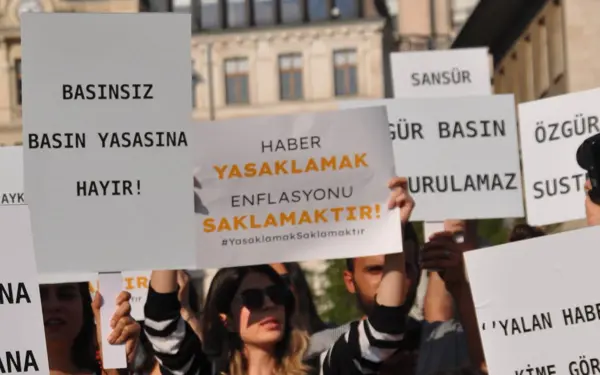
A coalition of 24 international press freedom organizations has issued a joint statement calling on Turkey to abolish its controversial “disinformation law,” citing alarming statistics about its use against journalists in the country.
According to the coalition’s report, at least 83 journalists have been charged with spreading disinformation 114 times since the law came into effect in October 2022. The legislation, formally known as Article 217/A of the Turkish Penal Code, has become a significant tool in the government’s arsenal against media criticism.
Among those targeted, BirGün reporter İsmail Arı and Deutsche Welle Türkçe correspondent Alican Uludağ have been the most frequently charged journalists, with six and four cases respectively. Both journalists are currently imprisoned, highlighting the severe consequences journalists face under this legislation.
The press freedom groups noted with concern that the application of Article 217/A has intensified in recent months, representing “part of a broader pattern of legal pressure criminalizing legitimate journalism in Turkey.” The statement specifically mentioned several other journalists who have faced legal action under the same charge, including Bilal Özcan, Murat Ağırel, Barış Pehlivan, Zafer Arapkirli, Turgay Kılıç, and Mehmet Yetim.
“Documented examples of this kind of abuse of the ‘disinformation law’ against journalists and the media make Turkey a regional, and even global, outlier in the misuse of regressive fake news and disinformation legislation to suppress media freedom and freedom of expression,” the coalition emphasized in their statement.
A key criticism of the law centers on its vague language, which fails to clearly define what constitutes “false information” or what content poses a threat to national security or public order. This ambiguity, according to the press freedom advocates, gives authorities nearly unlimited power to prosecute critical journalism.
“As one journalist prosecuted under the law emphasized, the government can deem any kind of information false. The vagueness of the law gives courts unlimited authority to determine the existence of an offense, enabling the prosecution of critical journalism,” the statement noted.
The coalition’s concerns reflect broader issues regarding press freedom in Turkey, which has consistently ranked among the countries with the highest number of imprisoned journalists worldwide in recent years. Media watchdogs have repeatedly criticized the deteriorating environment for independent journalism in the country, where a significant portion of mainstream media has come under government influence.
The timing of this joint statement comes as international scrutiny of Turkey’s media landscape continues to grow. Organizations like the International Press Institute (IPI), Committee to Protect Journalists (CPJ), and Reporters Without Borders (RSF) have long documented the systematic challenges faced by journalists working in Turkey.
The coalition has outlined specific demands for immediate action, calling on Turkish authorities to release all journalists currently imprisoned under Article 217/A, drop all pending cases against journalists related to their reporting or commentary, completely repeal the law itself, and bring all legislation governing freedom of expression into line with Turkey’s international obligations.
“A free and independent press is the most lasting safeguard against the spread of false information. Criminalizing journalism is neither a legal nor an effective response to it,” the statement concluded.
Among the 24 organizations signing the statement were prominent international groups such as PEN International, the European Federation of Journalists, the International Federation of Journalists, and several regional press freedom monitors.
The Turkish government has previously defended the law as necessary to combat misinformation in the digital age, but critics maintain it primarily serves as a tool to silence dissent and limit freedom of expression in an already constrained media environment.
Fact Checker
Verify the accuracy of this article using The Disinformation Commission analysis and real-time sources.

12 Comments
While disinformation is a real issue, this law appears to be used as a pretext to suppress critical reporting. The government should focus on transparency and accountability instead.
You raise a fair point. Targeted application of this law against specific journalists undermines its stated purpose and raises serious questions.
This disinformation law appears to be a tool for the Turkish government to crack down on press freedom. Imprisoning journalists sets a dangerous precedent.
Agreed. Restricting the ability of journalists to report freely undermines democratic values. Turkey should work to protect press freedoms, not erode them.
This disinformation law in Turkey seems concerning for press freedom. Imprisoning journalists for doing their jobs is a worrying trend that should be addressed.
Agreed, the chilling effect of such legislation is deeply problematic for a functioning democracy. Turkey must uphold its commitments to protect journalists.
The use of this law to target specific journalists is deeply concerning. Turkey should focus on promoting media pluralism and transparency rather than stifling critical reporting.
Well said. A free and independent press is crucial for a functioning democracy. Turkey must reconsider this legislation and its application.
It’s concerning to see the number of journalists charged under this law. Criminalizing reporting, even if deemed ‘disinformation’, is a dangerous precedent.
Absolutely. A free press is essential for a healthy democracy. Turkey must reconsider this legislation and protect the rights of journalists to do their work.
This disinformation law seems ripe for abuse by the Turkish government. Imprisoning journalists for their reporting is a serious violation of press freedoms.
I agree. Criminalizing journalism under the guise of combating disinformation is a tactic used by authoritarian regimes to silence dissent. Turkey must uphold democratic principles.