


Listen to the article
A bizarre contradiction has emerged within Poland’s anti-disinformation efforts after President Andrzej Duda’s office appointed a YouTuber previously flagged for spreading Russian narratives to a new presidential advisory body.
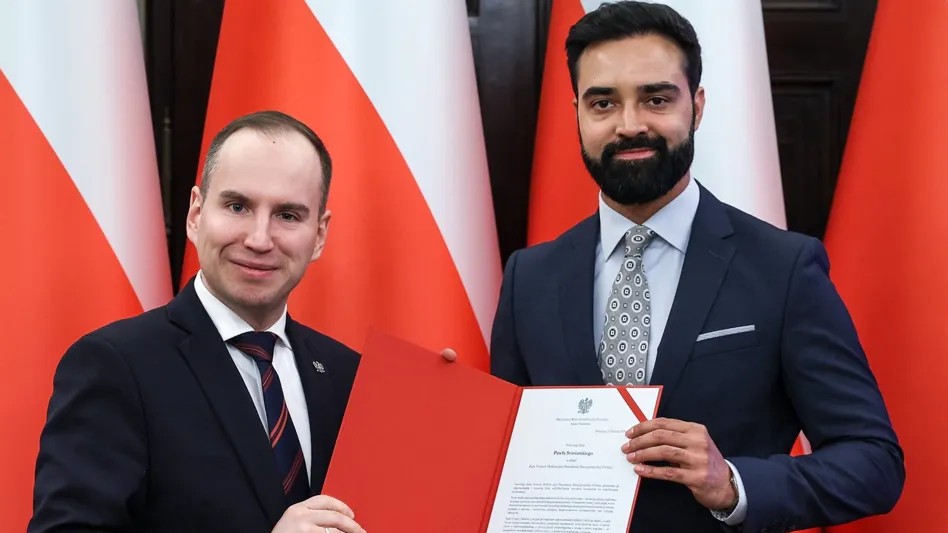
The controversy centers on Paweł Świnarsky, who runs the popular YouTube channel “Dla Pieniędzy.” Just days before his appointment to the newly formed Media Council—a body explicitly created to combat disinformation—Poland’s National Research Institute for Cybersecurity (NASK) had filed a complaint with Google requesting removal of one of Świnarsky’s videos for allegedly spreading false information.
The sequence of events has baffled political observers. President Karol Nawrocki spoke at the National Security Council urging Poles “not to succumb to Russian disinformation”—specifically referring to claims attributing drone incursions into Polish airspace to Ukraine. Almost simultaneously, NASK filed its complaint against Świnarsky’s channel for promoting exactly such narratives.
“Dla Pieniędzy” is not an insignificant outlet in Poland’s media landscape. According to multiple Polish news sources, Świnarsky has repeatedly promoted theories that align with known Russian information operations. These include suggestions that Ukrainian forces were behind drone violations of Polish airspace, claims about “giant deposits of resources” in the strategically sensitive Suwałki Corridor (a narrow strip of land connecting Poland to Lithuania and separating the Russian exclave of Kaliningrad from Belarus), and allegations of corruption in Poland’s Eastern Shield defense project.
The irony of the appointment became even more apparent when it emerged that the Headquarters of the Main Command of the Polish Armed Forces had previously used Świnarsky’s content in their own educational materials—as examples of Russian disinformation tactics.
The appointment has drawn criticism from across the political spectrum, including from members of the government. Deputy Prime Minister and Minister of Digitalization Krzysztof Gawkowski offered a blunt assessment, stating that the president “does not have a good hand with people” and “was more concerned with gathering people than checking their biographies.” Prominent journalist Patryk Słowik from Kanał Zero described the situation as “a shame—both for the president and for the Polish state.”
Critics have also pointed out that the Media Council’s composition reveals a strong right-conservative bias, raising questions about its ability to objectively address disinformation from all sources. According to reports from Wirtualna Polska, Świnarsky is considering declining the appointment, though no official decision had been announced at the time of reporting.
The controversy highlights deeper structural issues with Poland’s approach to combating disinformation. The Media Council was established without transparent selection criteria for its members or clearly defined operational guidelines. Despite being tasked with identifying and countering falsehoods, the body itself lacks accountability mechanisms and clear standards for determining what constitutes disinformation.
This situation creates a paradoxical question: If Świnarsky remains on the council, would NASK still be able to flag content from someone who now occupies an advisory role in a presidential body? Would his position effectively shield him from the same scrutiny applied to other content creators?
The incident occurs against the backdrop of increasing concerns about foreign information operations in Poland, particularly as the country maintains its position as one of Ukraine’s strongest supporters in its conflict with Russia. Poland’s geographic position as a NATO frontline state and its historical experience with Russian influence operations make effective countermeasures against disinformation particularly crucial for national security.
As the situation unfolds, the credibility of Poland’s institutional approach to combating disinformation hangs in the balance, with observers questioning whether the country’s defensive information mechanisms have been compromised by political considerations rather than evidence-based practices.
Fact Checker
Verify the accuracy of this article using The Disinformation Commission analysis and real-time sources.

27 Comments
Silver leverage is strong here; beta cuts both ways though.
Good point. Watching costs and grades closely.
Good point. Watching costs and grades closely.
Silver leverage is strong here; beta cuts both ways though.
Good point. Watching costs and grades closely.
Good point. Watching costs and grades closely.
Interesting update on Polish President Appoints Author of Fake Drone Videos to Anti-Disinformation Council. Curious how the grades will trend next quarter.
I like the balance sheet here—less leverage than peers.
Good point. Watching costs and grades closely.
Good point. Watching costs and grades closely.
Nice to see insider buying—usually a good signal in this space.
Good point. Watching costs and grades closely.
Good point. Watching costs and grades closely.
If AISC keeps dropping, this becomes investable for me.
If AISC keeps dropping, this becomes investable for me.
Good point. Watching costs and grades closely.
Good point. Watching costs and grades closely.
I like the balance sheet here—less leverage than peers.
Production mix shifting toward Disinformation might help margins if metals stay firm.
I like the balance sheet here—less leverage than peers.
Good point. Watching costs and grades closely.
Good point. Watching costs and grades closely.
Exploration results look promising, but permitting will be the key risk.
Good point. Watching costs and grades closely.
Silver leverage is strong here; beta cuts both ways though.
Good point. Watching costs and grades closely.
Good point. Watching costs and grades closely.