


Listen to the article
Union Minister Cautions Against Diet Misinformation While Advocating Personalized Nutrition
NEW DELHI — Union Minister Dr. Jitendra Singh emphasized the dangers of dietary misinformation during a book launch event in New Delhi on Monday, warning that diet advice cannot be reduced to generalized prescriptions.
“Diet is too important a subject to be left to any one group alone,” said Dr. Singh, who is also a Professor of Medicine and Diabetes. He stressed that while awareness about lifestyle diseases like diabetes and obesity is crucial, equal vigilance must be directed toward combating the spread of misinformation in nutrition science.
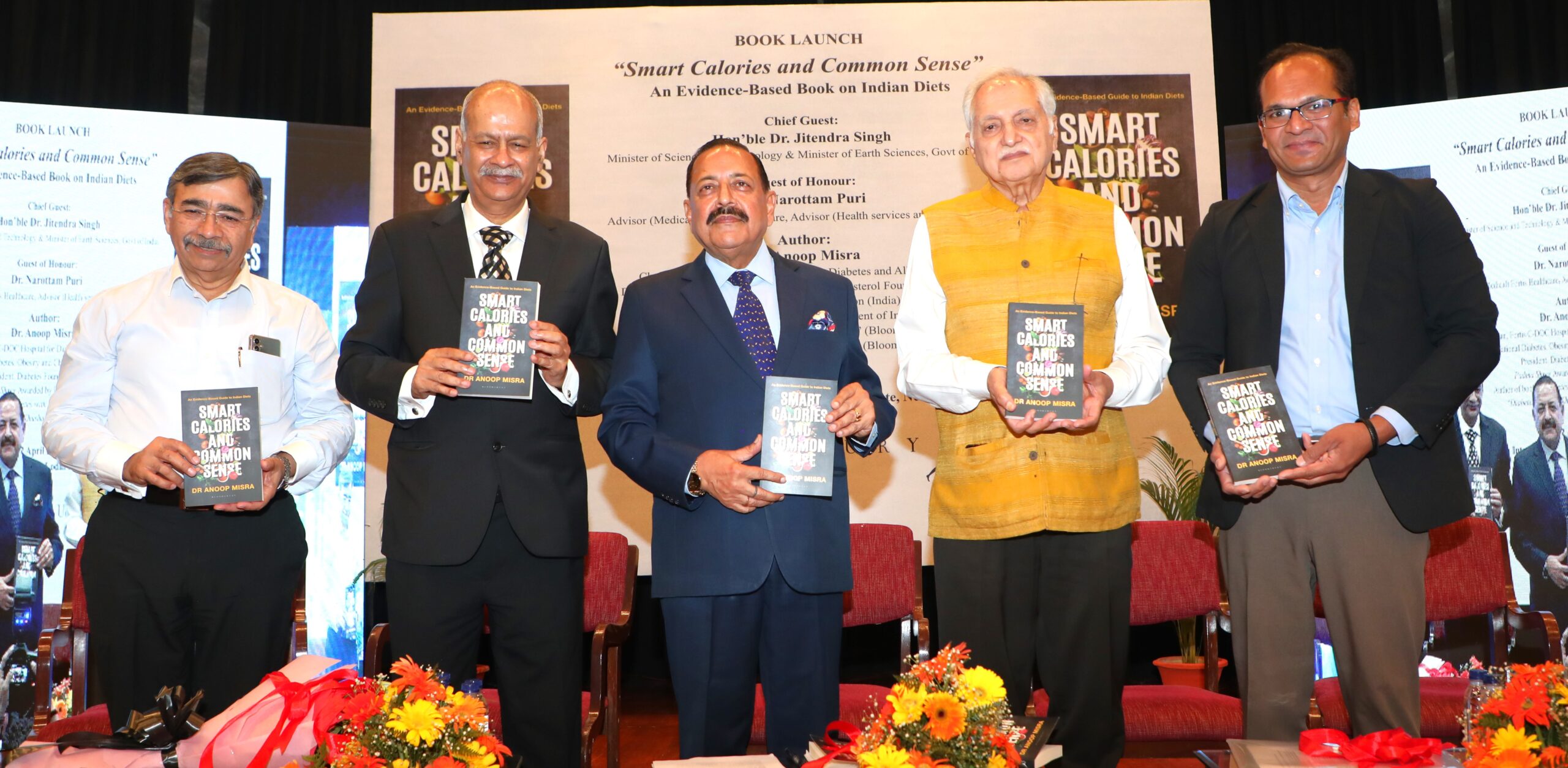
The remarks came during the launch of “Smart Calories and Common Sense: An Evidence-Based Guide to Indian Diets,” authored by senior diabetologist Dr. Anoop Misra of Fortis Healthcare. The event, held at India International Centre, gathered prominent figures from the medical community, including Dr. Narottam Puri, Advisor for Medical services at Fortis Healthcare and health services advisor at FICCI.
Dr. Singh highlighted the evolving nature of dietary science, citing how scientific understanding has shifted over decades—from recommending refined oils to returning to traditional fats, and from artificial sweeteners to natural alternatives. This evolution, he noted, demonstrates why dietary advice should be approached with nuance rather than treated as fixed doctrine.
“Conclusions in dietary science are often based on population-level evidence and may not apply uniformly to every individual,” Dr. Singh explained, drawing from his extensive medical experience. He recalled an earlier era of medicine where diagnosis relied heavily on detailed history-taking and clinical observation—practices he suggested might sometimes be overshadowed today by standardized protocols and test results.
The growing commercialization of healthcare and dietary advisory services was another concern raised by the minister. He cautioned that visually appealing or unnecessarily complex diet plans often gain popularity despite lacking practical relevance or scientific foundation. This trend, he suggested, creates confusion among consumers trying to make informed dietary choices.
India faces a significant public health challenge with diet-related conditions. According to the International Diabetes Federation, the country has approximately 77 million adults living with diabetes, second only to China globally. Additionally, obesity rates have risen dramatically over the past decade, particularly in urban areas, with the National Family Health Survey indicating that over 20% of urban Indians are either overweight or obese.
Against this backdrop, Dr. Singh emphasized that meal timing and portion distribution deserve greater attention in dietary guidance. “How you distribute your calories throughout the day can be as important as what those calories consist of,” he noted, sharing examples of how individual lifestyle patterns significantly influence suitable dietary approaches.
Nutritionists have increasingly recognized the importance of personalized nutrition in recent years. Research from the Indian Council of Medical Research suggests that genetic factors, gut microbiome composition, and regional dietary traditions all contribute to how individuals respond to different foods—supporting Dr. Singh’s assertion that standardized diet plans have limitations.
The event comes amid growing concern about the proliferation of unverified nutritional claims on social media platforms. A recent study by the Center for Science and Environment found that over 60% of popular dietary recommendations circulating online lack substantial scientific evidence, highlighting the problem Dr. Singh addressed.
In his concluding remarks, the minister reiterated that there is no universal “ideal diet” applicable to everyone. Instead, he advocated for a more personalized approach based on individual observation, moderation, and informed choices, while maintaining healthy skepticism toward unverified claims and dietary trends.
“Each individual must understand and adapt according to their own body, lifestyle, and metabolic needs,” Dr. Singh said, encouraging people to actively observe their own dietary responses over time rather than following generic advice uncritically.
Fact Checker
Verify the accuracy of this article using The Disinformation Commission analysis and real-time sources.

7 Comments
Personalized nutrition is the way forward. Curious to see how this guide approaches individual differences in metabolism, lifestyle, and health conditions. Sounds like a step in the right direction.
Personalized nutrition is key – one-size-fits-all diets often don’t work well. Good to see the minister emphasizing the need for tailored advice based on individual needs and circumstances.
Absolutely, everyone’s body and lifestyle is different. Cookie-cutter diet plans can do more harm than good. Sounds like this new guide aims to provide more nuanced, holistic guidance.
Interesting to see the government warning against dietary misinformation. Nutrition is a complex topic with lots of conflicting advice out there. Glad to see an evidence-based guide being published to help people navigate it.
Tackling nutrition misinformation is crucial, especially with the rise of social media influencers peddling dubious diet advice. This guide could be a valuable resource for the public.
I’m curious to learn more about the evolving scientific understanding of nutrition that the minister referenced. It will be interesting to see how this guide reconciles past dietary advice with newer evidence-based findings.
Glad to see the government taking a proactive stance against dietary misinformation. This is an important issue with serious health implications. Looking forward to checking out this new evidence-based guide.