


Listen to the article
Women Solar Technicians Illuminate Zanzibar’s Off-Grid Communities
When darkness fell over Hamna Silima Nyange’s home in Zanzibar, her only option was to light smoky oil lamps that provided dim illumination for her eight children to study by. Like approximately one million people in Tanzania’s semi-autonomous archipelago, her house wasn’t connected to the electricity grid.
“The light was too weak,” Nyange recalls. “And the smoke from the lamp hurt my eyes.”
Everything changed when her neighbor, Tatu Omary Hamad, installed solar panels and bulbs that harnessed the abundant sunlight along Zanzibar’s Indian Ocean coast. “Today we have enough light,” Nyange says with relief.
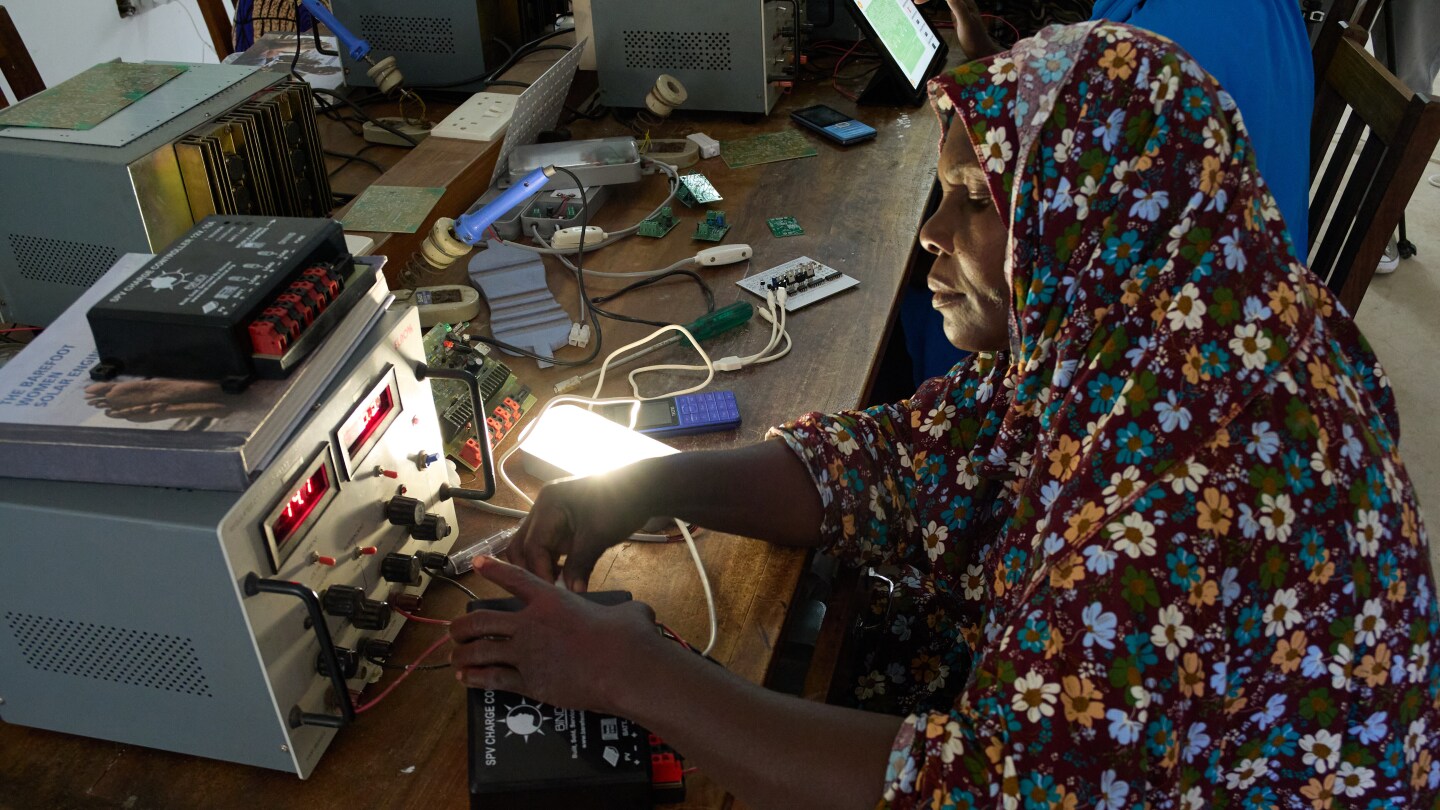
Hamad is among dozens of “solar mamas” trained by Barefoot College International, a global nonprofit that brings sustainable lighting to rural communities while creating employment opportunities for local women. The program has successfully illuminated 1,845 homes across Zanzibar over the past decade.
The initiative targets middle-aged women with limited formal education from villages lacking electricity. These candidates undergo six months of comprehensive training to become solar power technicians. Upon completion, they return to their communities equipped with at least 50 household solar panel kits and the expertise to install and maintain them.
“We want to train women who become change makers,” explains Brenda Geofrey, director of Barefoot College International Zanzibar.
The Zanzibar campus recently celebrated its tenth anniversary. Before establishing this local training center, the organization sent Zanzibari women to India, where Barefoot College International was founded.
One success story is Khazija Gharib Issa, a formerly unemployed widow who now serves as a master trainer. “I got a job. I got a place to stay. Before, I didn’t have one,” Issa shares.
Beyond providing electricity, improving health stands at the core of the program’s mission. In addition to solar power training, Barefoot College International offers courses in tailoring, beekeeping, and sustainable agriculture. Every graduate receives basic health education they’re expected to share with their villages.
The solar installations themselves directly improve community health by replacing harmful traditional lighting sources. “Using kerosene has many problems,” notes Jacob Dianga, a local healthcare worker familiar with the program. The fuel irritates eyes, while inhaling its smoke can cause long-term lung damage. It also presents a serious fire risk in cramped homes and shops, and can poison children who mistake it for a beverage.
“Clean energy is very important,” Dianga emphasizes. “It helps protect our health.”
The program has expanded throughout Africa, with additional campuses in Madagascar and Senegal. Recently, women from Malawi and Somaliland have traveled to Zanzibar for training, and this year, participants from the Central African Republic are being recruited.
Despite its success, the initiative faces significant challenges. Funding remains a persistent concern as major donors from the United States and Europe reduce foreign aid budgets, creating increased competition for limited resources. Barefoot College International operates through a combination of public and private donations, supplemented by revenue from its social enterprises.
Cultural resistance presents another obstacle. Some communities struggle to accept women in these traditionally male-dominated technical roles. While the program recruits with village leadership approval, who nominate candidates, some husbands have prevented their wives from participating in the training.
“In most African communities, women are pictured as somebody who is just at home,” Geofrey acknowledges.
However, the solar mamas report that their results eventually overcome skepticism. “People used to say this work is for men. They were surprised and laughed at me,” Issa recalls. “But now they see how important my work is. I have become an example.”
As Zanzibar continues its development journey, these women are proving that sustainable energy solutions can simultaneously address infrastructure gaps, improve public health, and transform gender roles in communities that need it most. One solar panel at a time, they’re bringing both literal and figurative enlightenment to the archipelago’s most remote areas.
Fact Checker
Verify the accuracy of this article using The Disinformation Commission analysis and real-time sources.

11 Comments
The ‘solar mamas’ program in Zanzibar is a fantastic model that could be replicated in other off-grid regions around the world. Investing in women’s education and vocational training is critical for driving sustainable development and energy access.
This is a wonderful initiative to empower women and bring clean, reliable electricity to off-grid communities in Zanzibar. Equipping local women with technical skills and turning them into solar technicians is a smart and sustainable approach.
Absolutely, training local ‘solar mamas’ to install and maintain solar systems is such an effective way to improve lives and strengthen communities. It’s great to see these women taking an active role in the energy transition.
The benefits of switching from smoky oil lamps to clean, affordable solar power are immense – better lighting, reduced health risks, and more opportunities for children to study. It’s heartening to see this program making a real difference in people’s lives.
Bringing reliable electricity to underserved communities through solar power is such an important goal. I’m glad to see the Barefoot College program empowering local women to become solar technicians and lead this change.
Absolutely, this is a great example of how targeted training and skills development can unlock new economic opportunities, especially for marginalized groups. Kudos to the ‘solar mamas’ for taking on this vital role.
It’s impressive that the Barefoot College International program has already brought solar power to over 1,800 homes in Zanzibar. Investing in women’s education and empowerment is crucial for driving sustainable development in remote areas.
Agreed, this initiative demonstrates the transformative impact that targeted training and skills development can have, especially for marginalized groups. Equipping local women with technical expertise is a powerful model for expanding energy access.
It’s wonderful to see women being trained as solar technicians in Zanzibar. Providing them with practical, in-demand skills is crucial for driving sustainable development and expanding energy access in off-grid communities.
This is a great example of how renewable energy can improve quality of life, especially in energy-poor regions. Providing women with the skills to become solar technicians is a smart, community-driven approach to rural electrification.
Absolutely, empowering local women as solar technicians is a brilliant strategy. It creates jobs, builds technical capacity, and ensures the long-term sustainability of these solar installations. A win-win for the community.