


Listen to the article
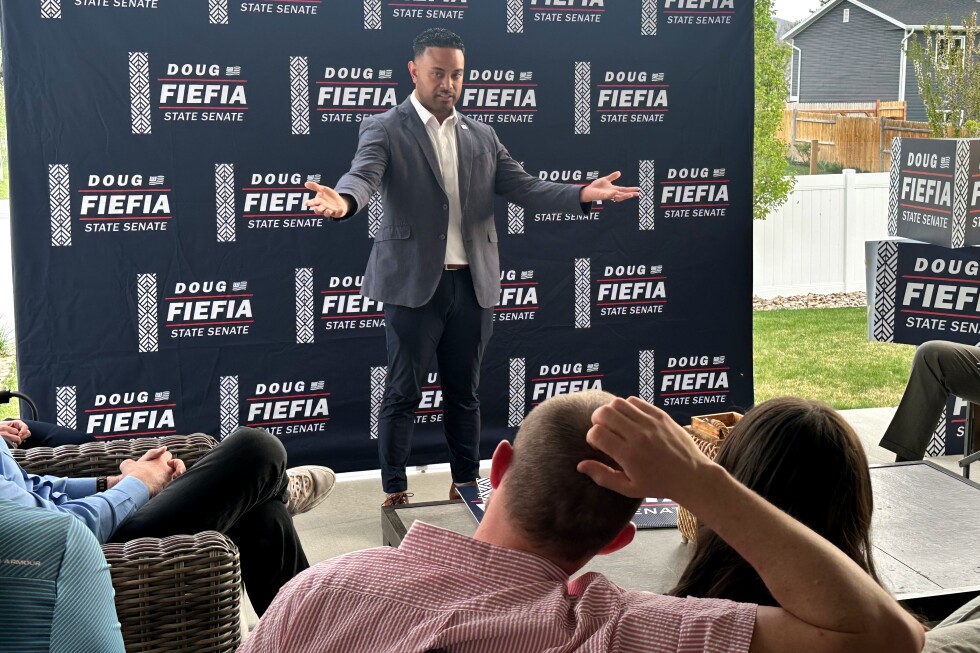
In a suburban neighborhood of Riverton, Utah, a dozen Republican activists gathered on a back deck to discuss the upcoming elections. While conversations touched on traditional conservative concerns like water scarcity and immigration, state representative Doug Fiefia steered the discussion toward artificial intelligence—a topic that has become the centerpiece of his campaign for state senate.
“I know it sounds like ‘Doug, this is all you talk about,'” Fiefia told the group. “That’s because it’s coming, it’s here and it’s going to be our biggest fight.”
Fiefia’s focus on AI regulation has placed him at odds with the Trump administration, which earlier this year helped block his state proposal requiring companies to implement child safety protocols in AI systems. The White House has pushed for a unified national standard for artificial intelligence, arguing that varied state regulations could hamper American innovation in the global race against China.
This conflict highlights a growing tension between federal and state approaches to AI regulation. With Congress making little progress on comprehensive legislation, state lawmakers have stepped into the regulatory void. More than 1,000 state legislative proposals addressing AI have emerged nationwide, reflecting widespread public concern about the technology’s potential impacts.
“Is this something we should be scared about, or is it no big deal and it’ll enhance our lives?” asked Brett Young, a structural engineer attending the Riverton gathering, capturing the uncertainty many Americans feel about AI.
The Trump administration has actively attempted to prevent state-level AI policies through executive orders that include legal threats and funding penalties to discourage new regulations. The White House recently released a framework for potential congressional legislation that would preempt state laws deemed “too burdensome” while allowing limited rules to protect children and copyright material.
Despite these federal efforts, state proposals continue to multiply. Popular measures include requiring chatbots to identify themselves as non-human and prohibiting the use of AI to create non-consensual pornography by digitally altering photos.
“There’s a lot of state lawmakers looking at what the federal government is doing and saying, ‘We want to take action because we’re not satisfied,'” explained Craig Albright, senior vice president for government relations at the Business Software Alliance, which represents software companies.
Public opinion strongly favors more oversight. A recent Quinnipiac poll found approximately 80% of Americans are “concerned” or “very concerned” about AI, with three-quarters believing government isn’t doing enough to regulate the technology. Support for increased regulation spans political lines, with roughly 90% of Democrats and 60% of Republicans favoring greater government involvement.
The strongest regulations have emerged in Democratic strongholds like California and New York, focusing on disclosure requirements for catastrophic risks such as AI-controlled nuclear plant malfunctions or systems refusing human direction. However, Republican-led states are also feeling pressure to act.
In Florida, Republican Governor Ron DeSantis has added AI to a special legislative session after a bill failed earlier this year that would have implemented parental controls for minors using AI and prohibited systems from using anyone’s likeness without permission. Similar AI regulation efforts in Republican-controlled Louisiana and Missouri have stalled due to resistance from the Trump administration.
Fiefia belongs to a growing network of former tech employees who have transitioned into state politics, bringing insider knowledge to their regulatory efforts. He co-chairs the AI task force of the Future Caucus, a group of younger state lawmakers, alongside Vermont Democrat Monique Priestley, who also has a tech background.
Priestley describes the challenge of advancing regulation against well-funded opposition: “It’s like you’re running around against an army of full-time lobbyists.” She noted that 166 of Vermont’s 482 registered lobbyists weighed in on her data privacy bill last year, which was ultimately vetoed by the governor.
Another member of this network is Alex Bores, a former data scientist at Palantir who authored New York’s AI regulation law. Now running for Congress in a crowded Democratic primary to replace retiring U.S. Rep. Jerrold Nadler, Bores faces significant industry pushback—a pro-AI campaign committee has spent $2.3 million opposing his candidacy.
“It’s one reason it’s so important for me to win this race,” Bores said, “because if I don’t, that intimidation they’re trying on Congress will be successful.”
Fiefia’s journey from Google to Utah politics reflects a growing trend of tech insiders becoming regulatory advocates. As the son of Tongan immigrants who worked as a salesperson for Google and managed a team implementing early AI models, Fiefia grew concerned about the industry’s priorities.
“What I realized is Big Tech cares about their bottom line, and they were worried about making money, not doing right for the human race,” said Fiefia, who now works at a Utah-based cloud computing and AI company.
His Utah legislation was initially successful, passing a House committee unanimously before the Trump administration intervened, calling the measure “unfixable.” Daniel McCay, the state senator Fiefia is challenging in the primary, supported its demise.
“I’ve been around long enough to recognize the invention of fire, the wheel, cars and the internet did not ruin society and I’m very skeptical of anyone trying to scare society into regulations,” McCay said, noting the bill went beyond child safety to include whistleblower protections and risk disclosure requirements.
At the neighborhood gathering in Riverton, Fiefia defended his stance against the Trump administration. “The Trump administration is, ‘We want zero regulations on AI,'” he said. “I think that’s wrong. I agree with a lot of what Trump says on taxes. I disagree with him on this.”
Fact Checker
Verify the accuracy of this article using The Disinformation Commission analysis and real-time sources.

12 Comments
As an investor in mining and energy-related equities, I’m curious to see how potential AI regulations could impact those industries. Careful policymaking will be crucial to balance innovation and safety.
Absolutely. AI is already being deployed in mining, energy, and other commodity sectors. Smart regulation can help harness the benefits while mitigating risks.
Kudos to the Utah Republican for prioritizing AI regulation. Proactive state-level action is crucial given the lack of progress on comprehensive federal legislation. This is an issue that will only grow in importance.
Well said. As AI becomes more ubiquitous, responsible governance at all levels of government will be essential to ensure its safe and ethical deployment.
I’m skeptical of the White House’s push for a unified national standard on AI. Varied state-level approaches could allow for more nimble, context-specific regulations that adapt to fast-moving technological changes.
That’s a fair point. Regulatory flexibility at the state level may be beneficial, especially for emerging technologies like AI where the landscape is rapidly evolving.
The conflict over AI rules highlights the ongoing power struggle between federal and state governments. It will be interesting to see how this plays out and whether a middle ground can be found.
Agreed. With AI advancing rapidly, there’s a need for coordinated yet flexible policies. Hopefully, pragmatic solutions can emerge that satisfy the various stakeholders.
Interesting to see the tension between federal and state approaches to AI regulation. It’s a complex issue with a lot of competing priorities and perspectives. I’m curious to learn more about the specific concerns and proposals from both sides.
Yes, it’s a nuanced topic with valid points on both sides. Striking the right balance between innovation, safety, and state autonomy will be crucial as AI tech continues to advance rapidly.
The Utah Republican’s focus on AI regulation seems commendable, even if it puts him at odds with the Trump administration. Proactive state-level action may be needed to address potential risks and challenges as AI systems become more prevalent.
Agreed. With Congress dragging its feet, state legislators may need to step up and provide more specific guidance and safeguards around AI deployment and use.