


Listen to the article
NASA’s Webb Space Telescope Reveals Dazzling Heart of Spiral Galaxy
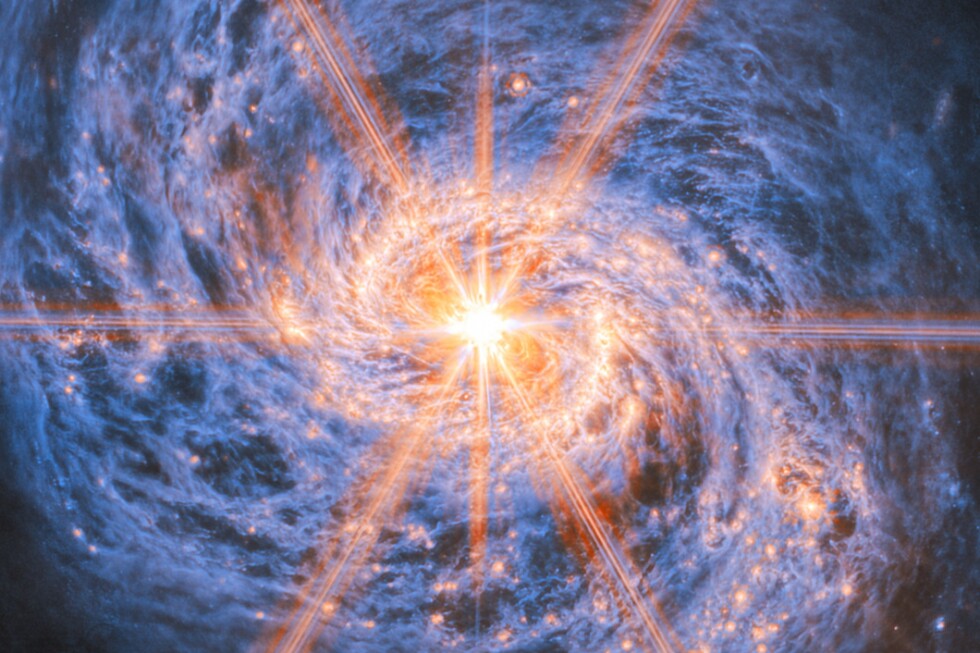
NASA’s Webb Space Telescope has captured a breathtaking new image of the Messier 77 galaxy, showcasing its brilliant core that outshines everything in its vicinity. The stunning photograph, released this week, provides an unprecedented view of this celestial object located 45 million light-years away in the Cetus constellation, also known as the whale constellation.
At the center of this cosmic spectacle lies an active galactic nucleus powered by a supermassive black hole with a mass 8 million times greater than our sun. This gravitational behemoth creates extraordinary conditions around it, drawing in surrounding gas into a tight orbital pattern. As this material spirals inward, it heats to extreme temperatures, generating the intense radiation captured in remarkable detail by Webb’s mid-infrared instrument.
Messier 77, also cataloged as NGC 1068, represents one of the most studied galaxies outside our local group. Astronomers have long been fascinated by its active nucleus, which belongs to a class of galaxies known as Seyferts—characterized by extremely bright centers that emit strong radiation across multiple wavelengths.
The Webb telescope’s ability to observe in infrared light gives scientists a crucial advantage in studying such objects. Unlike visible light, infrared can penetrate the thick clouds of cosmic dust that typically obscure galactic cores, providing researchers with clear views of phenomena that would otherwise remain hidden.
Since its launch in December 2021, the James Webb Space Telescope has revolutionized our understanding of the cosmos. As the successor to the Hubble Space Telescope, Webb represents the most powerful observatory ever placed in space. Its primary mirror, spanning 6.5 meters in diameter, collects light with unprecedented sensitivity, allowing astronomers to peer farther back in time and with greater clarity than ever before.
The telescope operates at the second Lagrange point (L2), approximately 1.5 million kilometers from Earth. This strategic position, combined with Webb’s sophisticated sunshield, maintains the telescope’s instruments at the extremely cold temperatures necessary for detecting faint infrared signals from distant celestial objects.
This latest image of Messier 77 exemplifies the capabilities that make Webb a transformative tool for astrophysics. By studying active galactic nuclei like the one in this spiral galaxy, scientists hope to better understand the complex relationship between supermassive black holes and their host galaxies—a relationship that plays a crucial role in galactic evolution throughout cosmic history.
The distances involved in such observations are almost unfathomable to the human mind. At 45 million light-years away, the light captured in this image began its journey toward Earth when mammals were just beginning to diversify following the extinction of the dinosaurs. For context, a single light-year spans approximately 6 trillion miles, making the total distance to Messier 77 around 270 quintillion miles.
The Webb telescope represents a collaborative effort between NASA, the European Space Agency (ESA), and the Canadian Space Agency (CSA), with thousands of scientists, engineers, and technicians contributing to its development over more than two decades. With an expected operational lifetime of at least 10 years, Webb promises to continue delivering groundbreaking discoveries that reshape our understanding of the universe.
As Webb continues its mission of cosmic exploration, images like this serve not only as valuable scientific data but also as profound reminders of the beauty and complexity of our universe—a universe where galaxies harbor brilliant cores powered by some of the most extreme physics known to science.
Fact Checker
Verify the accuracy of this article using The Disinformation Commission analysis and real-time sources.

10 Comments
Spiral galaxies like Messier 77 have such a dynamic and complex structure. The intense activity around the central black hole must be driving all kinds of fascinating astrophysical phenomena.
I’m curious to learn more about how the spiral arms and central nucleus interact and influence each other in this type of galaxy.
Messier 77 is a well-studied galaxy, but I’m sure the Webb data will reveal new details and phenomena that previous telescopes couldn’t observe. Excited to see how this contributes to our understanding of the life cycle of galaxies.
It’s amazing that Webb can capture such detailed observations of a galaxy 45 million light-years away. The sheer scale and power of the central black hole and surrounding accretion disk is really quite humbling.
The intense radiation emitted by the material spiraling into the central black hole must create a truly spectacular sight. I wonder what other fascinating features Webb might uncover in this galaxy’s structure and composition.
Absolutely, the Webb telescope’s infrared capabilities will likely shed new light on the complex physical processes at play in the core of Messier 77 and other active galactic nuclei.
Fascinating to see the supermassive black hole at the center of this distant galaxy. Webb’s mid-infrared instrument must be providing incredible detail on the extreme conditions and energetic processes happening there.
I’m really looking forward to more discoveries from the Webb telescope. Its ability to observe in infrared is opening up whole new vistas in astronomy.
Wow, 45 million light-years away – that’s an incredible distance for Webb to capture such detailed imagery. The sheer scale and power of these supermassive black holes is mind-boggling.
I agree, the capabilities of the Webb telescope continue to amaze. Observing the innermost regions of distant active galactic nuclei must provide crucial insights into their formation and evolution.