


Listen to the article
India and New Zealand Sign Landmark Free Trade Agreement Amid Global Uncertainties
India and New Zealand took a significant step toward strengthening their economic partnership on Monday by signing a comprehensive free trade agreement designed to expand market access and deepen trade ties between the two nations.
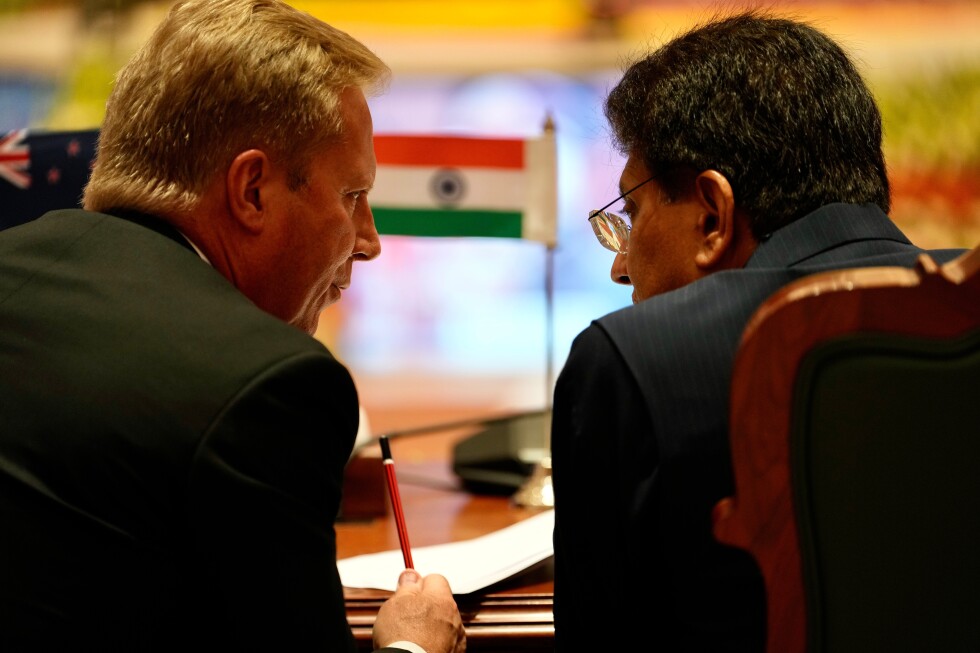
The agreement was formalized in New Delhi during a signing ceremony attended by India’s Commerce and Industry Minister Piyush Goyal and New Zealand’s Trade and Investment Minister Todd McClay, culminating nine months of negotiations that concluded with an initial agreement in December.
Under the terms of the deal, tariffs will be eliminated or reduced on 95% of New Zealand’s exports to India, while all Indian exports to New Zealand will become duty-free. Additionally, Wellington has pledged to invest $20 billion in India over the next 15 years, signaling a long-term commitment to the economic partnership.
For India, the agreement represents a strategic move to diversify its export markets amid mounting challenges on the global trade front, including steep tariffs imposed by the United States and disruptions in shipping and energy routes due to the ongoing conflict involving Iran. Indian exporters, particularly in labor-intensive sectors such as textiles, auto components, and metals, have been under pressure since the U.S. implemented higher tariffs last August, even as bilateral negotiations with Washington continue on a separate trade agreement.
From New Zealand’s perspective, the deal aligns with efforts to reduce its economic dependence on China, currently its largest trading partner. This diversification strategy comes at a time when many nations are reassessing their trade relationships amid growing geopolitical tensions.
“This agreement is also being concluded at a time of heightened global and regional uncertainty. In this context, strong, reliable partnerships matter more than ever before,” McClay said, describing the deal as a “once-in-a-generation” opportunity to strengthen economic ties between the two nations.
Goyal echoed this sentiment, calling the agreement a “defining milestone” and noting that India and New Zealand had “chosen each other” at a time “when the world economy is being recast.” He emphasized that the deal offers market access across multiple sectors and establishes frameworks for investment and regulatory cooperation.
The agreement is expected to benefit several key industries in both countries. Indian sectors positioned for expanded market access include textiles and apparel, engineering goods, leather and footwear, and marine products. New Zealand, meanwhile, anticipates increased exports in horticulture, timber, coal, wool, and meat.
Notably, India has excluded dairy and certain agricultural products from the agreement to protect its sensitive farming sector, a common practice in its trade negotiations aimed at shielding domestic producers from foreign competition.
The current bilateral trade between the two countries stands at $2.15 billion for the year through June 2025, according to official data, with India ranking as New Zealand’s 12th-largest export market. This agreement creates a framework to substantially increase these figures in the coming years.
Before implementation, the agreement requires ratification by New Zealand’s parliament, a process expected to proceed smoothly after securing backing from the opposition New Zealand Labour Party. This bipartisan support comes despite resistance from New Zealand First, a populist minor party in the governing coalition.
The India-New Zealand free trade agreement represents a strategic realignment of economic priorities for both nations at a time when global trade patterns are evolving rapidly amid geopolitical tensions and supply chain disruptions. As traditional trade relationships face increasing challenges, this agreement highlights how countries are seeking new partnerships to navigate an increasingly complex global economic landscape.
Fact Checker
Verify the accuracy of this article using The Disinformation Commission analysis and real-time sources.

13 Comments
Reducing tariffs on 95% of New Zealand’s exports to India is a bold move. I wonder how this will affect the global competitiveness of Indian miners and energy producers as they gain better access to Kiwi goods and services.
Good point. This could create both opportunities and challenges for Indian commodity firms as they navigate the new trade landscape. It will be important to monitor any shifts in trade flows and market dynamics.
While the details remain to be seen, this India-New Zealand trade agreement seems like a positive step toward deeper economic integration in the Asia-Pacific region. It will be worth monitoring how it impacts the flow of investment, technology, and expertise in the mining and energy sectors.
This development is particularly interesting given India’s recent efforts to position itself as a global manufacturing and export hub, especially for energy-intensive industries like metals and minerals processing. How might this trade deal factor into those broader economic strategies?
That’s a great point. Increased access to New Zealand’s resource inputs and technologies could potentially strengthen India’s hand in becoming a more dominant player in global commodity supply chains. But it will depend on how the two countries leverage their respective comparative advantages.
The mining and energy sectors will likely be closely watching this development, as it could open up new opportunities for cross-border investment and market access. How do you think this might impact commodity prices and industry dynamics in the long run?
That’s a great question. Reduced trade barriers could potentially increase competition and put downward pressure on prices for certain commodities. But it may also spur more joint projects and M&A activity between Indian and Kiwi firms. The net impact remains to be seen.
As a long-time observer of the mining and energy sectors, I’m cautiously optimistic about the potential of this India-New Zealand trade deal. But the devil will be in the details when it comes to implementation and enforcement.
Agreed. The ability of both countries to effectively navigate any frictions or disputes that may arise will be crucial. Transparent and collaborative governance will be key to realizing the full benefits of this agreement.
This free trade agreement between India and New Zealand is an interesting development. It will be fascinating to see how it impacts trade and investment flows between the two countries, especially in key sectors like mining and energy.
Yes, the commitment to $20 billion in investment from New Zealand over 15 years is a significant pledge. It will be worth tracking how that capital is deployed, particularly in resource extraction and processing industries.
Given the global uncertainties mentioned, this agreement seems like a strategic play by both countries to diversify their economic partnerships. It will be interesting to see if other major economies in the region follow suit with similar trade deals.
Absolutely. Regional economic integration is becoming increasingly important as geopolitical tensions and supply chain disruptions continue to roil the global trading system. This could be the start of a broader trend.