


Listen to the article
Archaeologists Use AI to Reconstruct Face of Pompeii Eruption Victim
For the first time, researchers at the ancient Roman site of Pompeii have used artificial intelligence to digitally reconstruct the face of a man killed during the catastrophic eruption of Mount Vesuvius nearly 2,000 years ago, offering new insights into one of history’s most documented natural disasters.
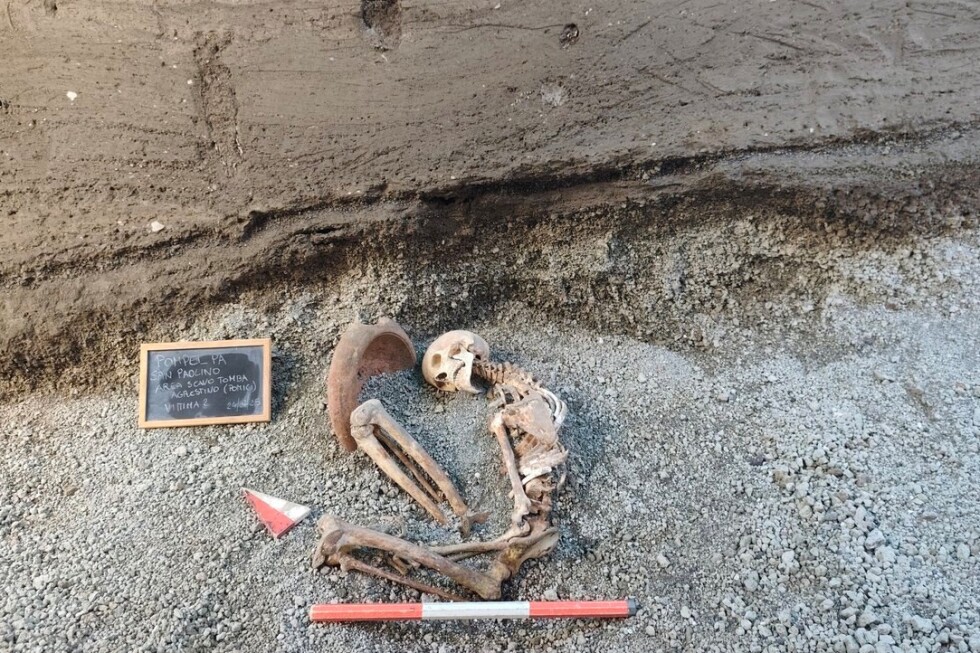
The digital portrait reveals the likeness of a man who died while attempting to flee the city with another person toward what is now Italy’s coast. According to researchers, he likely perished early in the disaster, during an intense fall of volcanic debris that would eventually entomb the entire city.
The innovative reconstruction was developed through a collaboration between the Pompeii Archaeological Park and the University of Padua, based on detailed archaeological data collected from excavations near the Porta Stabia necropolis, located just outside the ancient city’s walls.
In the AI-generated illustration released by the park, the man is depicted running along a debris-strewn road while holding a large, shallow terracotta bowl over his head as a makeshift shield. Mount Vesuvius looms ominously in the background, spewing ash and smoke into the darkening sky.
“The vastness of archaeological data is now such that only with the help of artificial intelligence will we be able to adequately protect and enhance them,” said Gabriel Zuchtriegel, director of the Pompeii Archaeological Park. “If used well, AI can contribute to a renewal of classical studies.”
This protective use of household objects aligns with historical accounts of the eruption, including those written by Roman author Pliny the Younger, who described Pompeii residents desperately attempting to shield themselves as volcanic ash and pumice stones rained down upon the city during the AD 79 catastrophe.
The archaeological discovery provides additional context about the victim’s final moments. Alongside the protective mortar bowl, researchers found the man carrying an oil lamp, a small iron ring, and ten bronze coins – personal possessions that offer rare glimpses into both his desperate escape attempt and everyday life in Pompeii before disaster struck.
The reconstruction technique combined artificial intelligence with sophisticated photo-editing methods designed to translate skeletal remains and archaeological evidence into a realistic human likeness. This approach marks a significant advancement in archaeological visualization, potentially opening new avenues for public engagement with historical sites.
Pompeii, now recognized as a UNESCO World Heritage site, was completely buried under ash and pumice during the Vesuvius eruption, preserving the city and thousands of its inhabitants in remarkable detail. This extraordinary level of preservation has made the site one of the world’s most valuable archaeological treasures, providing unparalleled insights into daily life in the ancient Roman world.
The project represents a growing trend in archaeological research that seeks to make complex scientific findings more accessible and emotionally resonant for the public while maintaining rigorous academic standards. By literally putting a face to history, researchers hope to deepen public connection with the human stories behind the archaeological record.
As technology continues advancing, similar AI applications could potentially revolutionize how researchers approach other archaeological sites around the world, allowing for more detailed reconstructions of ancient civilizations and the individuals who inhabited them.
The Pompeii Archaeological Park continues to draw hundreds of thousands of visitors annually, with ongoing excavations regularly uncovering new aspects of life in the ancient Roman city before its destruction in one of the most famous natural disasters in human history.
Fact Checker
Verify the accuracy of this article using The Disinformation Commission analysis and real-time sources.

12 Comments
This is a remarkable achievement in blending archaeology and modern technology. The digital portrait gives a remarkably lifelike look at one of the victims of the Vesuvius disaster. I’m curious to see if further AI-powered reconstructions can reveal more about the final hours of Pompeii.
Agreed, the level of detail is quite impressive. It’s exciting to think about how future advancements in AI and digital imaging could continue to shed light on this pivotal moment in history.
The digital recreation of this Pompeii victim’s face is both fascinating and poignant. It’s a powerful reminder of the human cost of the Vesuvius disaster. I wonder if this type of AI-driven approach could be applied to other archaeological sites to uncover more personal stories from the past.
That’s a great point. The ability to digitally reconstruct faces and visualize the human element of these historical events could be a transformative tool for archaeology and historical research. I’m eager to see how this technology continues to develop and be applied.
Fascinating to see this digital reconstruction of an ancient Pompeii resident’s face. I wonder what else we can learn about the daily lives and final moments of those trapped by the Vesuvius eruption through these advanced techniques.
Yes, it’s amazing how AI can bring the past to life in such vivid detail. I hope these insights can help us better understand and appreciate the human stories behind this tragic historical event.
This digital reconstruction is a remarkable achievement, providing a vivid and haunting glimpse into the final moments of a Pompeii resident’s life. I’m curious to learn more about the specific techniques and data used to create such a lifelike portrait. The potential applications of this technology for historical research seem quite promising.
Absolutely, the level of realism is truly impressive. I imagine this type of AI-driven approach could unlock new avenues of inquiry and help us better understand the human stories behind major historical events. It will be exciting to see how this technology continues to evolve and be applied in the future.
This digital reconstruction is a remarkable achievement, showcasing the potential of AI to unlock new insights into the past. I’m curious to see if further advancements in this technology could lead to even more detailed and accurate representations of the victims of the Vesuvius eruption.
Agreed, the possibilities are quite exciting. As the technology continues to evolve, I imagine we’ll see even more impressive and informative reconstructions that bring the past to life in vivid detail.
What an incredible use of AI to bring the past to life! The digital reconstruction offers a powerful and poignant glimpse into the final moments of this ancient Pompeii resident. I’m fascinated to learn more about the techniques and data used to create such a lifelike portrait.
Yes, the level of realism is truly remarkable. I wonder if similar approaches could be applied to other archaeological sites and historical figures to deepen our understanding of the past.