


Listen to the article
U.S. Ambassador Defends Controversial Middle East Remarks, Insists No Policy Shift
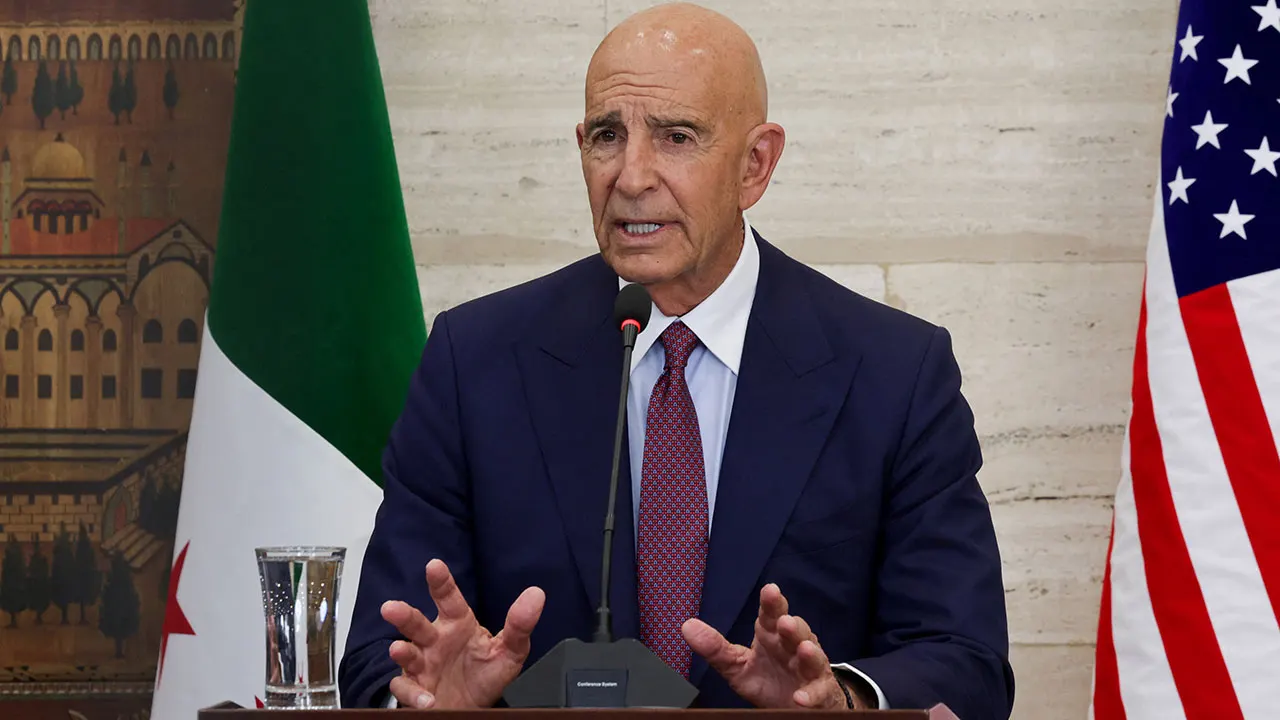
U.S. Ambassador Tom Barrack is pushing back against criticism over recent comments that appeared to equate Israel with Hezbollah, insisting his remarks reflect “realism” rather than a change in American policy toward the region.
In exclusive written responses to questions, Barrack defended his characterization of the Israel-Hezbollah ceasefire as a “time out” where “everybody has been equally untrustworthy,” stating this assessment represents the reality on the ground rather than criticism of any particular side.
“This is realism, not criticism of any side,” Barrack wrote. “The November 2024 ceasefire and the recent April 2026 ceasefire have repeatedly proven fragile because all parties — Israel, Hezbollah and their backers — have tested the limits in the past.”
Barrack emphasized that his statements in no way soften the U.S. position on Hezbollah. “This characterization in no way softens our ironclad position: Hezbollah is a designated terrorist organization responsible for the deaths of Americans and countless acts of destabilization,” he stated.
The ambassador’s original comments at the Antalya Diplomacy Forum drew sharp criticism, particularly his suggestion that the goal was “not killing Hezbollah.” In his response, Barrack stood by these remarks, arguing that purely military approaches to combating embedded militias have historically been ineffective.
“After decades in the region, you cannot eliminate an embedded militia solely by kinetic means when a sovereign state like Iran continues to arm and fund it. Pure ‘mowing the lawn’ has never worked,” Barrack explained. He emphasized that the administration’s objective remains degrading “Hezbollah’s terrorist infrastructure to the point where diplomacy and a sovereign Lebanese government can take over.”
Another contentious topic addressed was Barrack’s description of the dispute over Turkey’s participation in the F-35 program as “insane.” Turkey was removed from the program in 2019 after purchasing Russia’s S-400 air defense system, which U.S. officials warned could allow Moscow to gather intelligence on the stealth fighter.
Barrack suggested the issue could be resolved within months through “surgical diplomacy” from Secretary Rubio, based on the relationship between President Trump and Turkish President Recep Tayyip Erdoğan. He assured that any resolution would fully satisfy Section 1245 of the National Defense Authorization Act, which requires presidential certification that Turkey no longer possesses the S-400 system.
“There will be no shortcuts on American security standards,” Barrack insisted. “What I am signaling is that real breakthroughs are imminent: restoring Turkey’s role in the F-35 ecosystem, strengthening NATO interoperability, boosting U.S. industry and denying Russia leverage.”
The ambassador also defended his controversial statement that “powerful leadership regimes” are the only structures that have worked in the Middle East. Critics interpreted this as a potential shift away from American support for democratic governance and human rights.
“This is not a change in U.S. policy away from supporting democratic governance and human rights,” Barrack countered. “It is a realistic assessment of what produces stability so that human rights and prosperity can take root.”
He pointed to the failures of countries that attempted to adopt Western-style democracy after the Arab Spring, contrasting them with the relative stability and economic growth achieved by Gulf monarchies. Barrack cited Israel as “a notable outlier that has thrived under extremely strong, bold leadership” and Turkey as demonstrating how “strong, centralized leadership under President Recep Tayyip Erdoğan has delivered stability.”
Throughout his responses, Barrack framed his approach as aligned with President Trump’s “peace through strength” doctrine, describing it as dealing “with the world as it is, not as we wish it to be.”
The ambassador’s comments come at a delicate time for U.S. diplomacy in the Middle East, with ongoing efforts to maintain the fragile ceasefire between Israel and Hezbollah while navigating complex relationships with regional powers including Turkey, Lebanon, and Syria.
Fact Checker
Verify the accuracy of this article using The Disinformation Commission analysis and real-time sources.

9 Comments
It’s good to see the ambassador reinforcing the ‘peace through strength’ policy despite criticism. Maintaining a realistic assessment of the region’s complexities is important, even if it means not taking a one-sided stance.
I agree, a nuanced understanding of the situation is crucial. The ambassador seems to be trying to balance realism with the U.S. position on Hezbollah as a terrorist group.
It’s encouraging to see the ambassador taking a pragmatic approach, acknowledging the realities on the ground while maintaining the U.S. stance against Hezbollah. Navigating these types of regional conflicts requires a careful, multifaceted strategy.
The ambassador’s comments highlight the challenges in the Middle East. Characterizing the ceasefires as fragile and all parties testing limits suggests a complex, evolving dynamic that requires careful diplomacy.
Absolutely, the ambassador’s remarks demonstrate an awareness of the delicate balance at play. Maintaining firm principles while also acknowledging realities on the ground is a difficult but necessary approach.
Interesting perspective from the U.S. ambassador on the Israel-Hezbollah ceasefire. Acknowledging the fragility of the situation and the actions of all parties reflects a pragmatic approach, though the stance on Hezbollah being a terrorist organization remains firm.
The ambassador’s remarks highlight the need for a measured, realistic approach to diplomacy in the Middle East. Recognizing the fragility of ceasefires and the actions of all parties involved is a necessary part of promoting lasting peace.
While the ‘peace through strength’ policy may face criticism, the ambassador’s realistic assessment of the Israel-Hezbollah situation seems well-reasoned. Recognizing the fragility of ceasefires is important, even as the U.S. stance on Hezbollah remains unwavering.
The ambassador’s comments provide a nuanced perspective on a complex geopolitical issue. Balancing realism with clear policy positions is a delicate task, but one that appears to be handled thoughtfully in this case.