


Listen to the article
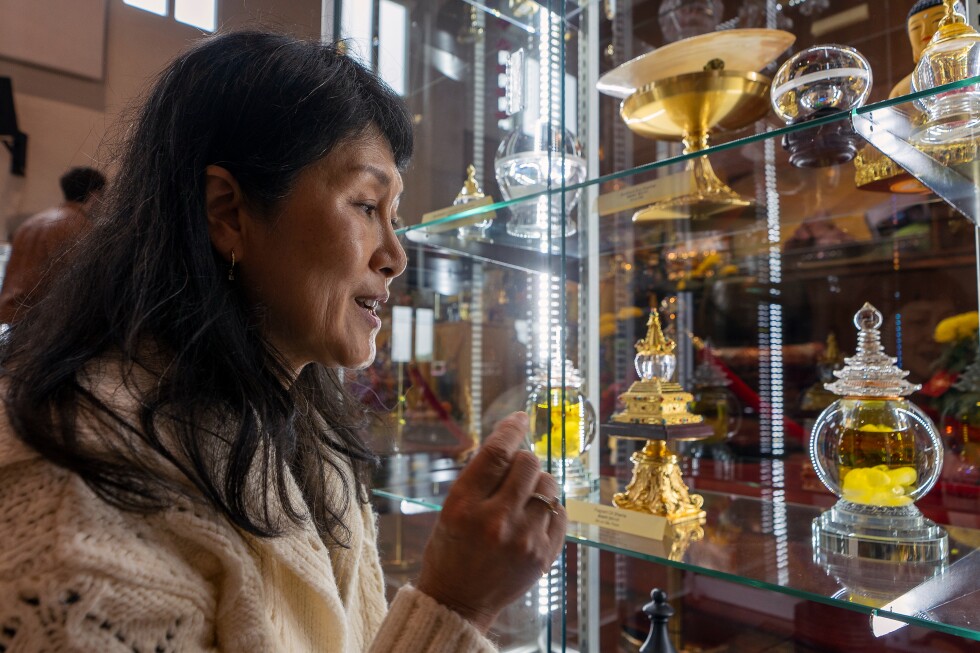
Katherine Nguyen stood with hands folded and head bowed at the altar of a Buddhist temple in Southern California, gazing reverently at tooth and finger bone relics believed to belong to Shakyamuni Buddha, who founded Buddhism approximately 2,500 years ago in India.
“To be able to see the Buddha, to get close to him and feel the energy — it’s very special for a Buddhist,” Nguyen explained.
Every Lunar New Year, the Wei Mountain Temple in Rosemead, California displays its extensive collection known as the “10,000 Buddha Relics.” While the name suggests a specific count, the actual number housed in glass display cases and miniature stupas is considerably larger, according to Master YongHua, the temple’s founder.
The collection features bones and teeth believed to have come from Buddha, his relatives, and disciples. It also includes numerous shariras — colorful pearl or crystal-like objects reportedly culled from the cremated ashes of Buddhist masters and the Buddha himself.
Unlike relics in Catholicism and Orthodox Christianity that serve as connections to saints or Christ, Buddhist relics are viewed as living sources of blessings with supernatural qualities. According to believers, these relics can appear spontaneously, grow, or even multiply, which explains their widespread presence across the world. In Buddhist tradition, relics of the Buddha or revered monks are typically enshrined in stupas — sacred, dome-shaped monuments used for meditation and pilgrimage.
At the Rosemead temple, the teeth and finger bone relics are noticeably larger than typical human remains. Master YongHua attributes this to their miraculous growth over time. He claims the tooth relic produces “baby shariras,” multicolored crystals that have multiplied to fill several containers in the exhibit.
Most Buddhist sects acknowledge the spiritual significance of relics, though some teachers emphasize Buddha’s teachings on mindfulness and kindness over physical objects. These sacred items can be found throughout countries with deep Buddhist traditions: India, Japan, Myanmar, Nepal, Singapore, Sri Lanka, Taiwan, and Thailand. In temple and monastic settings, their authenticity typically remains unquestioned, with religious leaders avoiding scientific testing for fear of undermining their spiritual significance.
The authenticity debate continues in the background. Reports of counterfeit tooth and bone relics, along with manufactured acrylic shariras, have flooded markets in Asia and online platforms, often accompanied by falsified authenticity certificates.
Singapore’s Buddha Tooth Relic Temple and Museum houses a controversial example — a tooth relic said to have been recovered from Buddha’s funeral pyre, displayed in a massive stupa made from 705 pounds of gold. The relic faced scrutiny in 2007 when dental experts noted that the 3-inch tooth’s characteristics were incompatible with human anatomy and likely belonged to a cow or buffalo. The temple’s abbot, Venerable Shi Fazhao, responded philosophically: “If you believe it’s real, it’s real.”
Master YongHua maintains that the main purpose of the relics donated to the Rosemead temple about 14 years ago is to inspire faith. He speaks of their supernatural properties with conviction: “I have seen them multiply with my own eyes. They move on their own, they levitate… I’ve seen people get cured of various ailments just by being in their presence.”
John Strong, professor emeritus of religion at Bates College, explains that the earliest accounts of Buddha’s funeral appear in Pali texts dating from about the 2nd century BCE. Later commentaries describe the relics from Buddha’s ashes as glittering jewels — some tiny as mustard seeds, others resembling gems or golden nuggets.
Geshe Tenzin Zopa, a Tibetan monk and educator, considers relics “the most precious, most sacred, most powerful holy objects in our understanding.” He claims to have witnessed his teacher, Geshe Lama Konchog, generate relics during cremation in 2001. Zopa describes pearl-like relics “popping out of the crematorium like popcorn,” and after leaving the structure sealed for three days, disciples discovered hundreds of relics along with the guru’s intact heart, tongue, and eyes.
“I’d never seen anything like that in my life. It was truly a miracle,” he said. These relics are now enshrined in a memorial stupa at Kopan monastery in Nepal.
Not all Buddhist teachers share the same perspective on relics. At the U.S. headquarters for the Fo Guang Shan Buddhist order in Southern California, Venerable Hui Ze explained their founder’s different approach.
“Our venerable master emphasized Humanistic Buddhism — how we can bring Buddha’s teachings into our daily lives with good thoughts, words and actions,” said Hui Ze. “He instructed us that relics should not distract us from the path to liberation.”
When their founder, Venerable Master Hsing Yun, died in February 2023 at age 95, he had instructed disciples not to search for relics in his ashes. Yet following his cremation, they discovered several colorful, pearly relics among his remains. Respecting his wishes, they’ve left these relics in the ashes, which will be spread across the order’s dozen centers on five continents. The ashes containing these relics will be enshrined at the Southern California headquarters during a ceremony on March 21.
Fact Checker
Verify the accuracy of this article using The Disinformation Commission analysis and real-time sources.

23 Comments
Production mix shifting toward World might help margins if metals stay firm.
If AISC keeps dropping, this becomes investable for me.
Good point. Watching costs and grades closely.
I like the balance sheet here—less leverage than peers.
Uranium names keep pushing higher—supply still tight into 2026.
Good point. Watching costs and grades closely.
Production mix shifting toward World might help margins if metals stay firm.
Good point. Watching costs and grades closely.
Good point. Watching costs and grades closely.
Interesting update on Teeth, finger bones and blessings: Buddhist relics inspire belief. Curious how the grades will trend next quarter.
Good point. Watching costs and grades closely.
Good point. Watching costs and grades closely.
Production mix shifting toward World might help margins if metals stay firm.
Good point. Watching costs and grades closely.
Exploration results look promising, but permitting will be the key risk.
Good point. Watching costs and grades closely.
Good point. Watching costs and grades closely.
Production mix shifting toward World might help margins if metals stay firm.
Good point. Watching costs and grades closely.
Good point. Watching costs and grades closely.
Silver leverage is strong here; beta cuts both ways though.
If AISC keeps dropping, this becomes investable for me.
Good point. Watching costs and grades closely.