


Listen to the article
Mali’s former defense minister General Sadio Camara, a key architect of the country’s security partnership with Russia, was laid to rest Thursday in a ceremony broadcast live on national television. The funeral followed two days of national mourning after Camara was killed in a car bombing outside his home during a coordinated militant attack last weekend, the largest Mali has seen in more than a decade.
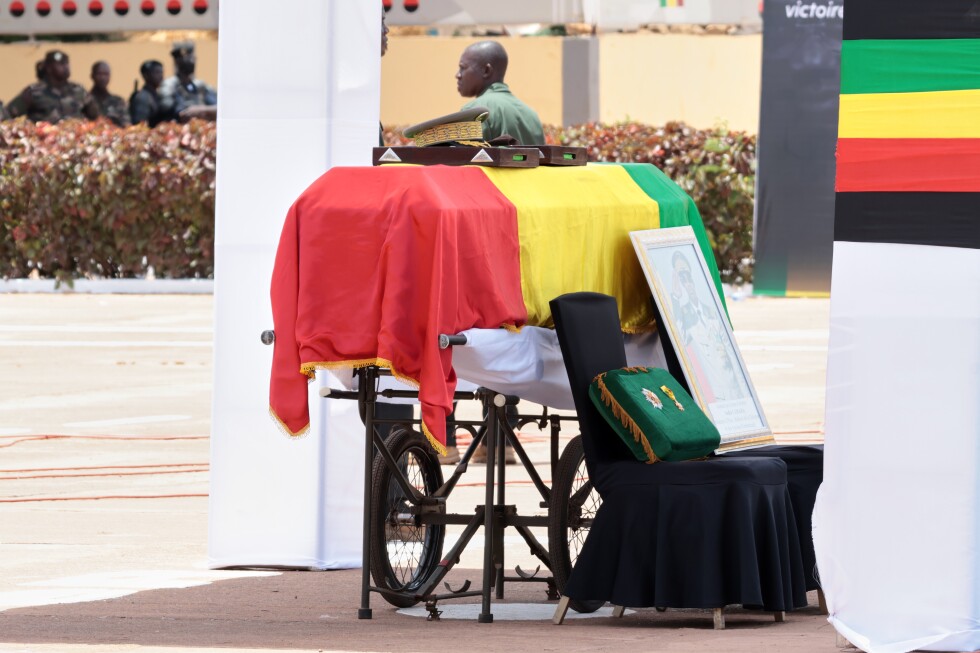
The funeral ceremony in Mali’s capital was attended by junta leader General Assimi Goita, with Camara’s coffin draped in the green, yellow and red of the Malian flag. Large portraits of the former defense minister adorned the ceremony hall, honoring a man who had become a central figure in Mali’s military government.
Born in 1979 in Kati, the same garrison town near Bamako where he was killed, Camara rose through military ranks before gaining national prominence. His early career included deployments to northern Mali during the rise of Al-Qaeda-linked insurgencies in the late 2000s. After graduating from a military academy, he pursued further military training abroad, including at a military academy in Russia, which would later prove significant in shaping Mali’s geopolitical realignment.
Camara first gained public recognition in August 2020 when he appeared on national television as one of five officers who had overthrown President Ibrahim Boubacar Keita. The coup leaders accused Keita of being a French puppet who had failed to contain militant violence across the country.
Following the coup, Camara emerged as the driving force behind Mali’s pivot away from traditional Western allies. He was appointed defense minister after the 2020 coup and maintained this position following a second coup in May 2021 that installed General Goita as the country’s leader.
“Camara was the architect of cooperation with Russia,” said Ulf Laessing, head of the Sahel program at the Germany-based Konrad Adenauer Foundation. Laessing noted that Camara proposed the deployment of Russian mercenaries in 2021 and advocated for the expulsion of the UN peacekeeping mission known as MINUSMA.
The defense minister made frequent trips to Moscow to strengthen bilateral security relations. His stewardship of Mali’s war effort against insurgents made him indispensable to the junta, despite the country’s deteriorating security situation under his watch.
Camara’s death comes at a critical moment for Mali’s military government. Just days after his killing, the recently created Africa Corps—a Russian military unit with approximately 2,000 troops in Mali—announced its withdrawal from the strategic northern city of Kidal. The retreat came only two days after separatist forces claimed to have captured the city, marking a significant military setback for the junta and its Russian allies.
Security analysts suggest that Camara’s death, combined with mounting frustration over the ineffectiveness of Russian mercenaries in containing insurgencies, could lead Mali’s leadership to reconsider its security partnerships.
“This major loss and the recent military failures may create divisions within the junta and potentially lead to a reassessment of Mali’s relationship with Moscow,” said Rida Lyammouri, senior fellow at the Policy Center for the New South, a Morocco-based think tank.
Despite these setbacks, General Goita met with the Russian ambassador to Mali on Tuesday, indicating the partnership remains active. However, Laessing noted that Goita “seems open to collaboration with some Western countries, such as the United States,” suggesting a possible shift in Mali’s diplomatic and security strategy.
The death of General Camara removes a central figure who championed Russia’s involvement in Mali at a time when that partnership faces increased scrutiny amid military failures. As Mali continues to battle jihadist insurgencies and separatist movements, the junta faces difficult questions about its security strategy and international alliances in the aftermath of this high-profile assassination.
Fact Checker
Verify the accuracy of this article using The Disinformation Commission analysis and real-time sources.

27 Comments
Exploration results look promising, but permitting will be the key risk.
Good point. Watching costs and grades closely.
Uranium names keep pushing higher—supply still tight into 2026.
Good point. Watching costs and grades closely.
I like the balance sheet here—less leverage than peers.
Silver leverage is strong here; beta cuts both ways though.
The cost guidance is better than expected. If they deliver, the stock could rerate.
Good point. Watching costs and grades closely.
Uranium names keep pushing higher—supply still tight into 2026.
Good point. Watching costs and grades closely.
Production mix shifting toward World might help margins if metals stay firm.
Uranium names keep pushing higher—supply still tight into 2026.
Good point. Watching costs and grades closely.
Good point. Watching costs and grades closely.
Nice to see insider buying—usually a good signal in this space.
Good point. Watching costs and grades closely.
Uranium names keep pushing higher—supply still tight into 2026.
Good point. Watching costs and grades closely.
Good point. Watching costs and grades closely.
If AISC keeps dropping, this becomes investable for me.
Good point. Watching costs and grades closely.
Silver leverage is strong here; beta cuts both ways though.
Good point. Watching costs and grades closely.
Good point. Watching costs and grades closely.
Silver leverage is strong here; beta cuts both ways though.
Good point. Watching costs and grades closely.
Production mix shifting toward World might help margins if metals stay firm.