


Listen to the article
Egypt Unveils Restored Colossi of Memnon After Two-Decade Renovation
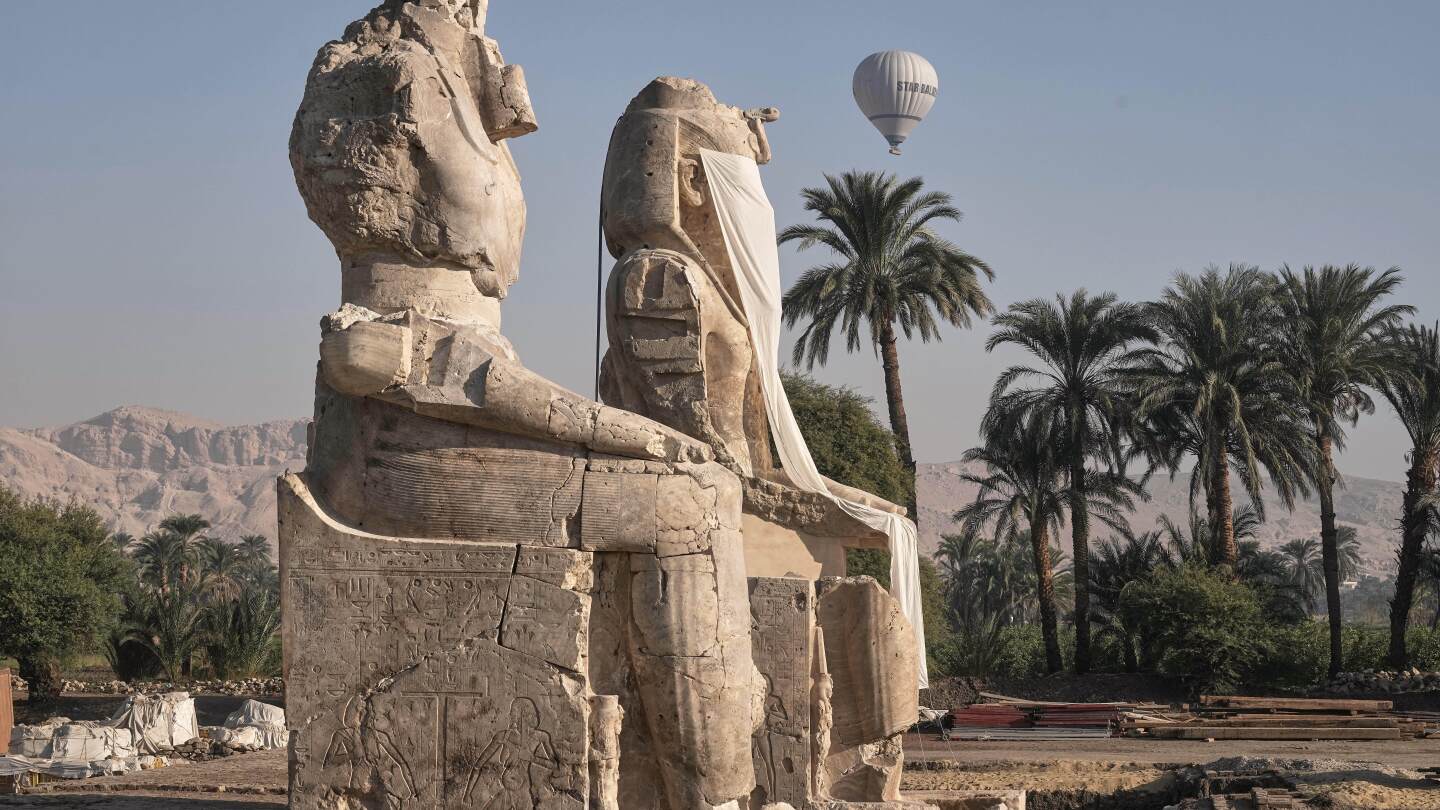
Egyptian authorities have revealed the results of a painstaking two-decade restoration of the Colossi of Memnon, two massive alabaster statues of Pharaoh Amenhotep III in the ancient city of Luxor. The unveiling ceremony marks a significant achievement in archaeological preservation and adds another jewel to Egypt’s crown of restored antiquities.
“Today we are celebrating the finishing and the erecting of these two colossal statues,” said Mohamed Ismail, secretary-general of the Supreme Council of Antiquities, highlighting the importance of the project for Luxor’s cultural landscape.
The meticulously reassembled statues represent Amenhotep III, who ruled Egypt approximately 3,400 years ago during the prosperous New Kingdom period. Standing 14.5 meters (48 feet) and 13.6 meters (45 feet) tall respectively, the colossi guard the entrance to the king’s funerary temple on the western bank of the Nile River.
Ismail explained the statues are an attempt to “revive how this funerary temple of king Amenhotep III looked like a long time ago.” The temple complex itself is believed to be one of Egypt’s largest and richest, comparable to the renowned Temple of Karnak across the Nile.
The statues were originally toppled by a powerful earthquake around 1200 BC, which also destroyed Amenhotep III’s funerary temple. Over centuries, the fragments were scattered, with some blocks even repurposed in other structures like the Karnak temple.
The restoration effort began in the late 1990s when an Egyptian-German archaeological mission, led by German Egyptologist Hourig Sourouzian, took on the monumental task. “This project has in mind to save the last remains of a once-prestigious temple,” Sourouzian stated.
The colossi depict Amenhotep III seated with hands resting on his thighs, facing eastward toward the Nile and the rising sun. The pharaoh wears the traditional nemes headdress topped with double crowns and the pleated royal kilt, symbols of divine rulership. Small statues at his feet represent his wife, Queen Tiye.
Unlike many Egyptian monumental sculptures, these statues were partially constructed from separate carved pieces attached to a monolithic alabaster core. The alabaster itself was sourced from the quarries of Hatnub in Middle Egypt, with the statues’ pedestals bearing inscriptions identifying both the temple and the quarry.
The unveiling comes just six weeks after Egypt inaugurated the long-awaited Grand Egyptian Museum near the Giza Pyramids, underscoring the government’s strategic focus on archaeological projects to revitalize tourism and stimulate economic growth. Egypt’s tourism sector, which relies heavily on its ancient heritage, has struggled through political upheaval following the 2011 uprising and more recently, the impacts of the COVID-19 pandemic and the Russia-Ukraine conflict.
“This site is going to be a point of interest for years to come,” said Tourism and Antiquities Minister Sherif Fathy at the ceremony. “There are always new things happening in Luxor.”
The tourism industry has shown signs of recovery, with approximately 15.7 million tourists visiting Egypt in 2024, contributing about 8% to the country’s GDP. Officials project this figure will rise to around 18 million visitors this year, with ambitious plans to reach 30 million annual visitors by 2032.
Amenhotep III, who ruled between 1390–1353 BC, presided over one of Egypt’s most peaceful and prosperous periods. His reign was marked by significant construction projects, including his mortuary temple in Luxor and the Soleb temple in Nubia, showcasing the artistic and architectural achievements of ancient Egyptian civilization at its zenith.
The restoration of the Colossi of Memnon represents not just archaeological preservation but also Egypt’s continuing efforts to showcase its rich cultural heritage while strengthening its tourism economy in challenging times.
Fact Checker
Verify the accuracy of this article using The Disinformation Commission analysis and real-time sources.

20 Comments
It’s wonderful to see these iconic Luxor monuments returned to their former prominence. The Colossi of Memnon are such an important part of Egypt’s rich cultural legacy.
I couldn’t agree more. This restoration project is a significant achievement that will help celebrate and protect Egypt’s ancient wonders for generations to come.
It’s wonderful to see these iconic Luxor monuments returned to their former prominence. The Colossi of Memnon are such an important part of Egypt’s rich cultural legacy.
I couldn’t agree more. This restoration project is a significant achievement that will help celebrate and protect Egypt’s ancient wonders for generations to come.
Fascinating to see these ancient colossi restored to their former glory. The Egyptians have truly mastered the art of preserving their cultural heritage.
I agree, it’s remarkable how they’ve managed to meticulously reassemble these massive statues after centuries of weathering and damage.
Fascinating to see these ancient colossi restored to their former glory. The Egyptians have truly mastered the art of preserving their cultural heritage.
I agree, it’s remarkable how they’ve managed to meticulously reassemble these massive statues after centuries of weathering and damage.
The scale and craftsmanship of these pharaonic statues is simply awe-inspiring. I can only imagine the immense effort and skill required to undertake such a meticulous restoration project.
Absolutely. It’s a testament to the dedication and expertise of Egypt’s archaeologists and preservationists.
The Colossi of Memnon are such an iconic part of Luxor’s landscape. It’s wonderful to see them restored to their former glory after two decades of meticulous work.
Absolutely. This project is a testament to Egypt’s commitment to preserving its rich cultural heritage for the world to appreciate.
What an incredible feat of archaeological preservation. Bringing these colossal statues back to their former grandeur must have been an immense challenge, but the results are truly breathtaking.
I’m curious to learn more about the specific techniques and technologies used in this restoration process. It would be fascinating to understand the painstaking work involved.
The scale and craftsmanship of these pharaonic statues is truly awe-inspiring. It’s remarkable that the Egyptians have been able to preserve and restore such monumental works of art.
Absolutely. This project is a testament to the depth of Egypt’s cultural heritage and the expertise of its archaeological community.
Impressive that the Egyptian authorities have been able to revive the funerary temple of Amenhotep III through the restoration of these colossal statues. It must have been an immense challenge.
I’m curious to learn more about the historical and cultural significance of this temple complex. It sounds like an important part of Egypt’s ancient legacy.
The scale and craftsmanship of these pharaonic statues is simply awe-inspiring. I can only imagine the immense effort and skill required to undertake such a meticulous restoration project.
Absolutely. It’s a testament to the dedication and expertise of Egypt’s archaeologists and preservationists.