


Listen to the article
Chile Heads to Tense Presidential Runoff Between Communist and Conservative Candidates
Chile’s political landscape has sharply polarized following Sunday’s presidential election, which has set up a high-stakes runoff between communist former labor minister Jeannette Jara and ultraconservative veteran politician José Antonio Kast.
With nearly 100% of votes counted, Jara secured 26.8% of valid ballots, falling well short of the 50% threshold needed for a first-round victory. Kast, a hard-right former lawmaker and devout Catholic, captured almost 24% of the vote, demonstrating strong appeal for his law-and-order platform amid growing security concerns in what has traditionally been one of Latin America’s safest nations.
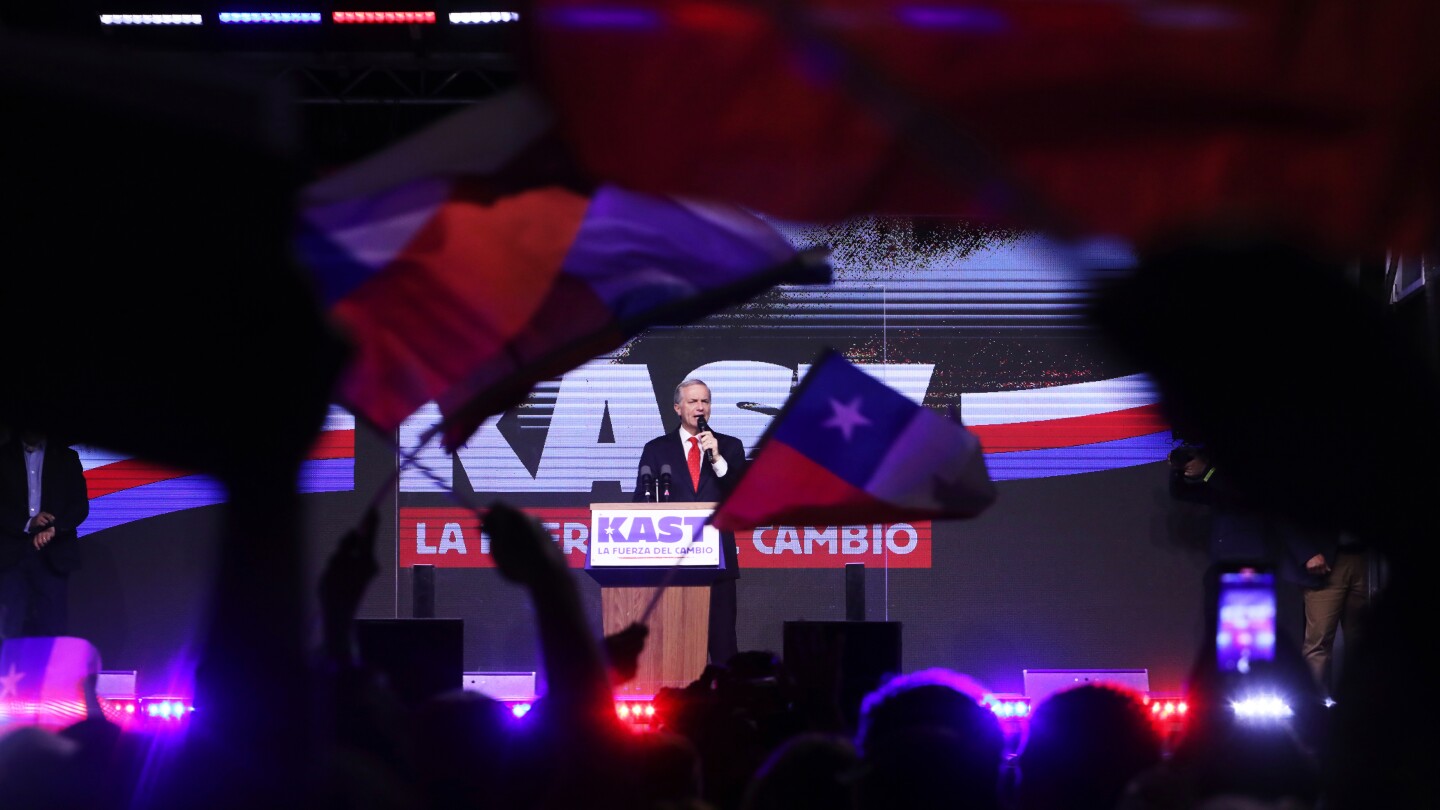
The December 14 runoff will pit two starkly different visions against each other in what Kast described as “the most important election of our generation.” Speaking to jubilant supporters, he framed the upcoming vote as “a true referendum between two models of society — the current one that has led Chile to destruction, stagnation, violence and hatred, and our model, which promotes freedom, hope and progress.”
Jara, meanwhile, delivered a more optimistic message, urging Chileans: “This is a great country. Don’t let fear freeze your hearts.”
Security concerns have dominated this election cycle, as Chile confronts a surge in organized crime and growing anti-migrant sentiment. Kast, who admires former U.S. President Donald Trump and Brazil’s ex-President Jair Bolsonaro, has promised drastic measures, including deporting tens of thousands of undocumented migrants and constructing extensive ditches and walls along Chile’s northern border with Bolivia to prevent crossings, particularly from crisis-stricken Venezuela.
“We want change, and that change today is about security,” said José Hernández, a 60-year-old agricultural business owner who voted for Kast.
Although Jara led the first round, Kast stands to benefit from votes that went to three eliminated right-wing challengers who also campaigned aggressively on immigration control. Franco Parisi, a right-leaning populist economist with a substantial social media following, took third place with 20% of votes, while Johannes Kaiser, a radical libertarian and former YouTube provocateur, secured 13.9%.
Chile’s outgoing left-wing President Gabriel Boric, who is constitutionally barred from seeking consecutive terms, will complete his presidency in March. His administration has faced criticism for failing to fulfill sweeping promises of social change made following the country’s 2019 mass protests over inequality.
Economic discontent continues to simmer in Chile, with sluggish growth and unemployment above 8.5%. The country also retains its dictatorship-era constitution after voters rejected a proposed progressive charter in 2022.
As both candidates pivot toward the center to broaden their appeal, Jara must overcome voter concerns about her lifelong membership in Chile’s Communist Party, which has supported authoritarian regimes in Cuba and Venezuela. Early in her campaign, she faced criticism for describing Cuba as a democracy.
“We liked her at first, but that moment was when our opinion shifted, it seemed like a really closed-minded view,” said Camila Roure, 29, outside a polling station.
Kast has attempted to deflect attention from his traditional family values platform and his German-born father’s Nazi past, factors that mobilized progressive voters against him during his previous failed presidential bids.
“A Kast government wouldn’t just be a political shift, it would be a huge step backward,” said Macarena Breke, 27, an English teacher who supported Jara.
The two candidates offer starkly different economic visions. As labor minister under Boric, Jara implemented several significant welfare measures, including raising the minimum wage, boosting pensions, and reducing the workweek from 45 to 40 hours. Her platform promises a “living” monthly income of around $800 through state subsidies and minimum wage increases, along with investments in infrastructure and housing.
Kast, by contrast, follows the playbook of Argentina’s President Javier Milei, pledging to shrink government by eliminating ministries, slashing corporate taxes, and cutting regulations. His ambitious promise to cut $6 billion in spending over 18 months resonates with voters concerned about Chile’s fiscal deficits.
“The money disappears, the left spends it on I don’t know what, human rights, and I can barely afford rent,” said Jorge Ruiz, 48, a cab driver who voted for Kast.
Political analysts note that both candidates will likely moderate their positions before the runoff. “We will definitely see Jara and Kast after today being even more moderate, talking about things that voters care about and trying to compete for the center,” said Rodolfo Disi, a political scientist at Chile’s Adolfo Ibáñez University.
The election comes at a critical moment for Chile, as it navigates the legacy of General Augusto Pinochet’s dictatorship and its extreme free-market economic model. Kast, whose brother served as a minister under Pinochet, has defended aspects of the dictator’s legacy.
This historical context continues to influence Chile’s politics, particularly regarding security concerns. As political scientist Lucía Dammert, Boric’s former chief of staff, observed: “From the moment that democracy arrived, Chile became fearful of criminal activity and distrustful of institutions, of foreigners. There was fertile ground for fear to grow.”
Fact Checker
Verify the accuracy of this article using The Disinformation Commission analysis and real-time sources.

8 Comments
The polarization evident in this election is a worrying trend. I hope the candidates and their supporters can engage in a substantive and civil debate, focusing on the key issues facing Chile rather than resorting to personal attacks or extreme rhetoric.
The fact that a communist candidate has made it to the runoff in Chile is quite remarkable. It reflects the growing appetite for radical change among some voters. However, the conservative candidate’s emphasis on law and order could also resonate with those concerned about security.
While the election results so far are intriguing, it’s important to remember that the situation in Chile is complex, with a range of social, economic, and political factors at play. The runoff campaign will be critical in determining the country’s future direction.
Chile has traditionally been seen as one of the more stable and prosperous countries in Latin America. This election shows how quickly the political landscape can shift, with populist and ideological forces gaining ground. The outcome could have significant implications for the country’s future direction.
The characterization of the election as a ‘referendum’ between two very different visions for Chilean society is telling. Voters will have a clear choice to make in the runoff. I’m curious to see how the candidates position themselves and try to win over undecided voters.
The contrast between the communist and conservative candidates is certainly striking. It will be fascinating to see how their respective visions for Chile’s future resonate with voters in the runoff.
This election in Chile is certainly a pivotal moment. The stark contrast between the two candidates highlights the deep divisions in the country. It will be interesting to see how the runoff campaign unfolds and what issues take center stage.
This runoff election will be a true test of Chile’s political institutions and its commitment to democratic principles. Whichever candidate prevails, they will face the challenge of uniting a deeply divided electorate.