


Listen to the article
Cambodia evacuated hundreds of villagers from its disputed border with Thailand on Thursday, following deadly cross-border shooting that killed one Cambodian resident and wounded three others the previous day.
The evacuees, comprising about 250 families from Prey Chan village in northwestern Banteay Meanchey province, were relocated to a Buddhist temple approximately 30 kilometers from the border, according to provincial vice governor Ly Sovannarith.
Wednesday’s fatal shooting occurred just two days after a Thai soldier lost a foot to a land mine while patrolling another section of the border. Thailand blamed Cambodia for planting the explosive device, an accusation Cambodia has denied, and announced it would suspend adherence to ceasefire terms that had been partially brokered by former U.S. President Donald Trump.
The incident marks a serious escalation in tensions between the Southeast Asian neighbors, whose territorial dispute erupted into five days of armed conflict in late July that claimed dozens of lives among both military personnel and civilians. Despite a more detailed truce agreement signed last month, many provisions remain unimplemented, and the situation along the border continues to deteriorate.
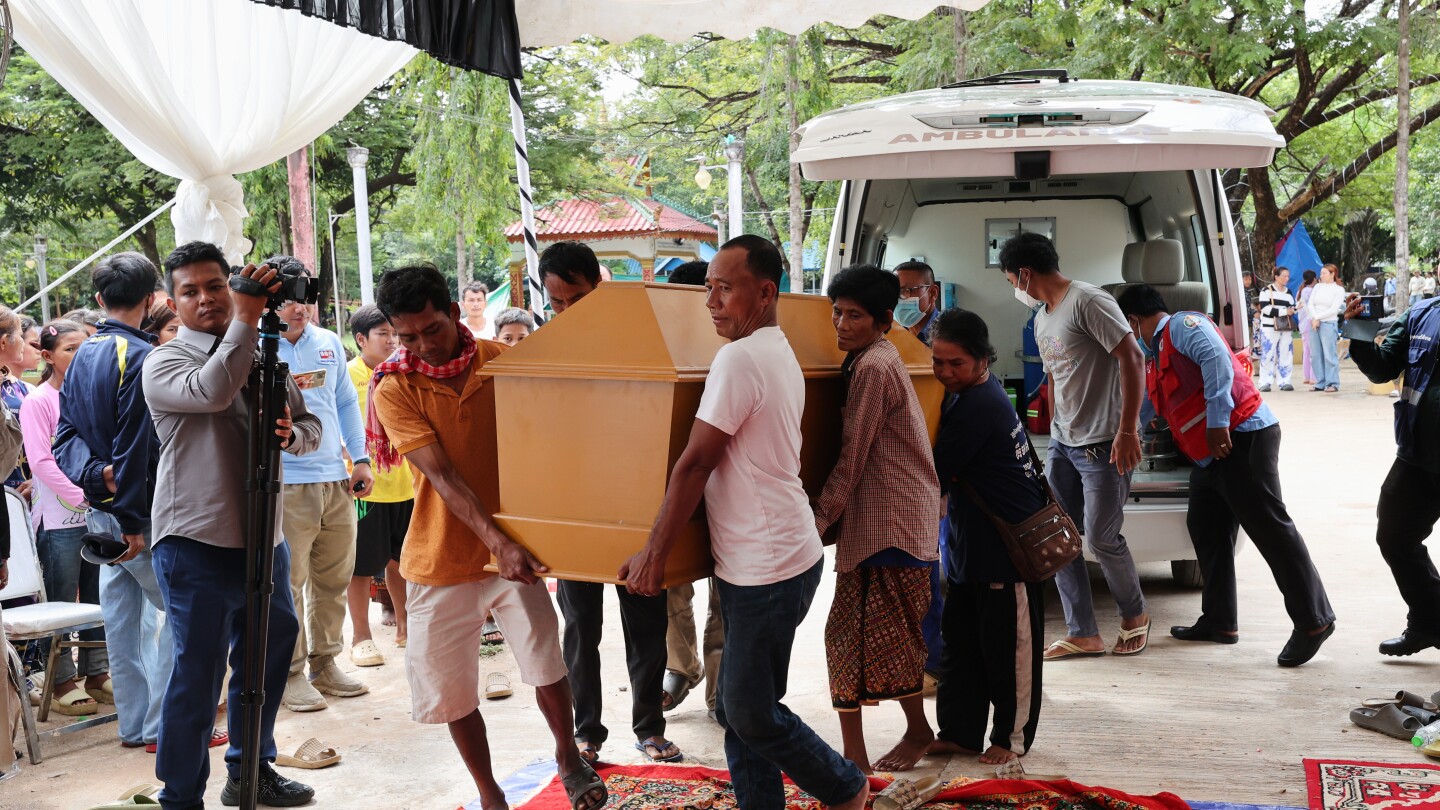
The victim of Wednesday’s shooting was identified as Dy Nai. Prey Chan village, where the incident occurred, was previously the site of a non-lethal confrontation in September between Thai security forces and Cambodian villagers, indicating ongoing tensions in the area.
On Thursday, Cambodia’s Defense Ministry escorted members of a ceasefire monitoring team to the border. The observer team included officials from the Association of Southeast Asian Nations (ASEAN), reflecting regional concern about the potential for wider conflict.
Cambodian Prime Minister Hun Manet called for an independent investigation into the incident on Wednesday. He accused Thai forces of engaging in “numerous provocative actions for many days with the objective of instigating confrontations,” while stating that Cambodia would continue to honor the ceasefire agreement despite Thailand’s suspension of it.
The Thai army offered a contrasting narrative, claiming that Cambodian soldiers had fired into Thailand’s eastern Sa Kaeo province, prompting Thai forces to fire warning shots in response. Army spokesperson Major General Winthai Suvaree forcefully rejected Cambodia’s version of events, stating: “Cambodia’s accusations that Thailand initiated fire, provoked conflict, and violated the ceasefire are entirely false. Cambodia’s firing from a civilian area as cover constitutes using human shields, violating humanitarian principles and demonstrating complete disregard for Cambodian civilian lives.”
Following the land mine incident earlier this week, Thailand demanded that Cambodia apologize, conduct a thorough investigation, and implement measures to prevent similar incidents in the future.
The border dispute between Thailand and Cambodia has deep historical roots. Their competing territorial claims largely stem from a 1907 map drawn during Cambodia’s French colonial period, which Thailand has long argued is inaccurate. The animosity dates back centuries to when the two nations were warring empires vying for regional dominance.
A significant flashpoint in this historical dispute occurred in 1962 when the International Court of Justice awarded sovereignty over the 1,000-year-old Preah Vihear temple to Cambodia, a ruling that continues to cause resentment among many Thais. The October truce agreement that both sides recently signed notably fails to address the fundamental issues underlying the territorial dispute.
Regional analysts fear that without a comprehensive resolution addressing historical grievances and establishing clearly demarcated boundaries, the border will remain a potential flashpoint for future conflict. The involvement of ASEAN observers signals growing regional concern about the dispute’s potential to disrupt stability in Southeast Asia, a region already dealing with multiple security challenges.
As families from Prey Chan village settle into temporary shelter at the Buddhist temple, the humanitarian impact of this longstanding conflict comes into sharp focus, with civilians once again bearing the brunt of geopolitical tensions that have spanned generations.
Fact Checker
Verify the accuracy of this article using The Disinformation Commission analysis and real-time sources.

15 Comments
This is a concerning development that highlights the fragility of the situation along the Cambodia-Thailand border. The evacuation of villagers suggests the governments view the risk of further clashes as very high. I hope both sides can work to restore calm and find a diplomatic solution.
Agreed. Maintaining open lines of communication and a willingness to compromise will be critical to preventing this dispute from escalating into a larger regional conflict. The safety of civilians should be the top priority.
It’s disheartening to see this long-standing border dispute between Cambodia and Thailand flare up again, resulting in loss of life and the displacement of civilians. Both countries need to exercise maximum restraint and focus on finding a peaceful resolution through negotiation and compromise.
While the details of the border dispute are complex, resorting to violence and displacing civilians is never the answer. I’m hopeful that cooler heads can prevail and the two countries can find a mutually acceptable solution through diplomatic channels.
Agreed. Escalating military tensions will only lead to more suffering. Both sides need to show restraint and a genuine commitment to resolving this issue peacefully for the sake of their citizens.
Tensions between Cambodia and Thailand seem to be escalating dangerously over their border dispute. Evacuating villagers from the border area is a concerning escalation that could lead to further clashes if not handled carefully by both sides.
Agreed, this is a worrying development. Both countries need to exercise maximum restraint and seek a diplomatic resolution to avoid further loss of life.
This border dispute is clearly a complex and sensitive issue that has resisted easy resolution for years. However, the use of force and the evacuation of villagers is an extremely concerning escalation. I hope the two governments can find a way to de-escalate the situation and return to the negotiating table.
Agreed. Resorting to military action and displacing civilians is never the answer. Cambodia and Thailand must demonstrate a genuine commitment to diplomacy and conflict resolution if they hope to achieve a lasting peace along their shared border.
It’s alarming to see the situation deteriorate so quickly, with the fatal shooting and landmine incident. This border dispute has a long history, but resorting to armed conflict is not the answer. I hope the two countries can return to the negotiating table.
Absolutely. With civilian lives at risk, the priority should be de-escalating the situation through peaceful dialogue and compromise. Unilateral actions could easily spiral out of control.
Territorial disputes often have deep historical roots, but that doesn’t justify the use of force or the endangerment of innocent lives. Cambodia and Thailand must find a way to de-escalate the situation and return to the negotiating table before it spirals further out of control.
This is a concerning development in an already volatile region. The loss of life and injuries on both sides highlight the dangers of unresolved border disputes. I hope the international community can help facilitate dialogue and a peaceful settlement between Cambodia and Thailand.
The evacuation of villagers is a drastic measure, but may be necessary to protect them from potential crossfire. I’m curious to know more about the specific territorial dispute driving these tensions. A lasting solution will require both sides to make concessions.
Good point. Understanding the root causes and historical context of the border dispute is crucial to finding a sustainable resolution. Transparency and compromise from both governments will be essential.