


Listen to the article
Argentine President Javier Milei has declassified more than 1,850 documents detailing the country’s efforts to track and verify thousands of Nazi war criminals who fled to South America after World War II. The release, which comprises thousands of pages, was prompted by a request from U.S. Senate Judiciary Committee Chairman Chuck Grassley, who was credited by the Simon Wiesenthal Center for his efforts in securing the documents.
The materials, now available on Argentina’s General Archive website, primarily cover investigations conducted between the late 1950s and 1980s, along with declassified presidential decrees spanning from 1957 to 2005. The documents are organized into seven large files, each focusing on major Nazi fugitives who sought refuge in Argentina.
Adolf Eichmann, the architect of the Holocaust’s “Final Solution,” features prominently in the collection. Living under the alias Ricardo Klement near Buenos Aires, Eichmann was captured by Israeli Mossad agents in 1960 and taken to Jerusalem for trial. The documents provide conflicting evidence suggesting Juan Perón’s populist government may have knowingly protected Eichmann during his time in Argentina.
The files also contain extensive information about Josef Mengele, the notorious “Angel of Death” from the Auschwitz-Birkenau concentration camps. Mengele lived in Argentina before escaping to Paraguay and eventually Brazil, where he died in 1979.
Other prominent Nazi figures documented include Martin Bormann, Hitler’s lieutenant; Croatian war criminal Ante Pavelic; Rudolf Hoess, the former Auschwitz commandant who defected; and Klaus Barbie, known as the “Butcher of Lyon.”
“There are numerous questions that these documents can bring light to why a sophisticated society, far from the plagues of European antisemitism such as Argentina’s, agreed to hide Nazi criminals and their secrets for so long,” said Harley Lippman, a member of the United States Commission for the Preservation of America’s Heritage Abroad and a board member of the European Jewish Association.
“What happened to the U-boats loaded with Nazi gold brought to the country and given to the authorities?” Lippman questioned, highlighting the historical significance of these revelations.
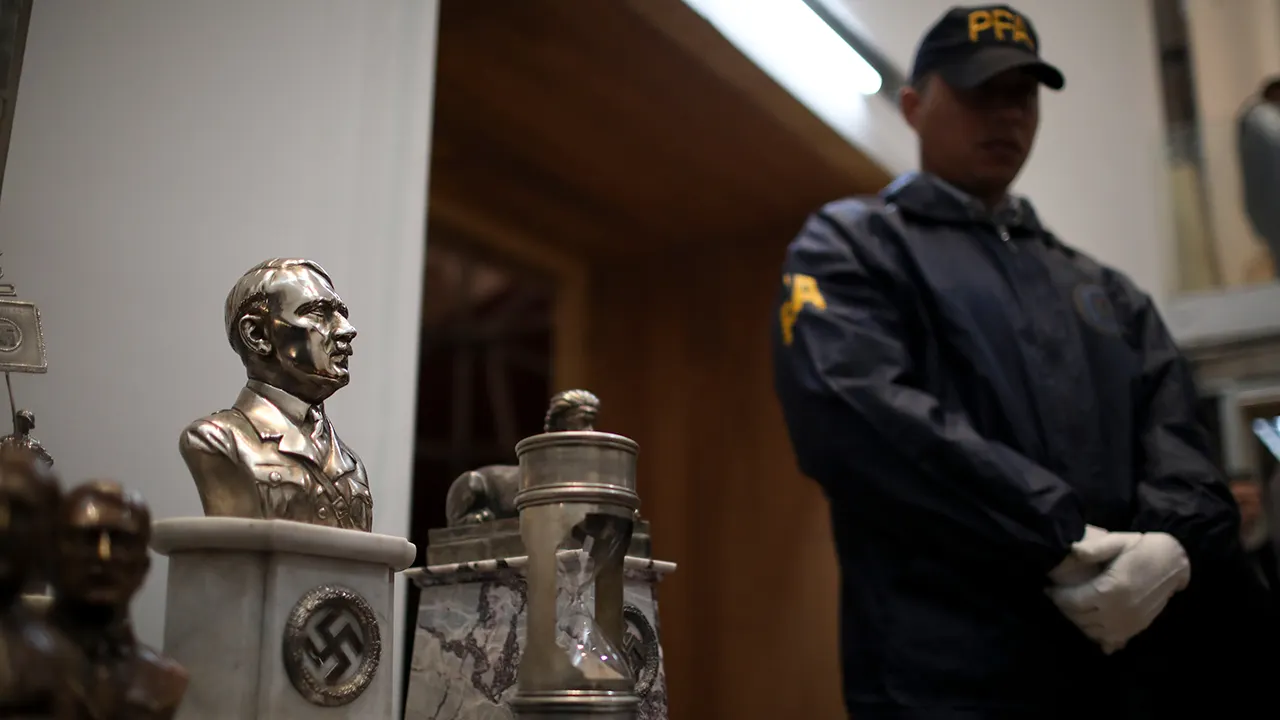
In a separate but related discovery, 83 boxes of Nazi documents were found in May during renovations at Argentina’s Supreme Court. These materials, virtually untouched for 84 years, had been intercepted by Argentine customs in 1941. They were originally sent from the German Third Reich Embassy in Tokyo to Buenos Aires aboard a Japanese steamer.
The shipment, seized under orders from Argentina’s foreign minister to maintain the country’s wartime neutrality, contained propaganda materials aimed at spreading Hitler’s ideology throughout South America. Argentina’s Supreme Court ordered an exhaustive survey of these documents, noting their “historical relevance” and potential to “clarify events related to the Holocaust.”
Guillermo Francos, Argentina’s chief of the Cabinet of Ministers, stated that President Milei ordered the declassification because “there is no reason to continue withholding that information, and it is no longer in the interest of the Republic of Argentina to keep such secrets.”
The documents could also shed light on the financial aspects of the Holocaust, particularly regarding Swiss and Argentine banks. “The Holocaust was the greatest theft in history,” Lippman noted. “Many Swiss banks would not release funds to sometimes a sole survivor from a family who perished in the Holocaust without a death certificate for their loved ones. But Auschwitz did not issue death certificates — they only issued ashes.”
Lippman emphasized the educational importance of these documents in an era when knowledge about the Holocaust is declining among younger generations. “The fact that many people under 30 do not know or understand the meaning of the Holocaust is part of the reason why antisemitism is on the rise again,” he said.
The Argentine government has pledged to make all documents public once they have been properly digitized, marking a significant step toward transparency regarding the country’s historical relationship with Nazi fugitives who escaped Europe after World War II.
Fact Checker
Verify the accuracy of this article using The Disinformation Commission analysis and real-time sources.

10 Comments
I’m glad to see that the US Senate is taking an interest in these Nazi fugitive files from Argentina. Collaboration between countries is key to piecing together this complex historical puzzle.
Agreed. International cooperation is vital when it comes to uncovering the full truth about postwar Nazi activity and the evasion of justice.
Kudos to the Argentine government for taking this step. Declassifying sensitive files like these, no matter how uncomfortable the revelations may be, is crucial for historical accountability.
Fascinating to see Argentina declassifying these WWII files on Nazi fugitives. Wonder what other secrets they may uncover about the country’s past dealings with the Third Reich.
It’s important for countries to confront their history, even the uncomfortable parts. Shedding light on these kinds of cases can help provide closure and accountability.
As someone interested in the history of Nazi fugitives and the postwar efforts to track them down, I’m eager to comb through these newly declassified documents. Hopefully they provide new insights.
Absolutely. The more we can uncover about these historical events, the better we can understand the complex geopolitical dynamics at play in the aftermath of WWII.
Release of these classified files is a positive step towards transparency, but it also raises questions about what else may be hidden in Argentina’s archives related to Nazi activity in the region.
The documents on Eichmann’s time in Argentina under an alias are particularly intriguing. Curious to see if they shed any new light on the extent of government protection he may have received.
Agreed. The idea that a populist government like Perón’s may have knowingly harbored a notorious Nazi war criminal is certainly concerning and warrants further investigation.