


Listen to the article
Richard Gamble broke ground last week on what will become one of England’s largest Christian monuments, marking a milestone in his 21-year spiritual journey. The Eternal Wall of Answered Prayer, a 168-foot-tall architectural landmark, is set to rise alongside the M6 motorway outside Birmingham, visible to thousands of daily travelers from six miles away.
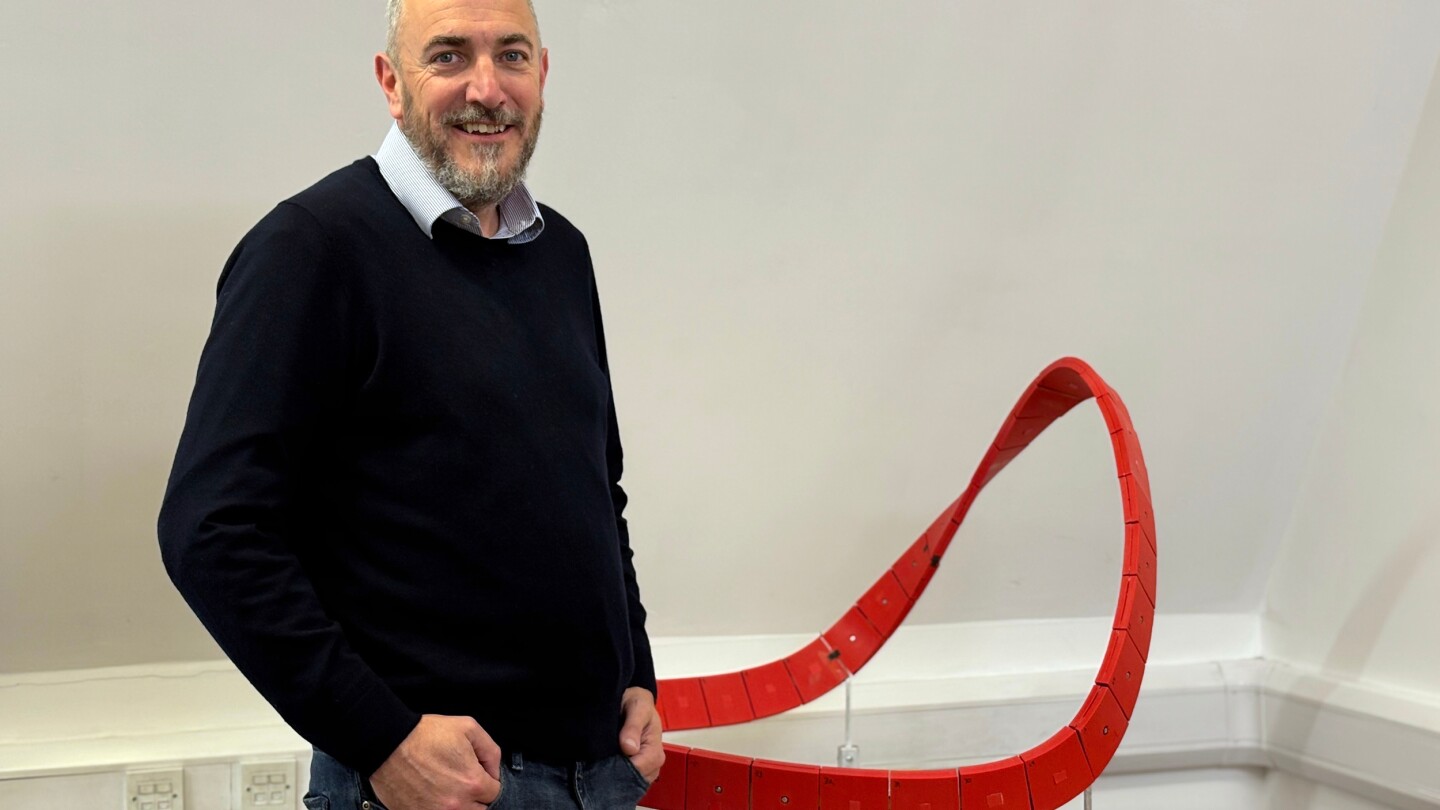
The £45 million ($59 million) monument will take the form of a massive white Möbius strip stretching nearly the length of a football field. Unlike traditional Christian monuments, it will bear no crosses, fish symbols, or depictions of Jesus. Instead, the structure will feature one million small rectangular bricks, each digitally linked to a personal story of answered prayer that visitors can access via a mobile app.
“We live in a country where Christianity has been pretty much put on mute,” said Gamble, 56, in an interview at the project’s offices near the construction site. “To build something that big and unashamedly Christian, I don’t think anybody had the faith that it was going to happen.”
For Gamble, a former software developer and church planter who once served as chaplain to the Leicester City Football Club, the groundbreaking represents the culmination of decades of prayer and persistence. His Christian journey began at age 20 after visiting a charismatic church, an experience that prompted him to quit drinking and gambling and enroll in Bible college.
Though he eventually concluded pastoral ministry wasn’t his calling, Gamble’s faith remained unwavering. In a nation where only 21% of people report praying daily according to Pew Research Center data, he sought a way to demonstrate what he believes is God’s active role in people’s lives.
The path to securing land for the monument came through Andrew Edmiston, son of British billionaire businessman Lord Robert Edmiston, who established the charity Christian Vision. The Edmiston family company has contributed over £30 million to the project, with approximately 22,000 individuals providing additional financial support.
The monument’s distinctive design emerged from a 2016 global competition organized by the Royal Institute of British Architects, which attracted 133 entries from 28 countries. The winning concept—a Möbius strip—was created by a UK architectural firm and received approval from the North Warwickshire Borough Council in 2020.
Mathew Guest, professor of sociology of religion at Durham University who researches UK evangelicals, suggests the design’s non-denominational nature may have helped its approval. “Having religious symbolism in the UK beyond the traditional architecture of churches can be very controversial,” Guest noted. “In a polarized world where there’s a lot of religious tensions between religious groups, it can be perceived as a potential provocation.”
The monument emerges against a backdrop of declining Christian identification in the United Kingdom. Recent Pew research found that between 2010 and 2020, the Christian share of the UK population fell to 49%, while the religiously unaffiliated increased to 40%. Muslims constitute 6.5% of the population, approximately 3.9 million people, according to the 2021 census from the Office of National Statistics.
Among Christian denominations, independent evangelical churches—including charismatic and Pentecostal groups like Chroma Church in Leicester, which Gamble and his family attend—represent one of the few growing segments of British Christianity.
Gamble’s team of ten full-time staff has been collecting testimonies of answered prayer, each limited to 500 written words or three minutes of video. These stories, covering everything from physical healing and employment to addiction recovery and relationship reconciliation, will form a searchable database, with each story assigned to a brick-sized space on the monument.
While acknowledging that not all prayers receive affirmative answers, Gamble emphasizes the importance of spiritual dialogue. “Sometimes the answer is ‘wait,’ and sometimes the answer is ‘no.’ The important thing is the conversation with Jesus,” he said.
The Eternal Wall of Answered Prayer is scheduled to open to the public in 2028. Gamble hopes the monument will spark spiritual curiosity among visitors, regardless of their initial perspectives.
“It’s like this secret world in the UK that nobody knows that God is alive and answering prayer,” Gamble said. “If somebody comes and looks at it and goes, ‘Great piece of architecture, but a load of rubbish,’ that’s a win because they have taken themselves out of a secular environment and considered elements of the Christian message.”
Fact Checker
Verify the accuracy of this article using The Disinformation Commission analysis and real-time sources.

10 Comments
This project is a bold move in a country where Christianity has been marginalized. I’m curious to see if it can inspire a renewed sense of faith and community engagement, or if it will face significant opposition.
The lack of traditional Christian imagery in the design is an intriguing choice. I wonder how this approach will be perceived and whether it will help the monument resonate with a wider audience.
The use of digital technology to link each brick to a personal story of answered prayer is a unique and innovative approach. I wonder how this will enhance the visitor experience and the overall impact of the monument.
The £45 million price tag for this monument is certainly substantial. I’m curious to know more about the funding sources and whether the investment will be seen as worthwhile by the local community.
It’s interesting to see a large-scale Christian monument being built in a secularizing environment. I hope the project can foster meaningful dialogue and reflection, even among those who may not share the same beliefs.
This is an intriguing project to build a large Christian monument in England, where secularism has been on the rise. I’m curious to see how the community responds and whether it can reignite interest in faith-based spirituality.
The Eternal Wall of Answered Prayer sounds like an ambitious and unique approach to Christian architecture. Linking each brick to a personal story is an innovative way to engage visitors and capture the diversity of religious experiences.
While Christianity may have been marginalized in England, this monument could serve as a bold statement of faith and a symbol of resilience. I wonder how the design and symbolism will resonate with both believers and non-believers.
Building a monument of this scale in a secularizing environment is a remarkable feat. I’m interested to see how the local community, both religious and non-religious, will respond to this ambitious project.
As a former chaplain, the project leader’s personal journey seems to have informed the vision for this monument. I’m interested to learn more about the inspiration and motivation behind this ambitious endeavor.