


Listen to the article
The Growing Crisis of Truth in Political Discourse
The erosion of shared facts in political discourse has accelerated dramatically over the past decade, transforming from occasional broken promises into a systematic breakdown of consensus reality. While voters often attribute unfulfilled political commitments to personal dishonesty, the roots of this problem run much deeper into the structure of modern politics and media.
Political campaigns inherently reward certainty and clear promises rather than nuanced explanations of complex trade-offs. Once elected, officials face constraints from budgets, courts, opposing legislators, and unexpected crises that weren’t factored into campaign rhetoric. Party discipline, donor priorities, and media pressure further complicate delivery on commitments.
However, these traditional challenges pale in comparison to what has emerged more recently: a fundamental collapse in agreement about what constitutes reality itself.
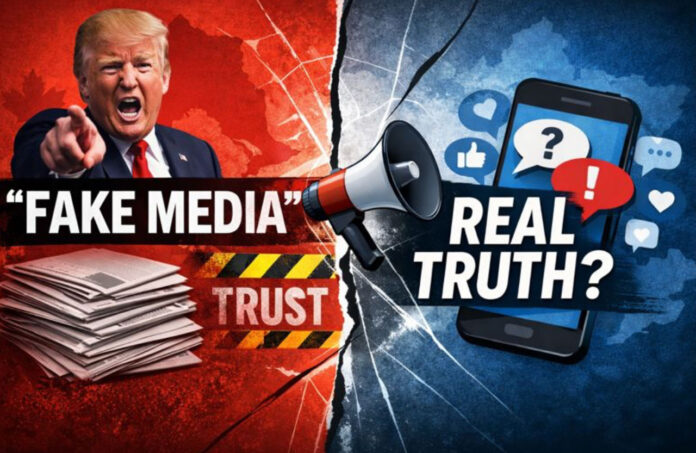
The phenomenon gained significant momentum during Donald Trump’s presidency. While mistrust in media predated his political rise, Trump’s repeated framing of major news outlets as “fake news” and sometimes as “the enemy of the people” shifted public discourse away from evidence-based debate toward loyalty-driven information consumption. This strategic approach turned truth into a partisan choice – if a story damages your political side, the source itself becomes illegitimate.
“Truth becomes rarer when leaders can evade accountability by attacking the referee,” explains media analyst Rebecca Hanson. “Critical reporting is no longer something to address with facts but something to delegitimize entirely.”
The sheer volume of misleading statements has also played a critical role. The Washington Post’s Fact Checker documented over 30,000 false or misleading claims during Trump’s first term. Such overwhelming frequency creates audience burnout – eventually, people stop evaluating individual claims and instead adopt wholesale allegiance to their chosen information sources.
Social media platforms have amplified this dynamic. According to a landmark MIT study, false news travels “farther, faster, deeper, and more broadly” than accurate information on platforms like Twitter (now X). This creates a perfect environment for the “fake news” playbook: a politician makes a claim, critical reporting follows, the politician dismisss the reporting as fake, and supporters share that dismissal widely. Audiences then choose between competing narratives based primarily on political identity rather than evidence.
Perhaps most concerning is the shift toward personality-driven information consumption. Pew Research found 21% of American adults now regularly get news from social media “influencers” rather than traditional news organizations. The Reuters Institute documents similar shifts worldwide, particularly among younger audiences.
While some independent creators maintain high journalistic standards, many in this ecosystem sell certainty as their product. They position mainstream coverage as coordinated deception while claiming exclusive access to “the real truth.” This framing flatters audiences (“you’re smarter than the masses”), shields creators from criticism (“my critics are corrupt”), and reduces complex issues to shareable slogans.
The accountability gap compounds the problem. Many influential content creators operate anonymously, with vague credentials and unclear funding sources. According to UNESCO research, approximately 62% of digital content creators don’t engage in rigorous fact-checking before publishing. Most lack journalistic training yet command significant influence over public perception.
This environment has been particularly effective in certain right-wing media ecosystems, where “fake news” rhetoric aligns with long-standing narratives about institutional bias. Gallup polling reveals the partisan trust gap: in 2024, 54% of Democrats reported trust in mass media versus just 12% of Republicans – a historic divergence.
For communities like Thunder Bay, these US-originated information patterns don’t stop at the border. They spill into Canadian debates about public health, policing, resource development, housing affordability, and Indigenous issues. Statistics Canada reports 59% of Canadians expressed serious concern about online misinformation in 2023, with 43% finding it increasingly difficult to distinguish truth from fiction compared to three years earlier.
The consequences extend beyond partisan squabbling. When citizens cannot agree on basic facts, communities become ungovernable by consensus. Every inconvenient fact can be dismissed as propaganda, while unverified claims gain legitimacy through repetition.
Rebuilding trust requires concrete action from multiple stakeholders. Politicians must offer specificity about timelines, costs and constraints, clearly distinguishing aspirational goals from firm commitments. News organizations should provide transparent sourcing, document access, clarity about levels of certainty, and visible corrections when errors occur.
For citizens navigating this landscape, experts recommend scrutinizing emotional triggers, checking multiple sources, and prioritizing content with documented evidence and transparent attribution – especially from sources claiming exclusive access to truth.
The stakes are practical rather than abstract. Communities require shared understanding to make collective decisions about budgets, safety, development, and reconciliation. Without that foundation, public life deteriorates into permanent conflict, making even routine governance nearly impossible.
Fact Checker
Verify the accuracy of this article using The Disinformation Commission analysis and real-time sources.

16 Comments
This is a complex issue without easy solutions. Restoring faith in institutions, improving digital literacy, and promoting objective journalism will all be crucial going forward.
You’re right, it’s a multifaceted problem. Rebuilding a shared sense of reality will require concerted efforts on many fronts.
The spread of misinformation and conspiracy theories on social media is deeply troubling. Addressing this challenge will require a concerted effort from policymakers, tech companies, and the public.
It’s troubling how social media algorithms and influencers can amplify misinformation and conspiracy theories. We need better media literacy education to help the public navigate the complex information landscape.
The proliferation of social media and the echo chambers it creates have exacerbated the problem. Combating misinformation and cultivating critical thinking skills should be priorities for educators and policymakers.
This breakdown in shared truth poses a serious threat to democratic institutions. Restoring faith in objective journalism and reliable information sources should be a top priority.
The influence of social media influencers and the echo chambers they create is a major contributor to the erosion of consensus reality. Combating this will require innovative approaches to media literacy and digital citizenship.
This issue highlights the need for greater media literacy and critical thinking skills among the public. Addressing the breakdown in shared facts will require a multi-faceted approach from various stakeholders.
This is a concerning trend that has been building for years. Social media and polarized news sources make it increasingly difficult for the public to discern fact from fiction. Restoring trust in institutions and objective journalism will be critical.
The erosion of consensus reality is a concerning trend with far-reaching consequences. Rebuilding trust in institutions and objective journalism is essential, but will require a multi-pronged approach.
This breakdown in shared truth has serious implications for policymaking and public discourse. Restoring faith in institutions and objective media will be an uphill battle, but it’s necessary for a healthy democracy.
Trump’s inflammatory rhetoric about the media was hugely damaging and contributed to the erosion of shared truth. While politicians often struggle to fully deliver on campaign promises, the outright rejection of facts is a dangerous development.
I agree. Leaders need to be held accountable, but dismissing all negative coverage as ‘fake news’ is irresponsible and undermines democracy.
This is a complex issue with no easy solutions. Strengthening media literacy, promoting fact-based reporting, and holding leaders accountable for their rhetoric will all be important steps forward.
The rise of political figures who openly reject facts and spread disinformation is alarming. Holding them accountable and countering their influence will be vital to preserving democratic norms.
While political rhetoric and the dynamics of modern media have exacerbated this problem, the roots of it are complex. Rebuilding trust in institutions and objective truth will be an ongoing challenge.