


Listen to the article
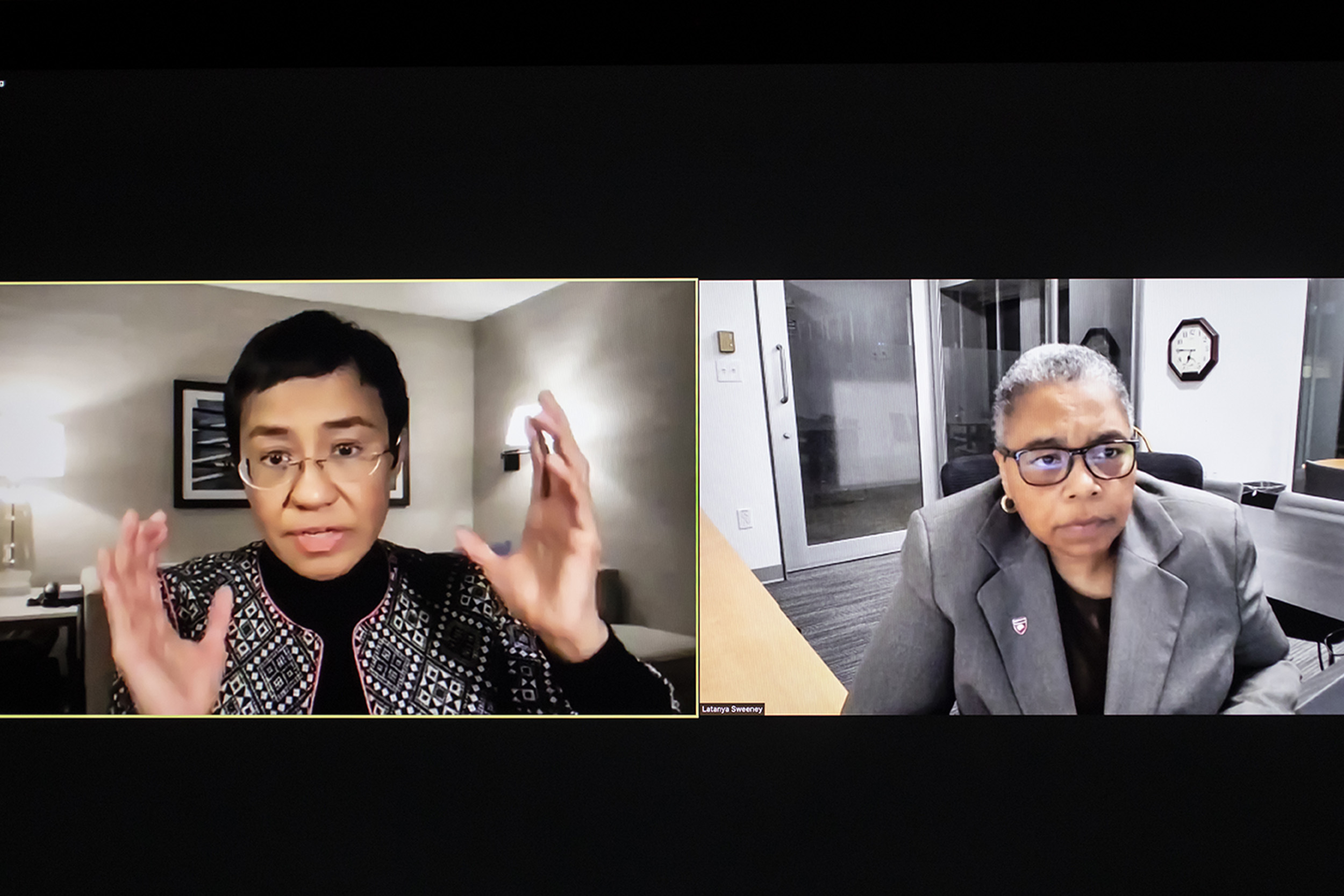
Amid a brutal anti-drug campaign in the Philippines, social media has become a powerful weapon against press freedom and democratic values, Nobel Peace Prize winner Maria Ressa warned during her address at the annual Salant Lecture on Freedom of the Press on Tuesday.
“When you want to rip the heart out of a democracy, you go after the facts. That’s what modern authoritarians do. This is the world we live in,” said Ressa, quoting Yale historian Timothy Snyder’s book “On Tyranny.”
Ressa, currently a Shorenstein Center Fellow and Hauser Leader at Harvard Kennedy School’s Center for Public Leadership, has spent 35 years covering Southeast Asia. In 2012, she co-founded Rappler, an independent investigative news outlet in the Philippines that has become a target of President Rodrigo Duterte’s regime since 2016.
The veteran journalist has faced multiple arrests and lawsuits for Rappler’s critical coverage of Duterte’s administration. In June 2020, a Manila court convicted her of cyber libel over a story about a businessman’s alleged ties to a judge and drug operations—despite the fact that Ressa neither wrote nor edited the article, which was published before the relevant law existed.
Now facing potential prison time while appealing her conviction, Ressa remains uncertain whether the Duterte government will allow her to travel to Oslo in December to receive her Nobel Peace Prize.
“I am putting myself in their power because I will do my job. I have done nothing wrong,” Ressa declared. “All of this is meant to intimidate me, to silence me, or to be afraid and duck out. And these types of tactics on social media really do work.”
During her conversation with Latanya Sweeney, Daniel Paul Professor of the Practice of Government and Technology at Harvard Kennedy School, Ressa detailed how the Duterte regime has built an elaborate network of fake and authentic Facebook accounts to flood social media with disinformation designed to overwhelm facts and reshape public opinion.
This strategy, she warned, serves as a “cautionary tale” with dangerous implications for democracies worldwide, particularly as many countries, including the Philippines and the United States, prepare for elections in 2022.
“You can’t have integrity of elections if you don’t have integrity of facts,” Ressa emphasized, drawing parallels to information operations in the United States, including the “Stop the Steal” narrative that preceded the January 6 Capitol riot.
Though Americans might believe they face less severe information warfare than Filipinos, Ressa cautioned against complacency: “You guys heaved a sigh of relief after the election of President Biden. But the underlying systems haven’t changed.” She cited recent Wall Street Journal revelations about Facebook abandoning post-election measures that minimized angry engagement because they were less profitable.
Addressing these challenges requires action from technology companies, journalists, and the public, Ressa argued. Since tech “created the problem,” she believes the industry must lead reform efforts, though she expressed skepticism about its willingness to prioritize public interest over shareholder returns.
“This is part of the reason this moment is particularly important, because how much money is enough?” Ressa asked. “The Philippine administration, right now, is using a scorched-earth policy to stay in power. I would suggest that these American companies are using a scorched-earth policy for money.”
Among potential solutions, Ressa suggested revising Section 230 of the Communications Decency Act, which shields internet platforms from liability for user-generated content. She also pointed to the European Union’s Digital Services Act as a promising, if imperfect, approach to addressing algorithmic bias that promotes misinformation.
When asked by Harvard student Ryan Tierney how she perseveres amid constant threats, Ressa reflected on her personal commitment to journalistic principles.
“I knew that if I stopped doing my job — that it wasn’t just about me — and I couldn’t,” she said. “Because if I gave up, then it’s almost like my entire life, my entire career, would be a lie. You need to actually live your values when it matters the most, not when it’s convenient. And the true test of your values is when you stand to lose something.”
As press freedom faces increasing threats globally, Ressa’s experience illustrates the high personal cost journalists may pay for holding power accountable in the digital age—and the critical importance of maintaining fact-based discourse to preserve democratic institutions.
Fact Checker
Verify the accuracy of this article using The Disinformation Commission analysis and real-time sources.

10 Comments
While the situation for journalists in the Philippines is dire, it’s important to recognize that the challenges Ressa describes are not unique to that country. Disinformation and attacks on press freedom are a global phenomenon.
Absolutely. This is a systemic problem that requires a coordinated international response to defend democratic values and the free flow of accurate information.
The erosion of press freedom and the rise of disinformation are deeply troubling trends. Ressa’s work is a crucial reminder of the vital role of independent journalism in a healthy democracy.
Well said. Supporting and protecting journalists like Ressa should be a priority for anyone who values democratic principles and the free exchange of ideas.
This is a sobering reminder of the dangers journalists face in standing up for the truth. Ressa’s work exposing disinformation and the erosion of democratic values is courageous and vital.
I agree. Social media has become a powerful tool for authoritarians to target independent journalism and undermine facts. Protecting press freedom is crucial for safeguarding democracy.
Ressa’s warnings about authoritarians going after the facts are a sobering reminder of the fragility of democratic institutions. Her commitment to independent journalism in the face of persecution is admirable.
Ressa’s experiences highlight the immense personal risks journalists face in holding power to account. Her resilience and commitment to the truth are truly inspiring.
The threats Ressa describes from social media disinformation are concerning, especially in the context of the Philippines’ crackdown on the media. It’s a disturbing trend we’re seeing globally.
You’re right, this is a global issue that requires concerted efforts to address. Strengthening digital literacy and media accountability will be key to combating the spread of disinformation.