


Listen to the article
Fake news should be criminalized to effectively combat misinformation, according to Prime Minister’s Adviser on Policy and Strategy Dr. Zahed Ur Rahman, who emphasized that many people fail to recognize the serious nature of spreading false information.
“The spread of fake news cannot be curbed without legal measures. Criticism and abuse are separate issues; they are not fake news. Fake news should be treated as a crime and the government must send a clear message in this regard,” Dr. Zahed stated at a recent seminar in Dhaka.
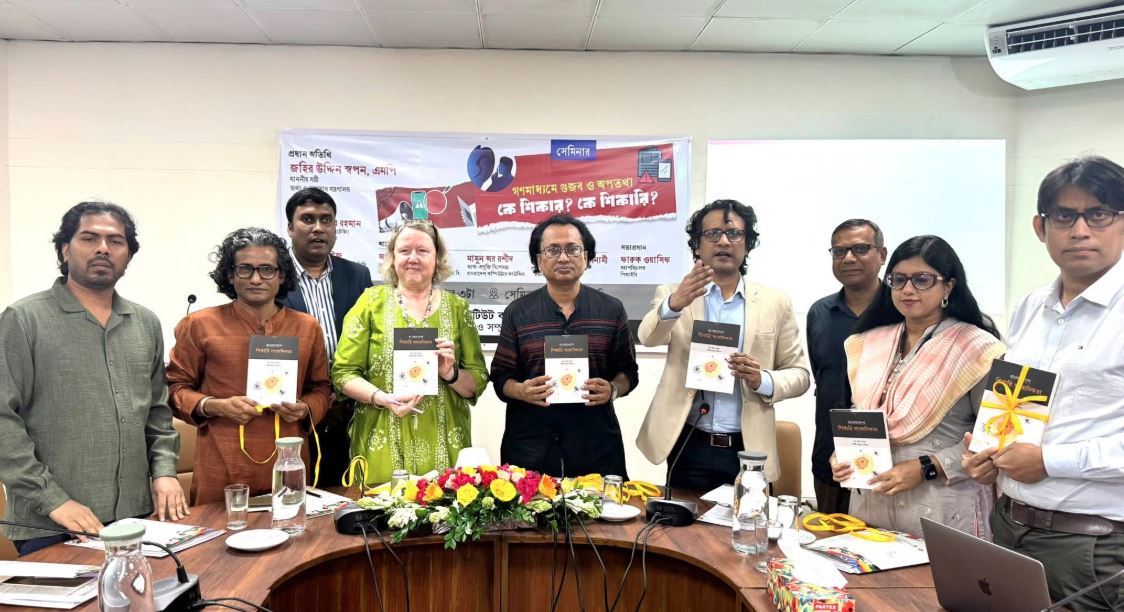
The event, titled “Rumours and Misinformation in Media: Who is the Victim? Who is the Predator?” was held at the Press Institute Bangladesh (PIB) auditorium on May 2, with PIB Director General Faruk Wasif presiding.
Dr. Rahman’s comments come amid growing concerns about misinformation’s impact on Bangladesh’s social and political landscape. His position reflects a hardening government stance on false information that has gained traction following several high-profile incidents where misinformation led to public unrest.
UNESCO’s Head of Office and Representative to Bangladesh, Dr. Susan Vize, offered a more nuanced perspective, calling for a balanced approach that preserves media freedom while implementing necessary regulations. She advocated for building comprehensive fact-checking mechanisms, enhancing journalists’ professional skills, strengthening media institutional capacity, and raising public awareness about artificial intelligence and algorithms.
In his keynote presentation, Mohammad Mamun Or Rashid, a language technology specialist at the Bangladesh Computer Council, highlighted the critical role professional fact-checkers and fact-checking organizations play in combating the spread of fake news. He detailed how technological solutions can be leveraged alongside human expertise to identify and counter misinformation more effectively.
Professor AA Mamun from Rajshahi University’s Department of Mass Communication and Journalism provided insight into the political dimensions of the issue, noting that disinformation serves as both a commercial venture and a powerful political weapon. “At times, political actors become victims, while in other cases, they turn others into victims,” he explained, highlighting the dual nature of the disinformation ecosystem.
Qadaruddin Shishir, Editor of The Dissent and a recognized fact-checking expert, criticized media organizations for failing to demonstrate accountability when they publish false information. He emphasized that news outlets rarely issue corrections or retractions when their reporting proves inaccurate, insisting there is “no scope for supporting fake news” in responsible journalism.
PIB Director General Faruk Wasif addressed the technological aspects of the issue, warning that social media algorithms are creating what he termed “digital servitude” by shaping users’ preferences and information consumption habits. He expressed concern that increasing numbers of people accept information that aligns with their existing beliefs without verification, contributing to a growing crisis of trust in media institutions.
Wasif called for rebuilding media structures on a knowledge-based foundation to address these challenges effectively, suggesting that journalism must evolve to counter algorithm-driven information bubbles.
The seminar comes as Bangladesh, like many countries globally, grapples with the proliferation of misinformation through digital platforms. The government has previously implemented various measures to combat fake news, though critics have expressed concerns about potential impacts on free speech and press freedom.
The discussion reflects the ongoing tension between protecting citizens from harmful misinformation and preserving democratic values of free expression—a balance that policymakers and media professionals continue to negotiate in the rapidly evolving digital information landscape.
Fact Checker
Verify the accuracy of this article using The Disinformation Commission analysis and real-time sources.

16 Comments
Curbing the spread of fake news is a valid goal, but criminalizing it could backfire and give the government too much power to silence criticism and dissent. A more measured approach focusing on education, transparency, and accountability for major purveyors of misinformation may be preferable.
I agree, the risks of overreach and abuse with a criminalization approach are significant. Nuance and balance will be essential in tackling this complex issue.
Criminalizing fake news is a complex issue with valid concerns on both sides. While misinformation can be harmful, a heavy-handed legal approach risks chilling free expression and press freedoms. A more balanced strategy focusing on media literacy, platform transparency, and targeted action against major purveyors of disinformation may be more effective.
The proposal to criminalize fake news is understandable but highly problematic. It risks giving the government too much power to silence criticism and dissent under the guise of combating misinformation. A better approach may be investing in media literacy, increasing platform accountability, and pursuing legal action against the worst offenders, rather than a broad criminalization.
While the intent to address misinformation is valid, criminalizing fake news is a concerning and potentially dangerous step. This risks creating a powerful tool for the government to silence criticism and dissent. A more measured approach focusing on media literacy, platform accountability, and targeted legal action against major purveyors of disinformation may be a better solution.
Criminalizing fake news is a complex and concerning proposal. While misinformation can be harmful, this legal approach risks undermining core democratic freedoms like free speech and press. Perhaps a wiser path would be investing in media literacy education, increasing transparency around online content sources, and holding major platforms accountable for the spread of false information, rather than a broad criminalization.
While the intent to combat misinformation is understandable, criminalizing fake news is a concerning step that could set a dangerous precedent. Perhaps a better approach would be strengthening media literacy, increasing online platform accountability, and targeted legal action against the worst offenders, rather than a broad criminalization.
Agreed. A multifaceted strategy addressing the root causes of misinformation, rather than just the symptoms, seems like a wiser path forward.
Criminalizing fake news is a complex issue. While misinformation can have serious consequences, we must balance the need to curb it with protecting free speech and press freedoms. A nuanced approach involving education, media literacy, and targeted legal measures may be more effective than a blanket criminalization.
I agree that a balanced perspective is important. Criminalizing fake news could set a dangerous precedent if not implemented very carefully.
Misinformation is certainly a growing concern, but using the law to combat it raises many concerns around censorship and chilling effects on free expression. Perhaps a combination of public awareness campaigns, media literacy education, and targeted legal action against the most egregious cases could be a more effective approach.
Interesting points. There are no easy solutions, but finding the right balance between addressing misinformation and preserving core democratic freedoms will be crucial.
Combating the spread of misinformation is crucial, but criminalizing fake news sets off alarm bells. This could open the door to censorship and the suppression of free expression. Perhaps a wiser path would be empowering citizens through media literacy education, enhancing transparency around online content sources, and holding major platforms accountable for facilitating the spread of false information.
Criminalizing fake news is a heavy-handed approach that could backfire and undermine press freedoms and free expression. A more constructive solution may be investing in media literacy education, increasing transparency around online content sources, and holding major platforms accountable for facilitating the spread of misinformation.
Absolutely. Nuance and proportionality will be key in tackling this issue effectively without creating new problems.
While the intent to combat misinformation is understandable, I have serious concerns about the criminalization of fake news. This could set a dangerous precedent and be open to abuse. Perhaps a better approach would be to focus on empowering citizens through media literacy education, increasing platform accountability, and targeted legal action against the worst offenders.