


Listen to the article
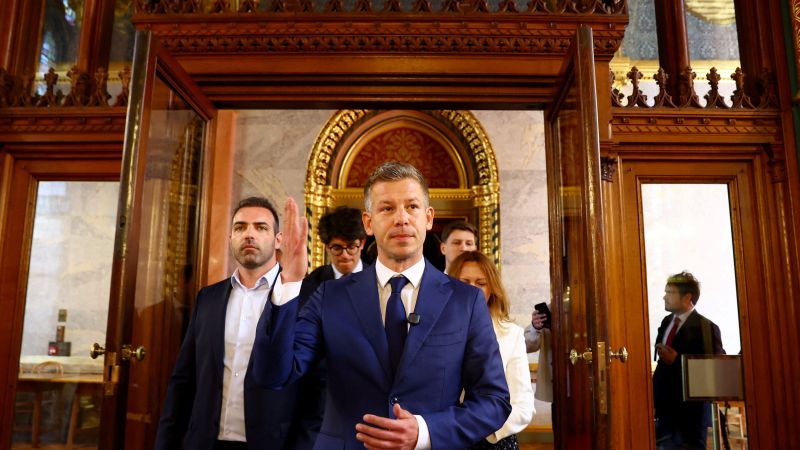
In the wake of Viktor Orbán’s unexpected electoral defeat, Hungary faces a profound media reckoning as prime minister-elect Péter Magyar begins dismantling what many call a decade-long propaganda machine.
For 42-year-old financial analyst Balasz, the shift is deeply personal. His elderly great-grandmother in rural eastern Hungary has consumed primarily state media for years, leaving her terrified of Magyar’s victory. “It’s like, you’re old, you’re in the countryside, you’re poor, you have, like, two TV channels, you’re listening to state radio,” Balasz told reporters, describing an “alternate reality” reminiscent of Soviet-era propaganda from his youth.
Throughout Orbán’s campaign, government-controlled media portrayed Magyar as a dangerous warmonger who would drag Hungary into the Ukrainian conflict, conscript Hungarian men, and trigger economic collapse. These narratives particularly affected elderly rural voters with limited media options.
Magyar, whose opposition Tisza party secured a commanding electoral victory despite being effectively barred from state media for 18 months, made his first appearance on the state-controlled M1 television network last Wednesday. During the combative interview, he reprimanded anchors for spreading “lies” about his family and compared the channel’s coverage to propaganda from North Korea and Nazi Germany.
“We have no personal resentment, but one of the elements of our program is that this factory of lies will be put to an end,” Magyar declared. “This isn’t about me, but about the fact that everyone deserves a public media that reports truthfully.”
Before the election, Magyar compared his potential victory to the jarring conclusion of “The Truman Show,” warning that many Hungarians would experience “cognitive dissonance” as their worldview unraveled. Gábor Polyák, a media law professor at Budapest’s Eötvös Loránd University, confirmed this phenomenon, describing reports of elderly villagers “who cannot come out from under the bed” since Magyar’s victory.
Orbán’s media takeover began systematically after his 2010 return to power. Having secured a two-thirds parliamentary majority, his Fidesz party amended Hungary’s constitution to limit pre-election political advertising primarily to government-friendly broadcasters. The administration installed party allies to lead regulatory bodies and orchestrated the acquisition of independent outlets.
“The most important changes came on the business side,” explained investigative journalist Szabolcs Panyi. “State-owned banks gave cheap or even free loans to Orbán’s allies to buy up media outlets,” which were subsequently either shuttered or converted into government mouthpieces.
The government weaponized state advertising budgets, which had long been Hungary’s largest media advertiser. When the national lottery stopped advertising on independent radio station Klubradio, private companies quickly followed suit. The station eventually lost its nationwide broadcasting license and went off air in 2021.
Similar tactics targeted news website Origo. Former reporter András Pethő recalled how management pressured editors to soften coverage critical of the government. The crisis peaked in 2014 when Pethő published an exposé on a minister’s lavish expenses. “The CEO wanted the editor to kill the story not because it was factually inaccurate – the problem was that it was true,” Pethő said. The editor resigned shortly afterward.
David Pressman, former US ambassador to Hungary, summarized Orbán’s approach: “He used a sophisticated, taxpayer-funded propaganda operation built on fear. He focused public attention on things that don’t exist in order to distract from things that do.” During his tenure, Pressman was regularly attacked on state media as an “LGBTQ activist.”
Despite being barred from traditional media channels, Magyar’s campaign succeeded through extensive grassroots outreach. He visited 700 towns and villages over two years, drawing unprecedented support from rural areas previously considered Fidesz strongholds.
Dismantling Orbán’s media apparatus presents significant challenges. With his two-thirds parliamentary majority, Magyar can reverse Fidesz’s constitutional changes and establish new regulatory frameworks. However, the private media landscape remains problematic, as Orbán’s allies accumulated substantial wealth during his tenure and can continue funding pro-Fidesz outlets.
For many Hungarian journalists, this week marks a potential renaissance. Some recall being systematically ignored at government press conferences, contrasting sharply with Magyar’s three-hour media session on Monday where he thanked reporters for their patience.
Yet Panyi remains cautious about this “honeymoon” period, hoping the new government will allow Hungary’s media landscape to heal “organically” so it can fulfill its essential role of holding power accountable – including Magyar’s inexperienced administration.
“To me, it feels like Season One has ended,” Panyi reflected. “I’m pretty sure that Season Two is starting soon.”
Fact Checker
Verify the accuracy of this article using The Disinformation Commission analysis and real-time sources.

7 Comments
It’s troubling to hear about the ‘alternate reality’ created by state media for rural, elderly Hungarians. Restoring access to balanced, factual reporting should be a top priority.
Absolutely. Empowering citizens with diverse, independent sources of information is essential for a healthy democracy.
The portrayal of the opposition leader as a ‘dangerous warmonger’ is a classic tactic of authoritarian regimes. I hope the new government can swiftly address these misinformation campaigns.
It’s concerning to hear about the elderly rural voters being so heavily influenced by state-controlled media. Providing greater access to diverse news sources will be crucial for an informed electorate.
You’re right, breaking the grip of state propaganda will be a major priority for the new administration. Rebuilding trust in independent media will be key.
This transition in Hungary’s media landscape will be an interesting test case for other nations grappling with the challenge of government-controlled information. The new prime minister has his work cut out for him.
The media landscape in Hungary has certainly been a contentious issue for years. I’m curious to see how the new government handles this challenge of dismantling the propaganda machine and restoring more balanced coverage.