


Listen to the article
Information Warfare Evolves: From WWII Colonial Propaganda to Modern AI Battlegrounds
In an active war, communication becomes as important as combat itself. The current U.S.-Iran conflict showcases this reality through a new visual vocabulary. While the United States pushes video game-style edits reminiscent of Call of Duty and Top Gun, Iran turns to rap music and Lego-style animation for its messaging. Though the styles differ, the objective remains consistent: to win not only on the battlefield but also in the battle over narrative. This represents the essence of psychological warfare—the weaponization and manipulation of information to shape public opinion, influence morale, and generate fear, consent, or hostility.
Some scholars now describe this new information environment as “slopaganda,” a blend of ‘AI slop’ and ‘propaganda,’ referring to AI-generated content designed to manipulate emotion and attention for political purposes. While slopaganda operates faster, cheaper, and with greater personalization than earlier influence campaigns, the underlying strategy remains unchanged. Long before social media, wars were fought through posters, rumors, leaflets, films, and carefully managed narratives.
To understand how little the fundamental approach has evolved, examining India during the Second World War proves instructive. The subcontinent became an intense propaganda battleground shaped by competing British and Japanese messaging campaigns.
When World War II began in September 1939, Viceroy Lord Linlithgow declared India at war with Germany without consulting the Legislative Assembly or any Indian political leaders. The Indian National Congress, the country’s largest political party, resigned from provincial governments in protest. Yet by August 1945, more than 2.5 million Indians had enlisted under the British flag, creating the largest volunteer force in history.
This paradox—a colonized nation sending an unprecedented volunteer army to fight for its colonizer—was not accidental but engineered through sophisticated propaganda. At the war’s beginning, the British Indian Army numbered just over 200,000 men. After France fell in June 1940, London abandoned earlier assumptions that India would contribute only modestly to the European conflict. Recruitment expanded rapidly: 456,000 by late 1940, over 900,000 by the end of 1941, and more than 1.5 million by late 1942.
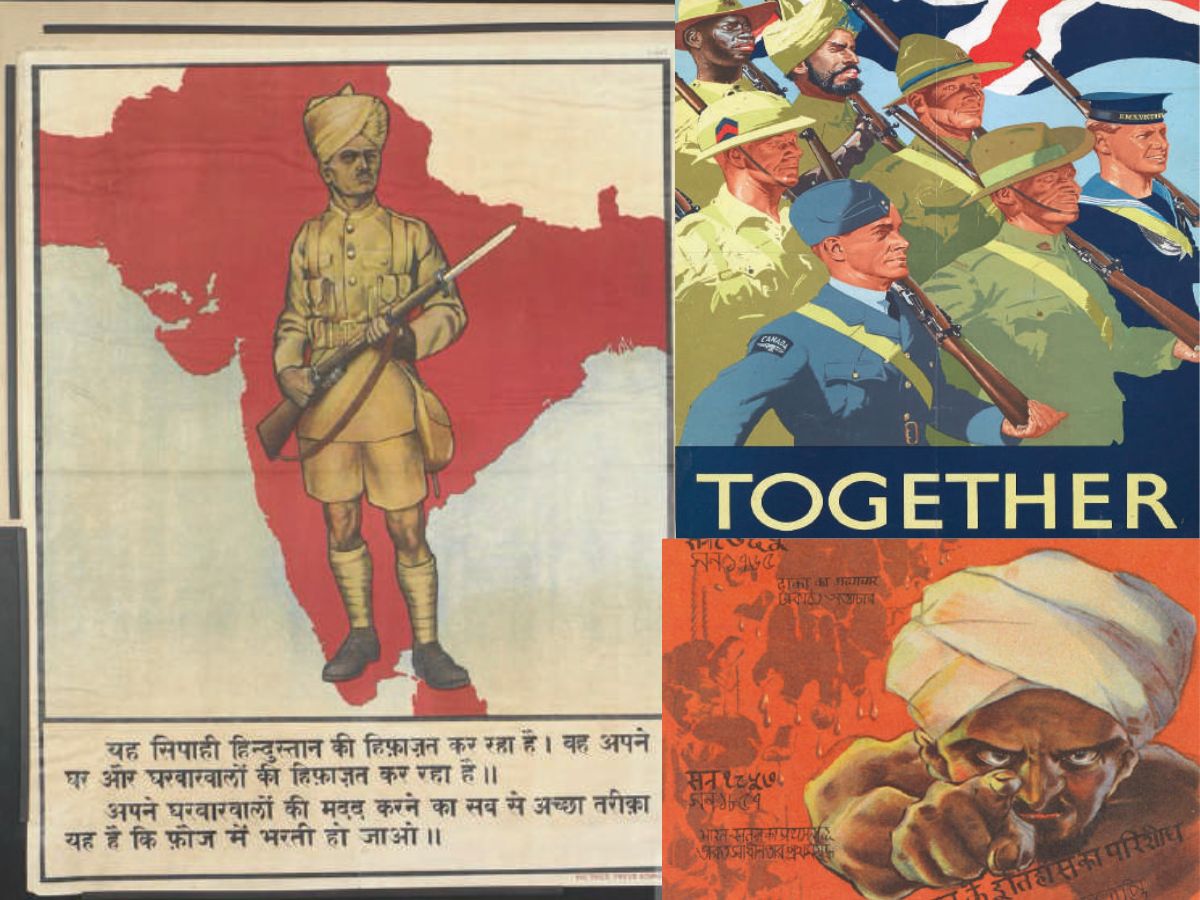
British authorities presented the war not as an imperial imposition but as a shared cause in which Indian dignity, family, and national honor were at stake. Recruitment posters, produced in multiple Indian languages, depicted soldiers protecting their homeland and families. One such poster showed an Indian soldier standing before a map of the subcontinent with Hindi text reading: “This soldier is protecting Hindustan. He is protecting his home and his family. The best way to help your family is to enlist in the army.”
After the Quit India Movement of August 1942, the propaganda effort intensified. The colonial government established the National War Front (NWF) under the Director of War Publicity, focusing on grassroots outreach. Its pledge captured the tone: “I solemnly pledge myself to stamp out defeatism and suppress alarmist rumour, to face and defy every peril threatening India’s national honour and security.”
As Japanese forces advanced through Southeast Asia, India became the site of a parallel propaganda battle. While British posters urged enlistment in the name of duty and family, Japanese propaganda sought to convert anti-colonial sentiment into political opportunity. It positioned Japan as Asia’s liberator and Britain as the brutal oppressor whose rule had brought famine, massacre, and humiliation to India.
Japanese leaflets targeted both civilians and soldiers stationed near the eastern front along the Burmese border. Their imagery was designed to be immediately emotional and accessible even to those with limited literacy. One recurring figure was a hybrid imperial villain resembling Winston Churchill, shown chaining Indians or feasting while Indians starved.
By 1944, the British had mounted a massive counterleaflet campaign, dropping an estimated 1.5 million leaflets monthly on Indian National Army positions. One anti-Japanese leaflet portrayed Subhas Chandra Bose as the “quisling son of India,” showing him handing a chained Bharat Mata to a Japanese soldier with a bloody sword.
Despite nationalist resistance and Japanese appeals to anti-colonial grievances, Indians enlisted in unprecedented numbers, serving across multiple theaters from North Africa to East Asia. This success stemmed partly from recruitment’s material benefits—steady wages and land grants—and partly because propaganda effectively framed military service as compatible with Indian dignity.
Today’s information warfare operates with new technologies but familiar strategies. From lithographic posters to AI-generated videos and algorithmically amplified memes, the basic approach remains recognizable. What the Second World War material reveals is that emotional resonance, strategic simplification, and mass distribution were already present in the leaflets falling into Assam paddy fields in 1944. Generative AI hasn’t invented a new type of information warfare; it has simply industrialized an old one.
The significant change lies in scale and speed. Content that once required print facilities in Bombay or transmitters in Zeesen can now be produced instantly by anyone with access to AI tools and distributed to precisely targeted audiences automatically.
Today’s India, now an independent nation and major Asian power, occupies a vastly different position than its colonial predecessor. It has the option to refuse participation in the emotional theater of other nations’ conflicts, maintaining strategic clarity to protect its citizens, secure its regional interests, resist disinformation, and continue advocating for de-escalation and dialogue.
Fact Checker
Verify the accuracy of this article using The Disinformation Commission analysis and real-time sources.

12 Comments
Fascinating look at how modern propaganda has evolved from traditional methods to new AI-driven techniques. The ability to manipulate information and narratives at scale is concerning, but understanding these evolving tactics is crucial.
Agreed. Propaganda has always been a tool of warfare, but the speed and personalization enabled by AI raises new challenges in combating disinformation and maintaining an informed public.
This is a sobering look at the evolution of propaganda in the digital age. The blending of AI and psychological warfare tactics is deeply worrying. Maintaining an informed, critical citizenry is essential to combating these insidious threats.
Well said. Fostering media literacy and critical thinking skills is crucial in this new information landscape. We must remain vigilant and hold both governments and tech companies accountable for their role in combating the spread of disinformation.
This article highlights an important shift in the information landscape. As technology advances, the weaponization of data becomes more sophisticated and harder to detect. Vigilance is key to safeguarding against the manipulation of public opinion.
You make a good point. The rise of ‘slopaganda’ blends AI and propaganda in novel ways. Staying informed on these evolving tactics is crucial for media literacy and democratic resilience.
The comparison of propaganda tactics to video games and Lego animations is an interesting analogy. It speaks to the need for a new visual vocabulary to understand modern information warfare. Parsing fact from fiction is becoming increasingly difficult.
Absolutely. The gamification and accessibility of propaganda techniques is worrying. We must be vigilant consumers of media and scrutinize the sources and motives behind the information we encounter.
This is a thought-provoking examination of the shifting landscape of psychological warfare. The concept of ‘slopaganda’ is particularly concerning, as it blends AI-driven personalization with the age-old tactics of propaganda. Vigilance is key.
Agreed. The speed and scale at which disinformation can now be produced and disseminated is alarming. Developing effective countermeasures requires a multifaceted approach combining technological, educational, and policy solutions.
While the article focuses on geopolitical conflicts, the underlying principles of propaganda and information manipulation are relevant across many domains. Understanding these dynamics is crucial for citizens, journalists, and policymakers alike.
The article raises valid concerns about the dangers of AI-powered propaganda. The ability to manipulate information and emotions at an individual level is a serious threat to democratic discourse and the free exchange of ideas.