


Listen to the article
Political Division Deepens as Social Identities, Not Just News, Drive Polarization
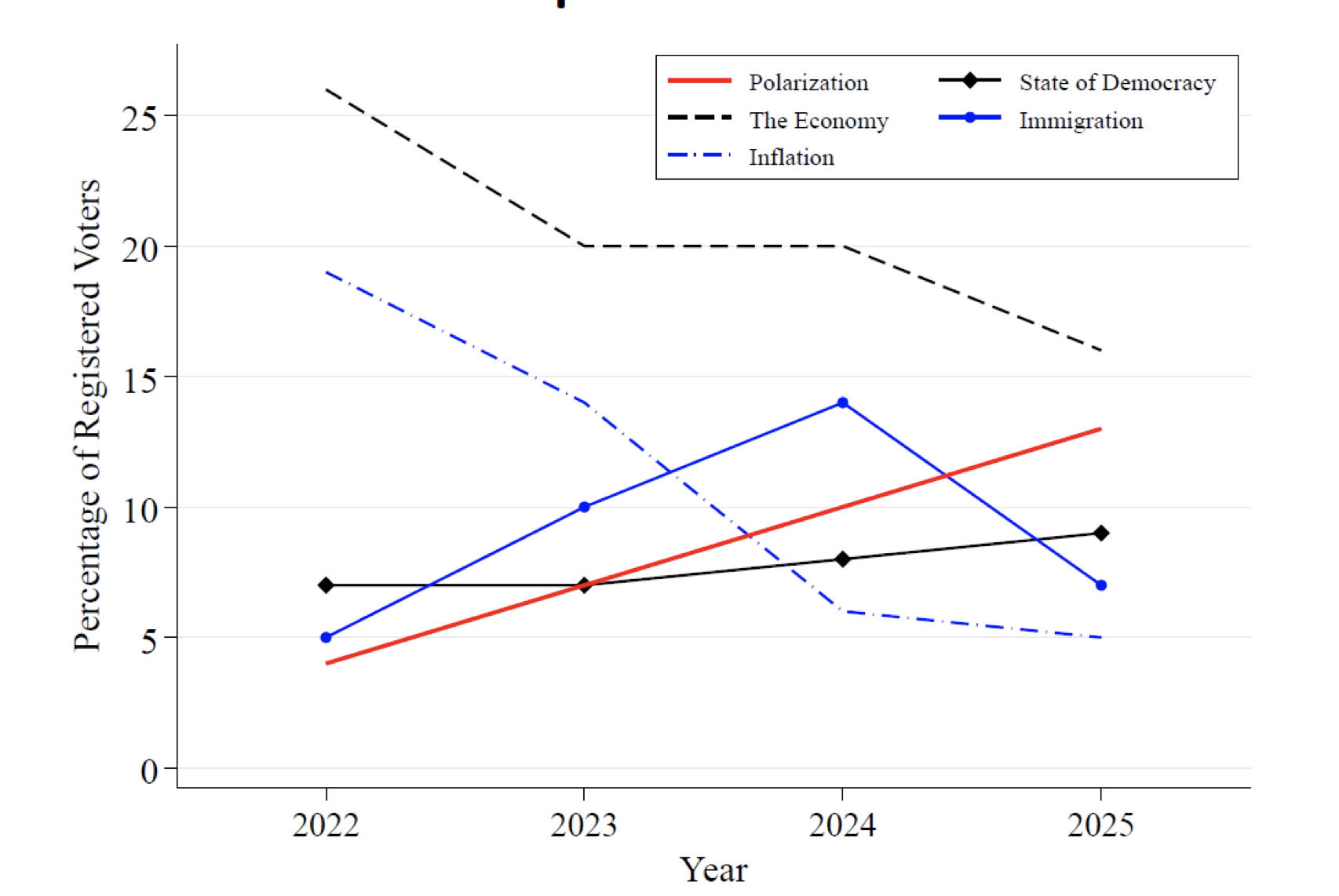
American voters now view political polarization as a major social problem, nearly equaling economic concerns in importance, according to recent polling. This growing division has prompted researchers to investigate deeper causes beyond the traditional explanations of information bubbles and media bias.
A groundbreaking study involving nearly 13,000 U.S. participants has revealed that simply making social conflicts more salient—without providing any new information—can significantly increase disagreement on political issues by up to 35%. The research, published by Nicola Gennaioli and colleagues, suggests that polarization stems from more fundamental sources than previously understood.
“We found that merely changing the order of survey questions, asking respondents to reflect on a social ‘enemy’ before stating their beliefs on topics like inequality or immigration, substantially shifted their positions,” explained the researchers. “This occurred without any new information, persuasion attempts, or partisan cues.”
The study identifies social identity as a key engine of polarization. When conflicts between groups become salient—whether economic (free market supporters versus government interventionists) or cultural (religious versus secular)—people begin viewing issues through the lens of their activated “ingroup.” Their beliefs then shift toward exaggerated ingroup stereotypes that distinguish them from the perceived “outgroup.”
This mechanism explains why certain political rhetoric proves effective despite lacking substantive policy proposals. Donald Trump’s campaign rallies frequently feature lists of enemies—”communists, Marxists, fascists, and the radical left thugs”—without offering new information about these groups. The research suggests this approach activates conservative identity by presenting progressive positions as a unified threatening outgroup.
The researchers documented two main effects: “amplification,” where making a conflict salient widens the gap between progressive and conservative groups across multiple issues, and “realignment,” where people with mixed profiles (economically progressive but culturally conservative, or vice versa) shift across ideological lines when different conflicts become prominent.
These findings help explain why politicians deliberately polarize voters. When voters are asymmetrically exposed to partisan messaging—with right-wing voters paying more attention to conservative content and vice versa—even opportunistic political parties find it optimal to adopt divergent platforms. This creates a self-reinforcing cycle where extreme voters push parties toward more polarized positions, encouraging more aggressive messaging that further divides the electorate.
Cultural conflicts have gained particular prominence in recent decades. U.S. political parties have increasingly shifted their advertising and rhetoric toward cultural issues, even as economic inequality has worsened. The researchers suggest this trend stems partly from globalization and technological change, which have adversely affected less-educated, culturally conservative workers and widened the cultural divide with progressive groups.
Media outlets also contribute to this dynamic. Cable news networks have increasingly focused on “culture war” content not because it’s most newsworthy, but because it generates higher audience engagement. Social media algorithms further amplify these trends, promoting content that triggers group conflict and keeping adversarial identities perpetually salient.
“The problem isn’t necessarily misinformation but selection—which conflicts are made prominent,” the researchers note. “Editorial choices about what to cover may matter more than the accuracy of the coverage itself.”
These insights carry sobering implications for addressing polarization. Traditional approaches like fact-checking, balanced media diets, and greater media literacy may prove insufficient when identity-based thinking is activated. In fact, well-placed fact-checks can sometimes backfire by reinforcing perceptions of outgroup bias.
More promising interventions might target conflict salience directly. The research shows that priming economic conflict can partially reverse culturally driven polarization among those with mixed ideological profiles. Interventions emphasizing common identities—shared national projects, cross-cutting social ties, or external challenges—could potentially de-escalate polarization more effectively than simply providing more information.
As political division continues to challenge democratic institutions, understanding that polarization can be manufactured through strategic framing of “us versus them” narratives offers new perspectives on addressing the problem. The researchers conclude that effective responses must go beyond correcting falsehoods to address how societies frame their disagreements at a fundamental level.
Fact Checker
Verify the accuracy of this article using The Disinformation Commission analysis and real-time sources.

8 Comments
This study underscores the need to address the deeper roots of polarization, not just the surface-level information gaps. It will be interesting to see if similar identity-based dynamics emerge in discussions of mining, lithium, uranium, etc.
An important reminder that political polarization is a multifaceted issue, not just a matter of information flow. I wonder how these social identity dynamics play out in discussions around extractive industries and energy policy.
Good point. Recognizing the psychological and social factors could lead to more productive dialogues on mining, commodities, and energy topics.
This study highlights the challenge of having nuanced, fact-based discussions on complex issues in a highly polarized environment. Focusing on shared identities and common interests may be key to depolarizing debates around mining, metals, and energy.
Fascinating study – it suggests political polarization is driven by more than just information bubbles. I wonder how these social identity factors might influence debates around the mining industry, energy transition, and commodity markets.
Definitely an important consideration. Understanding the psychological underpinnings of polarization could help foster more nuanced, productive dialogues on complex resource and energy topics.
Interesting findings. Seems political polarization goes deeper than just information bubbles – it’s tied to social identity and us-vs-them mentalities. Curious to see if the same dynamics apply in discussions around mining, energy, and commodities.
Good point. Understanding these psychological drivers of polarization could help improve dialogue on contentious resource and energy topics.