


Listen to the article
North Korea Celebrates Soccer Dominance with Third Women’s Youth World Cup in 13 Months
North Korea is celebrating a remarkable streak of international soccer success after clinching its third FIFA women’s youth World Cup in just over a year, a sporting achievement being hailed by state media as validation of the nation’s political system.
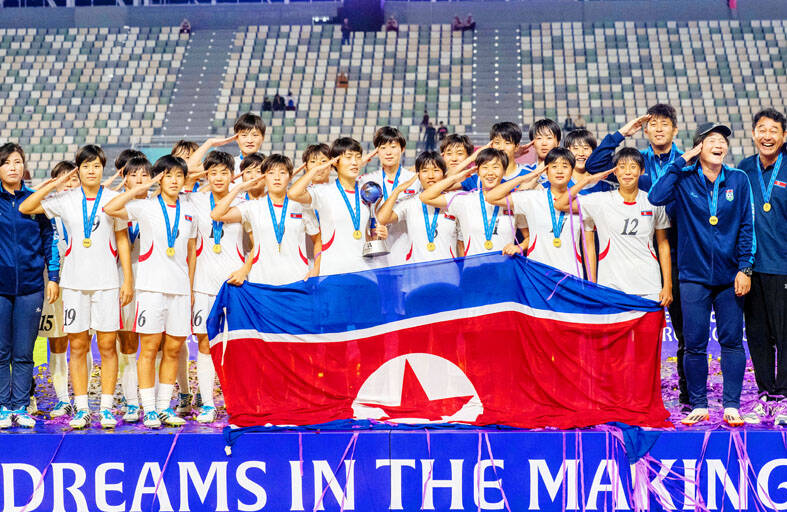
The North Korean team secured a convincing 3-0 victory against the Netherlands in Morocco on Saturday to claim their second consecutive FIFA Women’s U-17 World Cup title. This triumph follows their victory in the same tournament 12 months ago and their FIFA Women’s U-20 World Cup win in September 2023.
The team’s performance in Morocco was nothing short of dominant. They set a tournament record with 25 goals while conceding only three, maintaining a perfect record by winning all seven matches they played.
Following the victory, North Korea’s state propaganda apparatus quickly framed the achievement as a national triumph. The Rodong Sinmun newspaper prominently featured a Korean Central News Agency (KCNA) article across its front page, declaring: “Our players ran across the pitch waving the dignified flag of our republic with pride.”
State media portrayed the success as “great encouragement and inspiration to all the people” ahead of the Workers’ Party of Korea Congress, a critical political gathering held every five years under the leadership of Kim Jong-un.
The isolated nation, more frequently in international headlines for its nuclear program and ballistic missile tests, has increasingly invested in sports as a vehicle to project national strength and legitimacy on the global stage.
Hong Min, an analyst at Seoul’s Korea Institute for National Unification, predicts celebrations similar to the street parades that followed last year’s U-17 triumph. “There is a strong perception that the country is culturally backward and isolated,” Hong explained. “So, they will want to use this to project an image that their social and cultural foundations are strong and vibrant.”
North Korea’s approach to developing athletic talent follows a model seen in other socialist countries, with the state taking a central role in identifying and nurturing promising young athletes. “The North finds elite athletes at a very young age and pours in deep investment at a state level with an aim to stage them in global competition,” Hong said. “Players in return feel they must repay such investment with their performances.”
This systematic approach to youth development contrasts sharply with Western philosophies, according to Lee Jung-woo, a senior lecturer in sports policy at the University of Edinburgh. While European programs often emphasize enjoyment, North Korean players “join very highly disciplined, highly systematic and highly professionalized training regimes, so in early ages they can excel,” Lee told German outlet DW.
The gap in development was evident to Netherlands women’s U-17 coach Olivier Amelink, who acknowledged after the final: “I don’t think we could have beaten them. I think the gap… is simply too big to compete with them at the moment. They outplayed us throughout the entire match.”
North Korea’s women’s soccer program has established itself as a global powerhouse at the youth level, with this victory marking their fourth U-17 World Cup title overall. The senior women’s national team currently ranks 10th in the world according to FIFA and stands as one of the favorites for next year’s AFC Women’s Asian Cup in Australia, with only Japan (ranked 8th) holding a higher ranking among the 12 qualified teams.
This success in women’s soccer stands in stark contrast to North Korea’s men’s program, which currently ranks 120th globally and has not qualified for a World Cup since 2010.
Midfielder Ri Ui-gyong, who scored the third goal in the final, credited the team’s collective spirit for their success: “Our players played the final match wonderfully. All 25 goals were incredible, and we scored them because our players believed in each other and gave it their all.”
The tournament’s standout performer was North Korea’s Yu Jong-hyang, who netted a joint-record eight goals to secure both the Golden Boot as top scorer and the Golden Ball as the tournament’s best player.
Fact Checker
Verify the accuracy of this article using The Disinformation Commission analysis and real-time sources.

12 Comments
Winning three FIFA youth World Cups in just over a year is an incredible accomplishment. It speaks to the dedication and talent of North Korea’s women’s soccer program. But the state’s exploitation of these victories for propaganda is disheartening.
I hope the players are able to gain opportunities beyond North Korea that allow them to thrive and be recognized on their own merits, rather than as tools of the regime.
While athletic achievement is always commendable, the North Korean regime’s exploitation of this success for political gain is troubling. I hope the players are able to benefit from the exposure in meaningful ways beyond state propaganda.
It’s a shame when authoritarian governments co-opt the accomplishments of their citizens for ideological purposes. Hopefully the global community can find ways to support these young athletes directly.
This is an impressive feat for North Korea’s women’s soccer team. Their continued dominance on the youth world stage is certainly noteworthy, though the regime’s use of this success for propaganda is concerning.
It will be interesting to see if this translates to greater international recognition and opportunities for the players beyond the propaganda value for the North Korean government.
North Korea’s women’s soccer team has clearly demonstrated impressive talent and skill. However, the government’s efforts to leverage this for nationalist propaganda are concerning and detract from the players’ achievements.
I wonder if there are ways the international community could engage with these athletes directly, to ensure they receive the recognition they deserve without it being filtered through the North Korean regime’s agenda.
While the North Korean women’s soccer team’s string of World Cup wins is undeniably impressive, the government’s efforts to use these achievements for nationalist propaganda is troubling. I hope the players can find ways to be recognized for their talent without it being filtered through the regime’s agenda.
It would be great to see these young athletes gain access to more international exposure and opportunities that aren’t constrained by the North Korean government’s self-serving interests.
The North Korean women’s soccer team’s continued dominance on the youth world stage is a remarkable athletic accomplishment. However, the regime’s exploitation of these victories for propaganda purposes is deeply concerning and undermines the players’ achievements.
I hope there are ways the international community can engage with and support these talented athletes directly, without their success being co-opted by the North Korean government’s authoritarian agenda.