


Listen to the article
The Big Lie: How Nazi Propaganda Methods Fuel Anti-Israel Rhetoric
In a searing examination of propaganda techniques deployed against Israel, the Jerusalem Center for Security and Foreign Affairs has highlighted how the Nazi-perfected “Big Lie” methodology continues to shape anti-Israel discourse today.
“An equation between Israel and Nazism could only be made by someone who is totally ignorant of what Nazism was, or was indifferent to it,” stated Israeli Foreign Minister Golda Meir in 1961, responding to accusations from Saudi Ambassador Ahmed Shukeiry at the United Nations. Her words remain disturbingly relevant six decades later.
The “inversion of reality” technique—where aggressors portray themselves as victims—has become a cornerstone of anti-Israel propaganda. This method, perfected by totalitarian regimes, particularly Nazi Germany, seeks to dominate public discourse through constant repetition and intimidation, creating what experts describe as a “fictional world of untruth.”
Adolf Hitler himself acknowledged the power of this approach in “Mein Kampf,” noting that “the masses will fall victims to a big lie more readily than to a small one.” He praised British World War I propaganda for demonstrating that “untruthfulness on a large scale” could succeed through “continuity and sustained uniformity.”
Totalitarian regimes elevated this propaganda from temporary deception to sustained artificial reality. As Hannah Arendt explained, they create a fictional world “fit to compete with the real one” through generalizations that survive the exposure of specific lies. The approach relies on stubborn one-sidedness—refusing to engage with counterarguments.
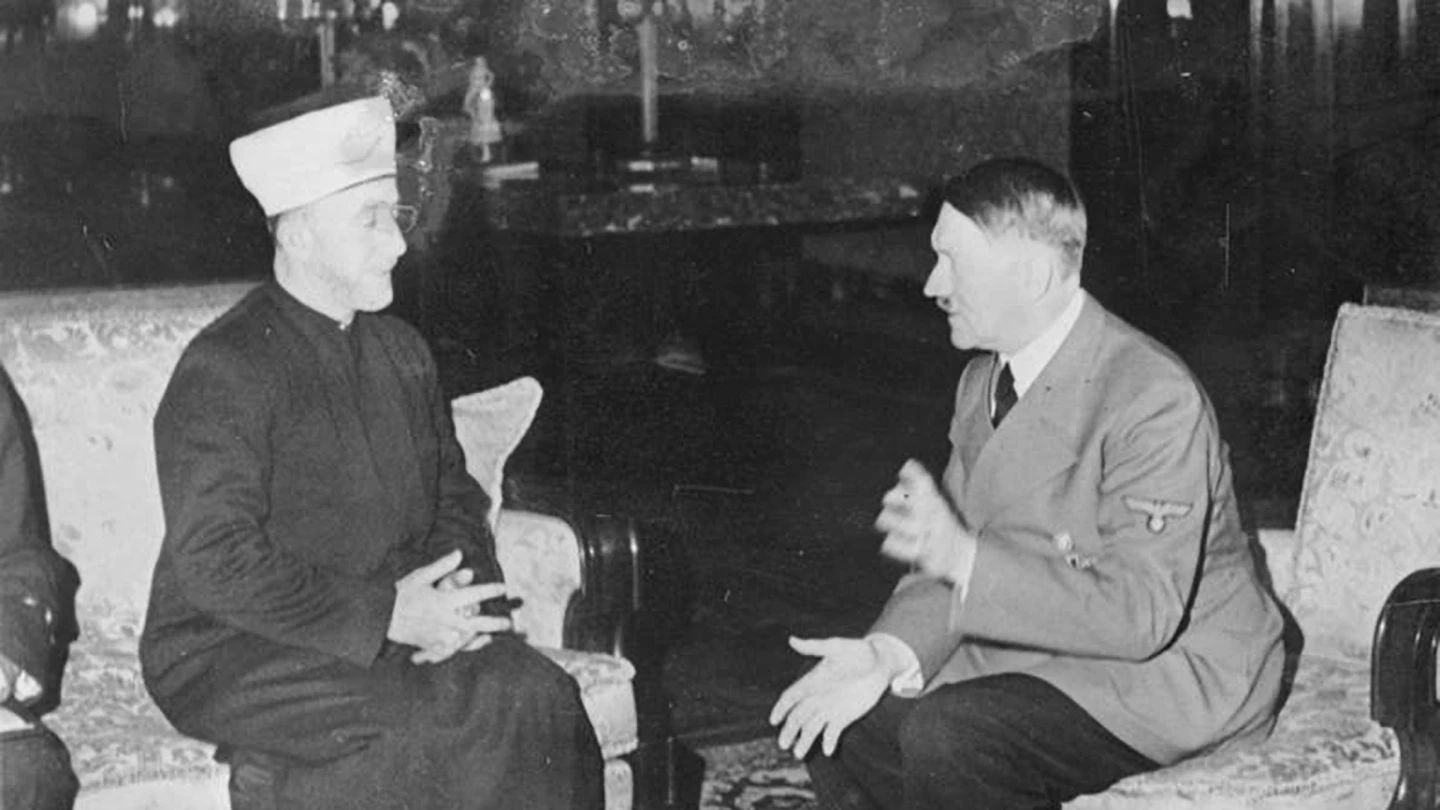
The Palestinian movement’s adoption of these techniques traces directly to Haj Amin al-Husseini, the Mufti of Jerusalem and an ardent Nazi collaborator during World War II. In a 1943 Berlin speech, he celebrated Germany’s fight against “world Jewry” and praised their “final solution to the Jewish menace,” declaring that “there will never be a stable arrangement for the Jews.”
Despite his clear Nazi affiliation, al-Husseini escaped accountability after the war when French authorities allowed him to flee to Egypt. This unpunished past created a historical blindspot that Palestinian leaders have exploited.
Ahmed Shukairy, who drafted the Palestinian Covenant and became the first PLO chairman in 1964, continued al-Husseini’s ideological line. During the Eichmann trial in 1961, while serving as Saudi Arabia’s UN ambassador, Shukairy astonishingly accused Israel of being “another Eichmann in a State”—projecting Nazi crimes onto Israel despite his own movement’s historical alignment with the Third Reich.
This tactic of accusatory inversion reached its zenith in May 1967 when Shukairy called for Arabs “to throw the Jews into the sea.” Though this statement damaged the Palestinian cause internationally, its underlying genocidal intent remained the movement’s guiding principle.
Yasser Arafat later confirmed this continuity during a 1974 visit to Venezuela: “Peace for us means the destruction of Israel… The destruction of Israel is the goal of our struggle, and the guidelines of that struggle have remained firm since the establishment of Fatah in 1965.”
The foundational contradiction of Palestinian rhetoric was inadvertently revealed by Zuhair Muhsen, a PLO executive council member, in a 1977 interview with Dutch newspaper Trouw: “There are no differences between Jordanians, Palestinians, Syrians and Lebanese… Only for political reasons do we carefully emphasize our Palestinian identity… The establishment of a Palestinian state is a new means of carrying on the struggle against Israel.”
This history reveals how contemporary accusations against Israel—including charges of genocide following Hamas’s October 7, 2023 attack—employ the same propaganda techniques that Hitler identified: repeat a big lie persistently until it gains acceptance. In doing so, they create what philosopher George Orwell warned against—a poisonous environment where “the mere prevalence of certain ideas” makes honest discussion impossible.
The antidote remains what Golda Meir demonstrated in 1961: a firm grounding in historical truth and the courage to confront falsehoods directly. As Hannah Arendt observed about Hitler’s declarations, the world has too often been “unprepared for such consistency” when confronted with the stark aims of those who seek Israel’s destruction.
In an era when social media accelerates the spread of disinformation, recognizing these propaganda techniques becomes essential not just for understanding the Israeli-Palestinian conflict, but for preserving historical truth against those who would manipulate it for destructive ends.
Fact Checker
Verify the accuracy of this article using The Disinformation Commission analysis and real-time sources.

10 Comments
This analysis highlights the need for a robust response to combat the spread of anti-Israel propaganda. Fact-based, nuanced dialogue is essential to counter these misleading narratives.
Absolutely. Relying on verifiable information and refusing to be intimidated by these tactics is crucial. We must remain steadfast in defending the truth.
This is a sobering look at the power of propaganda to distort reality and demonize Israel. We must be vigilant in challenging these false narratives with facts and reason.
Agreed. Combating this type of disinformation campaign requires a multifaceted approach, including media literacy education and a commitment to truth-telling.
This article highlights the concerning trend of using Nazi-era propaganda tactics to demonize Israel. It’s a disturbing example of how malicious actors can twist the truth to serve their own agenda.
The comparison to Nazi propaganda techniques is deeply troubling. It’s a stark reminder of how dangerous misinformation can become when it’s amplified and weaponized against a target.
Equating Israel with Nazism is a grotesque distortion of history. As the article notes, this ‘inversion of reality’ is a hallmark of totalitarian propaganda that should be vehemently rejected.
The article’s exploration of the ‘inversion of reality’ tactic is particularly chilling. It’s a clear example of how propaganda can be used to shift blame and obscure the truth.
The ‘big lie’ technique is a particularly insidious form of propaganda that relies on constant repetition to shape public perception, regardless of facts. It’s concerning to see this approach used against Israel.
Agreed. This type of disinformation campaign is extremely dangerous and undermines honest discourse. We must be vigilant in calling it out and countering it with facts.