


Listen to the article
Israeli Soldiers Light Hanukkah Candles in Tulkarm Refugee Camp Amid Ongoing Military Operation
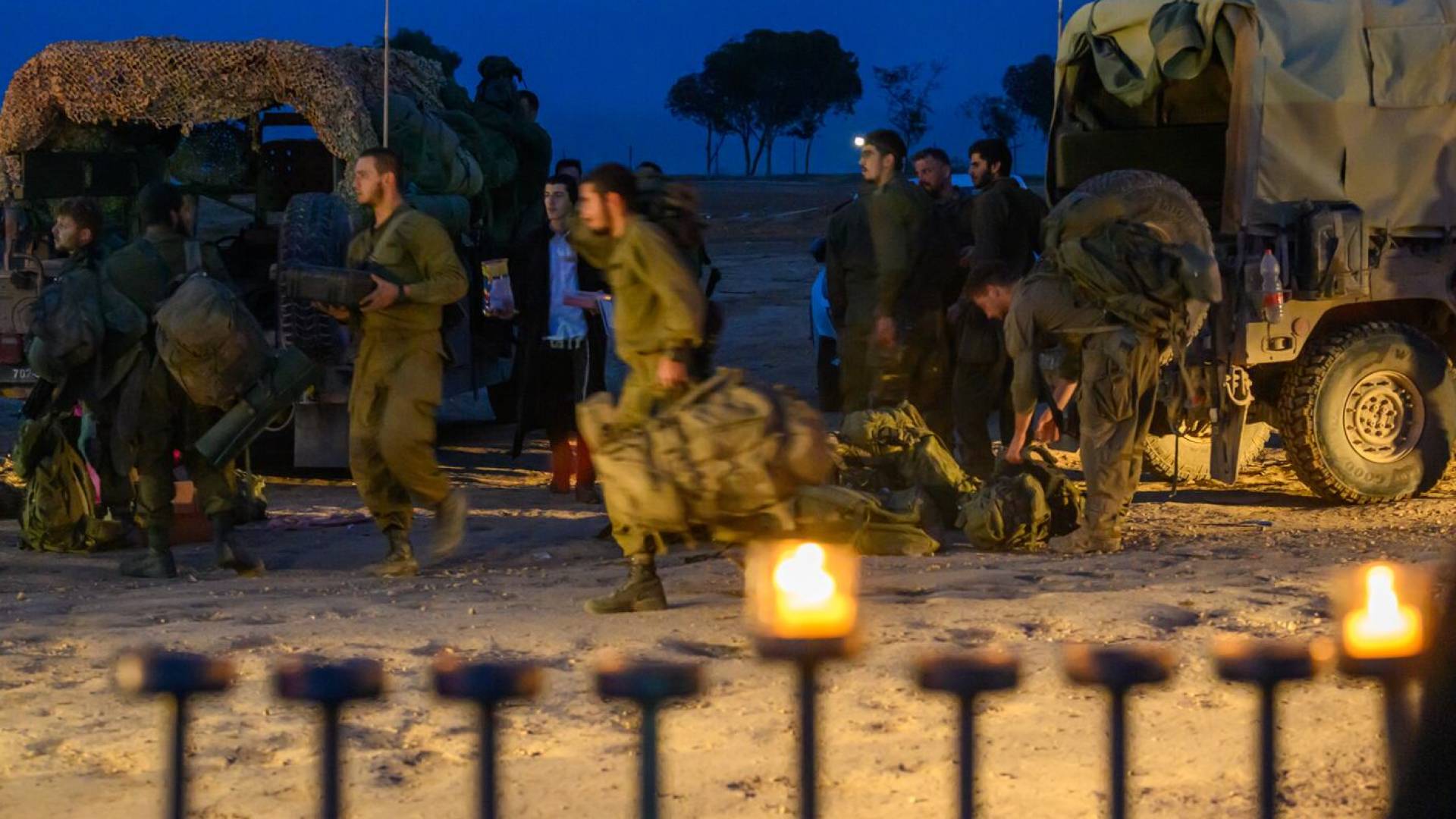
Israeli soldiers paused during a pre-dawn raid last week to light Hanukkah candles amid the rubble and barbed wire of Tulkarm’s Nur Shams refugee camp, sparking controversy over the symbolic nature of the act. The image, widely circulated in media, showed soldiers gathered around a makeshift menorah on a cracked concrete wall while Palestinian civilians crouched in nearby doorways.
The scene unfolded in a refugee camp that has been under intense military pressure for months. Coincidentally, as the photos were being shared, Israel’s National Security Council was issuing warnings to Israeli citizens abroad to avoid unsecured Hanukkah gatherings, citing fears of potential attacks.
The military operation in Nur Shams and Tulkarm refugee camps has been ongoing since late last year, with United Nations Relief and Works Agency (UNRWA) and local authorities reporting systematic destruction of homes and infrastructure. By November, Israeli bulldozers had leveled hundreds of homes in Nur Shams, isolating the area with concrete barriers.
A Reuters investigation conducted earlier this year found these camps “all but emptied” by the campaign. Witnesses described D9 armored bulldozers creating wide roads through demolished houses. Abdullah Kamil, the Palestinian governor of Tulkarm, offered a stark assessment: “There is nothing left in the camp, it has become a ghost camp.”
Israeli authorities present a different justification for their actions. In November, the Israeli army and Shin Bet security agency claimed they had discovered rockets and bomb-making materials during raids in the area. Israeli media reported the operation was part of a months-long security investigation that led to dozens of Palestinian arrests.
Human rights organizations contest this narrative, arguing that such claims regularly serve to justify disproportionate force. They point to similarities between tactics used in Tulkarm and those deployed in Gaza, including large-scale residential demolition and civilian displacement under counter-terrorism justifications.
The humanitarian toll has been severe. According to the Palestinian Center for Human Rights, the military campaign has left at least 13 Palestinians dead, including children and a pregnant woman, while displacing over 25,000 people. Many families have sought refuge in crowded schools and mosques in Tulkarm city, with only minimal healthcare available through UNRWA field clinics.
For camp residents, the candle-lighting ceremony represented not a private religious act but an extension of military dominance. Multiple testimonies describe families being awakened by explosions, confined in their homes for days, then forced outside while soldiers searched or demolished properties. One resident reported watching bulldozers advance through the camp before seeing soldiers arrange Hanukkah candles on the remains of a neighbor’s home.
Others described hearing Hebrew prayers and holiday songs during the operation, creating what one woman called a disturbing situation where “fear and celebration were occupying the same space.” Younger residents found the experience particularly disorienting, with religious celebration amid destruction conveying a message of power rather than faith.
Palestinian officials were quick to condemn the incident. Dr. Ahmed Abu Holi, head of the Refugee Affairs Department in the Palestine Liberation Organization, called it an “egregious breach of occupied civilian space” that added to Palestinians’ sense of collective punishment. Tulkarm governor Abdullah Kamil appealed to international organizations to intervene in what he termed “arbitrary and unjust” operations targeting civilians.
The incident touches on sensitive religious questions. Hanukkah traditionally commemorates a miracle where a small amount of oil burned for eight days in the Jerusalem Temple, emphasizing spiritual resilience rather than military conquest. The Talmudic reading includes Zechariah’s verse, “Not by might, nor by power, but by My spirit,” highlighting faith over force.
Some Jewish scholars and clergy have criticized the militarization of Hanukkah in contemporary Israeli contexts. An American rabbi noted that nationalist ideology has “turned the moral of the Hanukkah story on its head to praise militarism,” while traditionally the holiday celebrated peace and perseverance.
For Palestinians, the ritual carried dual significance – introducing a foreign religious practice in a predominantly Muslim-Christian community while using religious ceremony as what some view as a military prop. Islamic scholars have privately described it as “istihlal,” the desecration of sacred space by conquering forces.
Security communications experts suggest this messaging serves multiple audiences. For Israeli citizens and supporters, it projects normalcy and moral certainty. For Palestinians, it signals both territorial and spiritual dominance. Meanwhile, travel warnings to Israelis abroad reinforce a narrative of vulnerability that can justify continued military operations at home – a strategy some analysts describe as “information warfare” that links internal confidence with external fear.
Fact Checker
Verify the accuracy of this article using The Disinformation Commission analysis and real-time sources.

10 Comments
This seems like an unfortunate misuse of a cultural tradition for political messaging. The optics of soldiers lighting Hanukkah candles amid a military operation raise questions about the intent and symbolism.
It’s a complex and sensitive situation. I hope both sides can find ways to observe their traditions with respect and avoid further escalation of tensions.
While I understand the desire to observe Hanukkah, the decision to do so in the midst of a military operation in a refugee camp seems insensitive and potentially exploitative of the tradition. The optics and symbolism are troubling and raise valid concerns from critics.
I hope both sides can find ways to uphold their religious and cultural traditions in a manner that is respectful and does not further inflame tensions or appear to use them for political purposes.
This seems like an unfortunate and potentially exploitative use of a religious tradition for military messaging. While the intent may have been to observe Hanukkah, the context of an ongoing operation in a refugee camp makes it appear insensitive at best.
I hope both sides can find ways to uphold their traditions and religious observances without further inflaming tensions or appearing to use them for political purposes.
The timing and setting of this Hanukkah observance raise valid concerns about its appropriateness. Military operations in refugee camps are inherently fraught, and any actions that could be seen as symbolic aggression should be avoided.
I agree, the optics are problematic. The military should be mindful of how their actions, even unintentionally, can be perceived and impact civilian populations during sensitive periods.
The use of a Hanukkah observance by soldiers during a military operation in a refugee camp raises serious questions about respecting cultural traditions and avoiding the appearance of symbolic aggression. This seems like an unwise and potentially provocative action.
I agree, the timing and setting of this Hanukkah observance are highly problematic. The military should be more mindful of how their actions can be perceived, especially during periods of heightened tensions.