


Listen to the article
Growing tensions and ideological divides across American university campuses have escalated in recent weeks, with several high-profile incidents highlighting the increasingly polarized nature of academic environments.
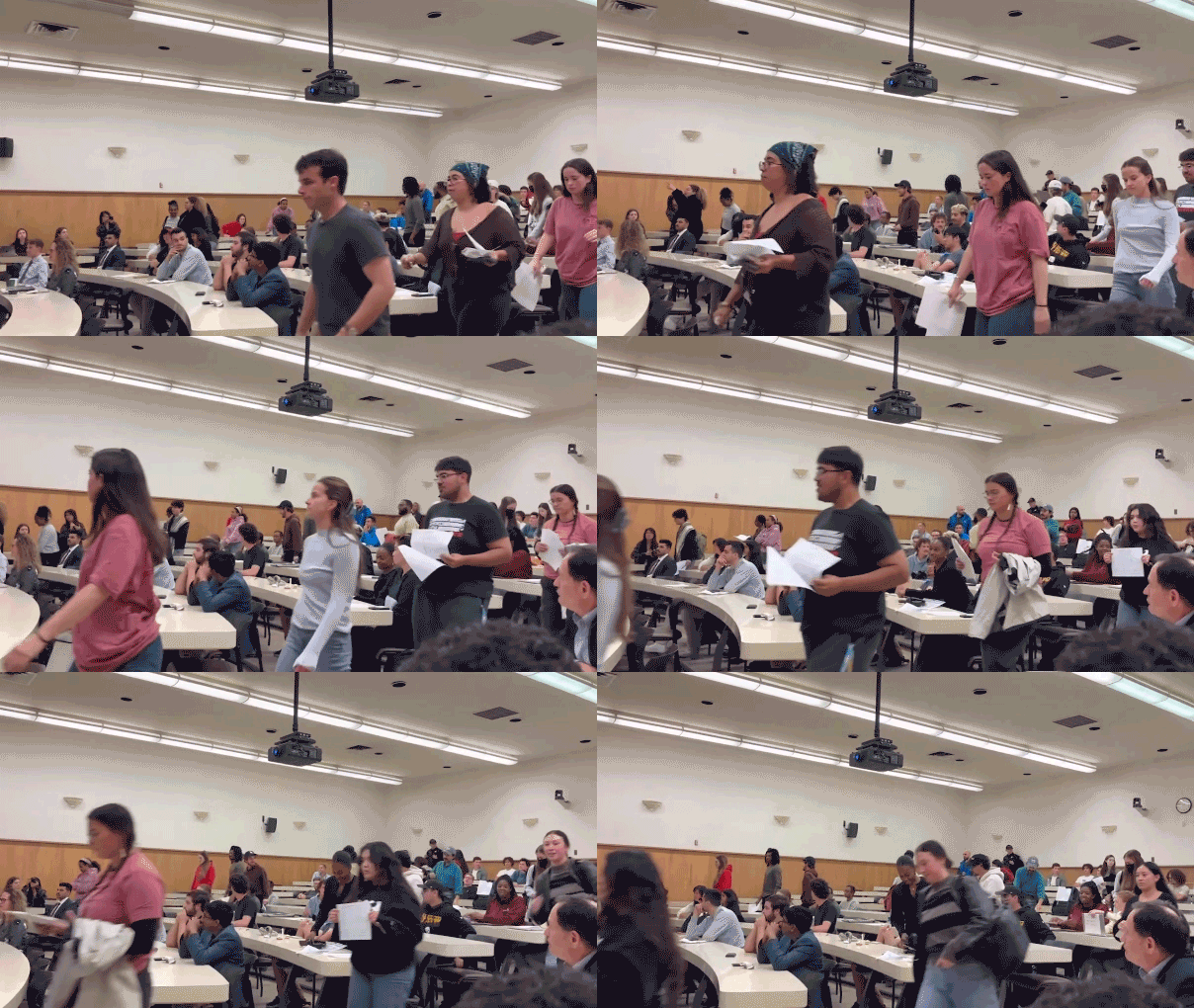
At UCLA, students recently walked out of a conservative speaker’s event, creating what one Department of Homeland Security lawyer described as protest “chaos.” The DHS attorney claimed UCLA “utterly failed” to maintain order during his appearance at the law school. Video footage captured the moment students abruptly exited the classroom, leaving the speaker mid-presentation as protesters disrupted the scheduled talk.
The incident represents a growing pattern of contentious interactions between conservative speakers and student protesters at prestigious universities. Campus security protocols have come under scrutiny as administrators struggle to balance free speech concerns with maintaining order during politically charged events.
Meanwhile, across the Bay Area at UC Berkeley, controversy erupted when an anti-Israel student group hosted a speaker identified as a failed suicide bomber. Critics condemned the university administration for allowing the event, with one commentator describing the campus as a “cesspool” for permitting such a speaker. The event featured Israa Jaabis, a Palestinian woman who reportedly spent eight years in Israeli prisons following severe burns sustained during her captivity.
The UC Berkeley incident comes amid ongoing pro-Palestinian demonstrations on campus, where students have established tent encampments similar to those seen at Columbia University and other institutions across the country. These protests have intensified following the October 7 Hamas attacks on Israel and subsequent military operations in Gaza.
Harvard University is facing its own controversy, reportedly investigating its Republican Club over social media posts related to a Muslim student group’s campus event. The investigation highlights the complex terrain universities must navigate regarding speech policies and potential discrimination concerns.
These incidents occur against the backdrop of broader national debates about diversity, equity, and inclusion (DEI) initiatives on college campuses. A watchdog organization has warned that former President Donald Trump’s proposed crackdown on DEI programs “misses core ideology” and should address what they describe as “lingering danger on campuses” related to these policies.
The political tensions extend beyond traditional academic settings. In Utah, controversy erupted after a Pride event reportedly displayed artwork depicting a severed head of former President Trump, alongside activities where children were invited to hit a piñata resembling Senator Mike Lee (R-Utah). The display has drawn criticism from conservative groups concerned about political violence and appropriate content for family events.
In response to these ongoing cultural debates, Texas Tech University has announced policy changes recognizing only two sexes and freezing gender-related academic programs. The decision aligns with similar moves in other conservative-led states to limit gender-identity discussions in educational settings.
These developments reflect a deepening national divide over issues of free speech, political expression, and identity politics. University administrators find themselves at the center of these conflicts, attempting to uphold academic freedom while addressing safety concerns and maintaining institutional reputations.
Education policy experts note that campus tensions often mirror broader societal polarization, with universities serving as flashpoints for cultural debates. As the fall semester approaches, many institutions are reviewing security protocols and speech policies to prevent further escalations.
The incidents collectively underscore the challenges facing American higher education as it navigates increasingly fraught political and cultural terrain, raising questions about the future of discourse and debate in academic settings.
Fact Checker
Verify the accuracy of this article using The Disinformation Commission analysis and real-time sources.

11 Comments
The protests at UCLA are concerning, but I’m curious to understand the full context and motivations behind the student walkout. Peaceful protest is a fundamental right, but disrupting events crosses a line.
Good point. We should be careful about jumping to conclusions without all the facts. Both sides likely have valid concerns that deserve thoughtful consideration.
This is a complex issue without easy answers. Balancing free speech and campus security is an ongoing challenge that universities must navigate carefully.
Agreed. There needs to be more nuanced discussion on how to uphold democratic principles while maintaining order. Knee-jerk reactions from either side won’t help.
This is a concerning development. While free speech is important, universities must also maintain order and safety during events. It’s a delicate balance to strike.
I agree, campus security protocols need to be improved to handle these volatile situations. Preventing violence while upholding free expression is crucial.
The growing ideological divides on college campuses are quite troubling. Students should be able to engage with diverse views without resorting to disruption or threats.
Absolutely. Universities have a responsibility to foster open dialogues, not shut down unpopular opinions. This trend towards intolerance is worrying.
This seems like a troubling trend of ideological clashes on college campuses. While free speech must be protected, universities also have a duty to maintain a safe and inclusive environment for all students.
Absolutely. There needs to be a balanced approach that respects diverse viewpoints while preventing them from escalating into threats or violence. Finding that middle ground is crucial.
The situation at UCLA is quite concerning. Universities should be places of open dialogue and intellectual exchange, not arenas for political confrontation. Both sides need to find a way to engage constructively.