


Listen to the article
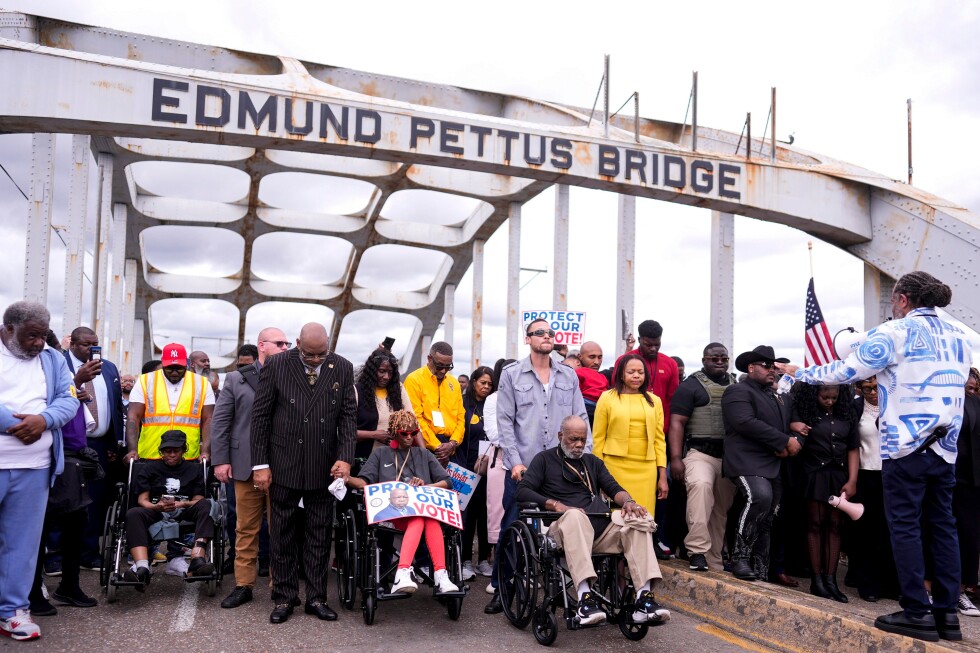
Civil rights advocates gathered in Selma, Alabama this weekend to commemorate the 61st anniversary of “Bloody Sunday,” a pivotal moment in American history that helped secure voting rights for Black Americans. The celebration, however, was tempered by growing concerns about the future of the Voting Rights Act amid a pending Supreme Court decision.
Thousands converged on the historic Edmund Pettus Bridge, where on March 7, 1965, state troopers violently attacked civil rights marchers in a brutal confrontation that shocked the nation’s conscience. The assault on peaceful protesters catalyzed support for the Voting Rights Act, which dismantled Jim Crow-era barriers to voting across the South.
“I’m concerned that all of the advances that we made for the last 61 years are going to be eradicated,” said Charles Mauldin, who at 17 was among those beaten on Bloody Sunday. Mauldin, now an elder statesman of the civil rights movement, reflected on the courage of that day: “It wasn’t that we didn’t have fear, it’s that we chose courage over fear.”
The commemorative events, which culminated with Sunday’s symbolic march across the bridge, drew Democratic officeholders, civil rights leaders, and citizens from across the country. Many speakers expressed alarm over a pending Supreme Court case that could significantly weaken a key provision of the Voting Rights Act.
The case before the Court examines the role of race in drawing congressional districts, with justices expected to rule soon on a Louisiana matter. Legal experts warn that a decision limiting race-conscious redistricting could have sweeping consequences nationwide, potentially allowing Republican-controlled states to eliminate majority-Black and Latino districts that have historically elected Democrats.
Maryland Governor Wes Moore, speaking from the pulpit of Selma’s historic Tabernacle Baptist Church, called for renewed activism. “Those who marched across the Edmund Pettus Bridge deserve better than us cowering while the freedoms that we inherited and they fought for, are being ripped away,” Moore told the congregation.
Illinois Governor JB Pritzker struck a similar tone at a rally near the bridge, claiming that “Trump’s Supreme Court is gutting the Voting Rights Act” and urging attendees to “march forward today with the knowledge that we are the inheritors of the faith that brought marchers to the bridge 61 years ago.”
The political stakes are particularly high in Alabama, where U.S. Representative Shomari Figures was elected in 2024 from a district redrawn by federal courts to enhance Black voting power. His district would likely be targeted for redistricting if the Supreme Court ruling gives states greater latitude.
“What happened in Selma and the subsequent passage of the Voting Rights Act was monumental in shaping what America looks like and how America is represented in Congress,” Figures noted.
The original Bloody Sunday march was led by future congressman John Lewis and activist Hosea Williams, with marchers walking two-by-two toward Montgomery. When they reached the apex of the Edmund Pettus Bridge, they encountered a wall of law enforcement officers, some mounted on horseback, but continued forward despite the obvious danger.
This year’s commemoration not only honored that historic sacrifice but served as a rallying point for current voting rights battles. Speakers also criticized recent political developments, including immigration policies and efforts to roll back diversity, equity, and inclusion programs.
As participants crossed the bridge on Sunday, many reflected on how the struggle for voting rights continues to evolve. While the 1965 Voting Rights Act eliminated many explicit barriers to voting, advocates worry that more subtle restrictions and redistricting tactics could undermine hard-won progress if courts further weaken federal protections.
The annual Selma commemoration, once primarily a historical remembrance, has thus transformed into an active front in contemporary political battles over voting rights and representation.
Fact Checker
Verify the accuracy of this article using The Disinformation Commission analysis and real-time sources.

12 Comments
The events of Bloody Sunday were a tragic but pivotal moment in the struggle for racial justice. It’s sobering to see how fragile progress can be.
Indeed. The work is far from over, and we must remain vigilant to protect the hard-won gains of the civil rights movement.
The events of Bloody Sunday were a pivotal moment in the civil rights movement. We must learn from history and ensure such injustices are never repeated.
Well said. Preserving the hard-won gains of the past is crucial to building a more equitable future.
Powerful reminder of the sacrifices made to secure voting rights. We must remain vigilant against any erosion of these hard-won protections.
Yes, the Voting Rights Act has been a vital safeguard. Any weakening of it would be deeply concerning.
Troubling to hear about the concerns over the future of the Voting Rights Act. Protecting this landmark legislation should be a top priority.
Commemorating Bloody Sunday is a solemn reminder of the ongoing fight for equal rights and the importance of civic engagement.
The civil rights pioneers who marched across the Edmund Pettus Bridge showed immense courage in the face of violence. Their legacy continues to inspire.
Absolutely. We must honor their sacrifice by redoubling our efforts to safeguard voting rights and democracy.
Kudos to the civil rights leaders and activists who continue to fight for equal access to the ballot box. Their courage and perseverance is inspiring.
Absolutely. We owe a debt of gratitude to those who risked everything to advance the cause of voting rights.