


Listen to the article
Nevada’s Electric Vehicle Charging Network Lags Despite Ambitious Plans and Funding
Scott Allison, a Las Vegas resident who drives an electric Kia, faces a common dilemma for Nevada’s EV owners. With a range of about 280 miles, he and his husband hesitate to drive to the Reno-Tahoe area despite having flown there for visits. The reason? Nevada’s unreliable rural charging infrastructure.
“When you’ve got so few that work, there’s no redundancy,” Allison explained. “We need dependable chargers that we know are going to work. You can’t just jump in the car and hope for the best.”
This frustration is shared by many of Nevada’s 65,000 EV drivers who find traveling through rural stretches of the state—such as Highway 50 between Tonopah and Las Vegas or U.S. Route 93 between Las Vegas and Wells—remains a risky proposition. With no official state or federal tracking system for operational charging stations, drivers must rely on unofficial sources to plan routes.
In 2021, state lawmakers attempted to address this infrastructure gap by passing legislation that authorized NV Energy to build out more than $100 million worth of EV charging stations over several years, with special focus on underserved communities. Combined with tens of millions in federal grant money from the bipartisan infrastructure law, the outlook for Nevada’s EV charging network appeared promising.
However, more than a year after NV Energy’s project was scheduled to be completed, the utility has spent just $12.4 million on the initiative. NV Energy cited high infrastructure costs and lower-than-expected interest from customers to develop charging stations on their properties as reasons for not utilizing the full $100 million allocation.
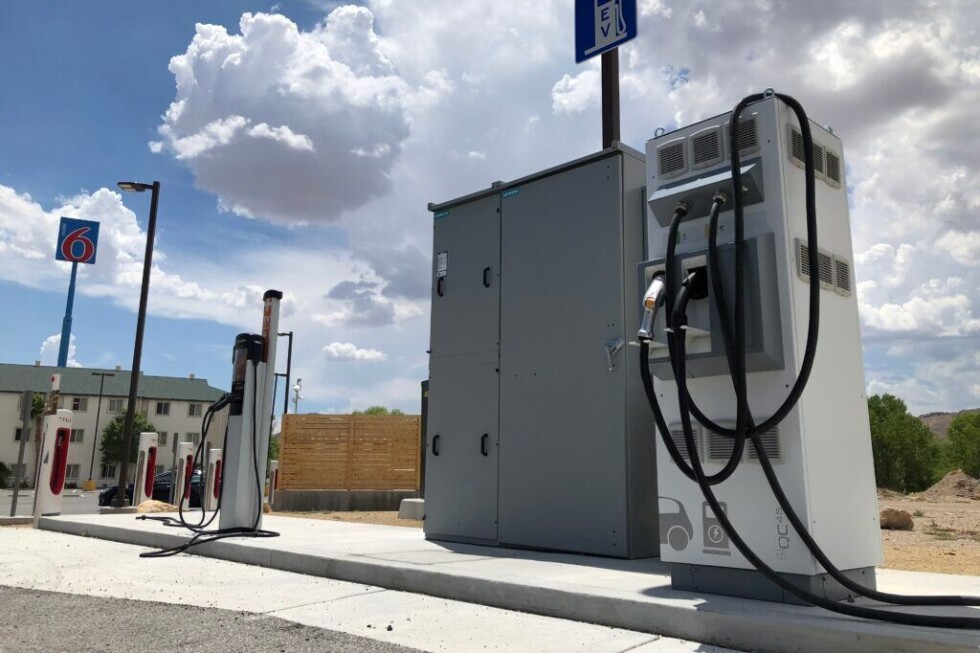
To date, only 16 charging sites have been built with two additional sites under construction. Together, these 18 sites will add nearly 350 charging ports across Nevada—far short of the 120 EV charging stations with 1,800 ports promised in the 2021 omnibus energy bill SB448, which was promoted as a way to boost post-pandemic job production while electrifying the state’s highways.
“I’ve heard people lift (SB448) up as a model of policy to accelerate and help with the adoption of electric vehicles. It’s frustrating to see that the reality didn’t play out that way,” said Assemblyman Howard Watts, a Las Vegas Democrat who supported the bill. “It set very clear metrics of ‘we want to spend $100 million over the next three years.’ It was a clear direction that this was something important.”
Compounding the problem, the Nevada Department of Transportation (NDOT) failed to spend $38 million in federal funds awarded in 2022 under the bipartisan infrastructure law. Those funds were recently reduced to about $25 million in Congress’s latest spending bill. Meanwhile, other states have moved much more quickly, allowing them to access all or most of their allocated funds.
“I can’t state strongly enough how disappointing this is,” Allison said. “We need chargers in rural areas, and due to NDOT’s desert tortoise pace, (we have) lost a significant portion of these funds.”
Nevada’s struggles with EV infrastructure aren’t new. More than a decade ago, under former Republican Governor Brian Sandoval, the Nevada Electric Highway initiative was launched with support from NV Energy and NDOT to electrify the state’s highways. The goal was to double public charging stations and expand them to all major Nevada highways by 2020.
That program went defunct in 2023, and progress stalled across all fronts. As of 2024, only about 630 of the nation’s nearly 77,600 EV charging stations are located in Nevada.
Of the $12.4 million NV Energy has spent on its current program, more than half—$6.8 million—went toward outreach, education, technical advisory services, operations, maintenance, and workforce development rather than actual charger installation. The utility did not track job creation directly, though it reported that 319 journeymen and apprentices received training through electrical training centers in northern and southern Nevada.
Chris Brooks, the 2021 bill sponsor and himself an EV driver who has faced charging challenges when driving across Nevada, admitted he hasn’t tracked the bill’s implementation closely. “I don’t know where we should be looking for more progress. As a state, we are just not doing a really great job on charging infrastructure,” he said.
Meanwhile, NDOT has been similarly slow to utilize federal funding. According to the National Electric Vehicle Infrastructure Awards Dashboard, which tracks federally funded charging sites, 10 states are fully built out and 18 states have at least one operational station. Nevada has none.
NDOT spokesperson Meg Ragonese said in an email that despite funding cuts, “We in Nevada will continue advancing toward future construction of EV charging improvements using available authorized funding and following priorities outlined in the state’s NEVI plan.” The department estimates its first charging stations will be operational later this year.
For drivers like Allison, however, the delays mean continued uncertainty about traveling across the state. “It’s crazy I can’t go safely drive around Nevada in an EV,” he said. “It’s really disappointing.”
Fact Checker
Verify the accuracy of this article using The Disinformation Commission analysis and real-time sources.

14 Comments
The lack of a centralized tracking system for operational charging stations in Nevada is a real problem. EV drivers need that visibility to plan reliable routes. This is an issue that likely extends beyond just Nevada – standardized data and coordination seems essential for a nationwide EV charging network.
Absolutely, a lack of transparency around charging station availability is a major barrier. A coordinated national database could really help drivers confidently plan longer EV trips.
It’s disappointing to see the EV charging buildout in Nevada fall so short of intentions, despite significant funding. This serves as a lesson that infrastructure deployment is complex, especially in rural areas. More holistic planning and execution is needed to make EV travel feasible across the state.
The lack of a centralized tracking system for EV charging stations in Nevada is a major pain point for drivers. Maintaining visibility and reliability of the network is essential for enabling long-distance EV travel. This is a problem that likely extends beyond just Nevada and requires a coordinated, national-level solution.
Absolutely. A standardized, nationwide database of operational EV charging stations would be a huge help for drivers planning routes. It’s a critical piece of the puzzle to make EV adoption more feasible, especially in rural areas.
Unreliable rural charging infrastructure is a significant obstacle to wider EV adoption, as this Nevada case highlights. Addressing this challenge will require a multi-pronged approach – from better coordination and data sharing to targeted investments and incentives. Lots of work still to be done.
Absolutely. Getting the right mix of public and private initiatives will be crucial to building out a truly robust and reliable EV charging network, even in more remote areas.
This is a cautionary tale about the complexities of EV infrastructure buildout, even with significant funding. It shows the importance of careful planning, coordination, and execution to ensure charging stations are actually built and operational. Nevada’s experience provides valuable lessons for other states facing similar challenges.
It’s disappointing to see Nevada’s ambitious EV charging plans fall short, despite the substantial funding allocated. This highlights the real-world challenges of building out reliable infrastructure, especially in less populated regions. Hopefully lessons from this experience can inform better strategies and coordination moving forward.
Interesting to see how Nevada’s ambitious EV charging plans have fallen short so far. It highlights the challenges of building out a reliable rural charging network, especially without a centralized tracking system. Seems like more work is needed to make long-distance EV travel feasible in the state.
Agreed, the lack of redundancy and dependable chargers is a real obstacle. Drivers need to be able to trust the infrastructure is there when they need it.
This is a common problem for EV adoption in more rural areas. Without a robust and reliable charging network, long-distance travel remains risky. Hopefully Nevada can learn from this experience and find ways to accelerate the buildout, maybe through public-private partnerships.
Yes, public-private collaboration could be key to unlocking the needed investment and coordination. Getting the right incentives and policies in place will be crucial.
It’s a shame to see so much funding not fully utilized for EV charging in Nevada. This highlights the complex logistical and infrastructure challenges facing the transition to electric vehicles, especially outside of major metro areas. More attention and creative solutions are needed.