


Listen to the article
A growing number of Democratic lawmakers plan to skip President Donald Trump’s upcoming State of the Union address on Tuesday, opting instead to attend an alternative “People’s State of the Union” event near the Lincoln Memorial as a form of protest against the administration.
The counter-event, organized by progressive groups MeidasTouch and MoveOn Civic Action, will feature several prominent Democratic senators including Ed Markey of Massachusetts, Jeff Merkley of Oregon, Chris Murphy of Connecticut, Chris Van Hollen of Maryland, and Tina Smith of Minnesota. House Democrats planning to attend include Representatives Yassamin Ansari of Arizona, Becca Balint of Vermont, Greg Casar of Texas, and several others.
Some Democratic legislators, including Senator Ruben Gallego of Arizona and Representative Jared Golden of Maine, have announced they will simply stay home rather than attend either event, signaling their disapproval without participating in the organized protest.
This coordinated absence reflects the limited options Democrats face in expressing opposition to Trump during the formal address. House Minority Leader Hakeem Jeffries outlined the party’s strategy last week, saying Democrats could either “attend with silent defiance or not attend and send a message to Donald Trump in that fashion.”
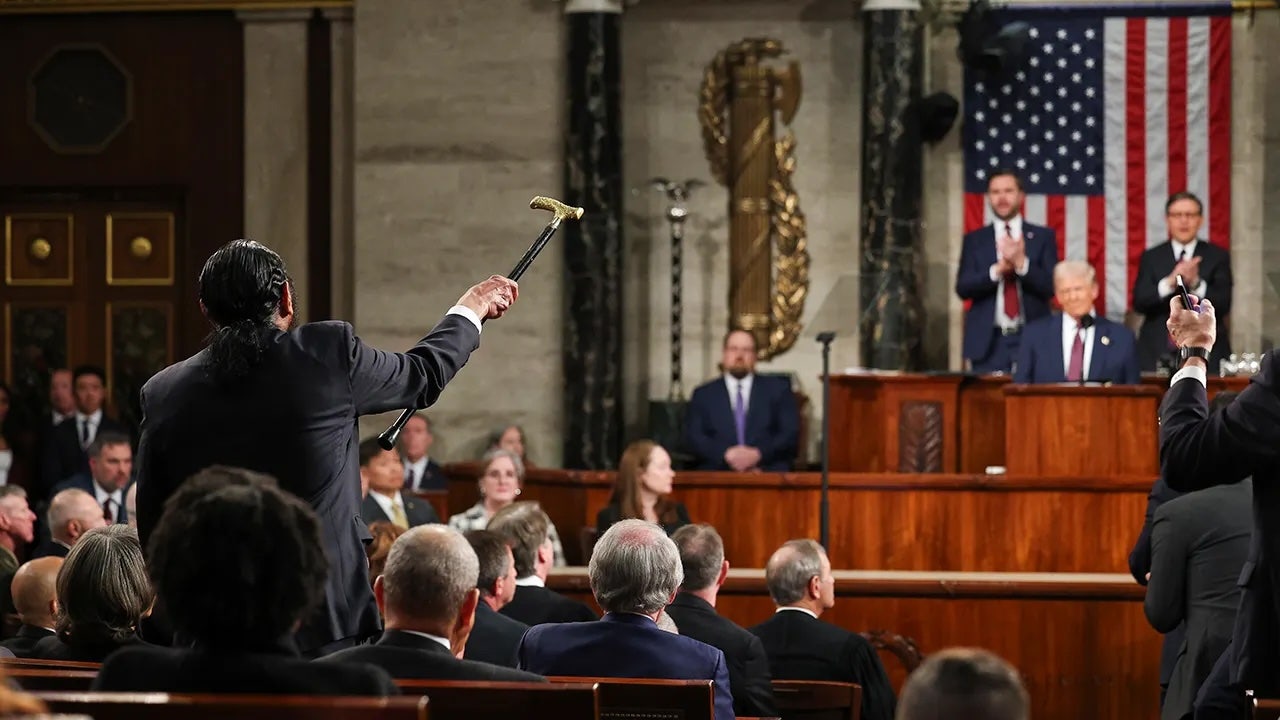
The boycott comes amid continuing tension over appropriate decorum during the State of the Union. Last year’s address was marred by controversy when Representative Al Green of Texas interrupted Trump’s speech by standing, waving his gold-studded cane, and shouting at the president. House Speaker Mike Johnson quickly directed the Sergeant-at-Arms to remove Green from the chamber after he refused to stand down.
Green, who has not confirmed whether he plans to attend this year’s address, released a statement indicating he would not participate in post-speech interviews with other lawmakers, describing his position as a “peaceful protest.”
Democratic leadership, including Jeffries and Senate Minority Leader Chuck Schumer, have confirmed they will attend the State of the Union, maintaining the traditional presence of party leadership at the annual address regardless of political differences.
The alternative “People’s State of the Union” represents a more organized approach to opposition compared to previous years, giving Democrats a platform to voice criticism of Trump’s first year back in office without risking disruption of the official proceedings. This strategy allows them to maintain a form of protest while avoiding potential backlash from interrupting the formal congressional event.
The divided response within Democratic ranks highlights the party’s ongoing struggle to balance institutional respect for the presidency with strong opposition to Trump’s policies and rhetoric. As the administration enters its second term, these tensions continue to shape the political landscape in Washington.
For Trump, the address represents an opportunity to outline his agenda before a joint session of Congress, though he will face a visibly diminished Democratic presence compared to traditional State of the Union ceremonies. This dynamic underscores the deep partisan divisions that persist in American politics as Trump begins his second administration.
Fact Checker
Verify the accuracy of this article using The Disinformation Commission analysis and real-time sources.

10 Comments
I’m curious to see how the public reacts to this coordinated Democratic boycott of the State of the Union address. It reflects the deep partisan divisions in Congress, but may also energize the president’s base.
It’s disappointing to see growing partisan divides in Congress. While political disagreement is natural, I hope both parties can find ways to engage constructively and address the country’s challenges together.
I agree, we need more bipartisanship and civility in politics these days. Skipping the State of the Union seems like a missed opportunity for dialogue.
The decision by some Democrats to boycott the State of the Union is an interesting political move, but I wonder if it will really impact the president’s message or sway public opinion. These events are often more theater than substance.
That’s a fair point. Boycotts can be symbolic gestures, but they may not change much in the end. There are more productive ways for the opposition to engage and influence policy.
Boycotting the State of the Union is a bold political statement, but I wonder if it will backfire and rally support for the president. These events tend to be more about theater than substance anyway.
That’s a fair point. Symbolic gestures can sometimes have unintended consequences. The opposition may need to find more constructive ways to engage and influence policy.
It’s concerning to see the growing polarization in Washington. While I respect the right of lawmakers to protest, I hope they’ll also consider attending the State of the Union to directly engage with the president’s agenda.
I share your concern about the partisan gridlock. Productive dialogue and compromise are essential for our democracy to function effectively.
The decision by some Democrats to skip the State of the Union address raises important questions about the role of dissent and opposition in our political system. It will be interesting to see how this plays out and impacts public perceptions.