


Listen to the article
Foreign Network of Fake Canadian YouTube Channels Uncovered by CBC
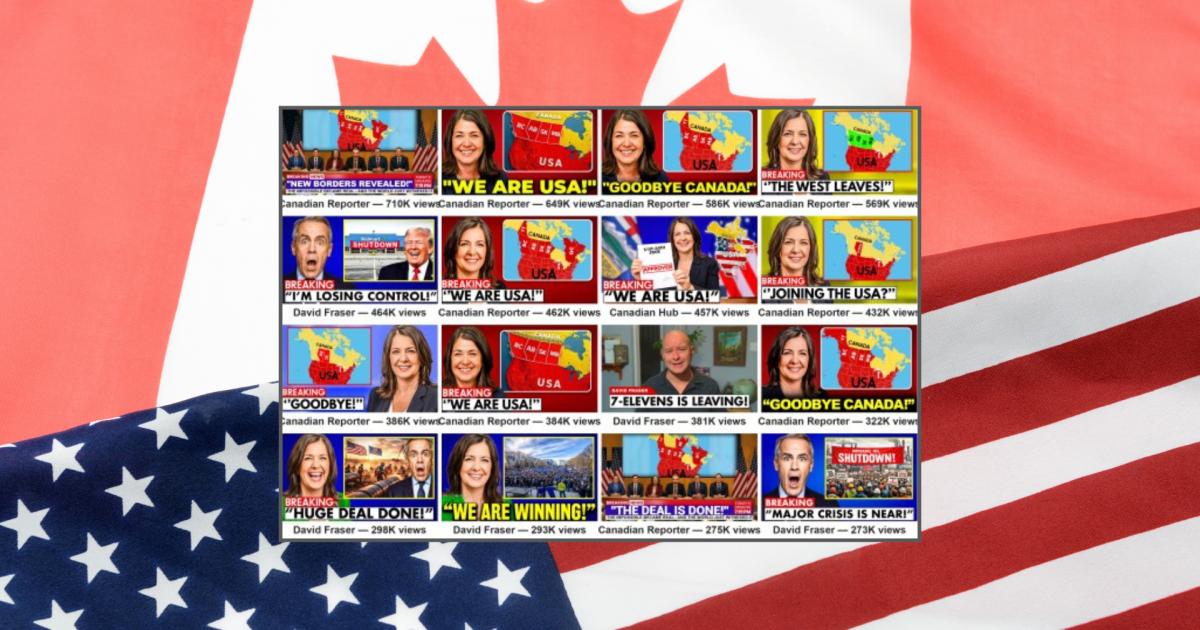
A sophisticated network of misinformation targeting Canadian audiences has been exposed by CBC’s Visual Investigations unit, revealing dozens of YouTube channels masquerading as Canadian news sources while actually being operated from overseas.
The investigation, led by reporter Eric Szeto, discovered that these channels—with patriotic-sounding names like “The Canadian Politician,” “The David Fraser Report,” and “CanadianReporter2025″—were not run by engaged Canadian citizens as they appeared, but by operators based in the Netherlands using American voice actors.
“What we ended up doing was finding that at least three of these channels had Dutch connections,” Szeto told NPR. “These are fake Canadians, because three of the people we found on these channels that are getting tens of millions of views turned out to be American.”
The investigation began after the Media Ecosystem Observatory published a report detailing a sudden surge in videos promoting Alberta separatism, all using nearly identical language and messaging. Alberta separatism has become a contentious issue in Canadian politics, with some of its leaders reportedly meeting with U.S. State and Treasury Department officials—actions that have drawn criticism from Alberta Premier Danielle Smith and Prime Minister Mark Carney.
CBC journalists followed digital breadcrumbs through social media accounts associated with the YouTube channels, discovering that many were created in the Netherlands. When they tracked down the on-screen presenters, they found paid voice actors who had no idea their work was being used in misinformation campaigns.
One Calgary-based voice actor told investigators he thought he was simply auditioning for freelance work when he received a script about Alberta separatism. “When we tracked him down, he said, ‘these guys from the Netherlands hired me,’ and he shared with us all this information, contacts, scripts,” Szeto explained.
Another presenter, identified only as Paul from Indiana, was a former professional golfer turned voice actor who expressed surprise when told his likeness was being used in politically charged videos about Canadian issues. When asked about Dutch connections, he confirmed it was “very possibly” the case.
The CBC team eventually contacted the channel operators in the Netherlands. At least one initially admitted to being behind the content before later denying involvement.
Unlike state-sponsored propaganda campaigns, this network appears to be motivated primarily by profit. The operators are part of a growing entrepreneurial trend called “Faceless YouTubers” who use AI tools and gig workers to produce polarizing content designed to exploit YouTube’s algorithms and generate advertising revenue.
“The accuracy, the quality of arguments, is less important to the algorithms than how engaging the content might be,” explained Yotam Ophir, professor of communications at the University at Buffalo and author of “Misinformation & Society.”
Ophir noted historical precedent for such financially motivated misinformation, citing groups of Macedonian teenagers who created pro-Trump accounts during the 2016 U.S. election. “To drive some online activity, to get people engaged, and eventually to make a little bit of money out of it,” Ophir said, adding that they specifically chose pro-Trump content because it generated more engagement than pro-Clinton material.
This tactic is now being deployed against Canadians amid growing tensions with the United States. The channels focused on divisive political topics, with particular emphasis on Alberta separatism and U.S.-Canadian relations.
“It skews the public opinion, the perceived public opinion of Canadians, and it incites kind of immediate emotions, especially anger and fear among Canadians,” Ophir said. “In the long term, the fact that Canadians now know that some of the discourse on their social media is coming from outside sources, [it] may just yield general skepticism and even cynicism.”
Following CBC’s investigation, many of the channels were removed from YouTube, but not before potentially generating thousands of dollars in monthly revenue. A YouTube spokesperson told CBC that the platform “doesn’t allow spam, scam or other deceptive practices that take advantage of the YouTube community.”
Faceless Education, the Dutch group that offers courses on creating “faceless” YouTube content, has denied any intent to influence politics or create divisions, and rejected claims of connections to the Alberta separatist movement.
Fact Checker
Verify the accuracy of this article using The Disinformation Commission analysis and real-time sources.

14 Comments
The use of American voice actors to pose as Canadian citizens is a particularly concerning tactic. It speaks to the lengths these bad actors will go to create a false sense of authenticity and credibility. Rigorous source verification is clearly crucial.
Agreed. This level of deception is deeply troubling and highlights the urgent need for greater transparency and accountability around online content creation and distribution.
This report is a stark reminder of the need for increased media literacy and critical thinking when consuming online content, especially around politically charged issues. Fact-checking and verifying sources should be second nature in the digital age.
Absolutely. Building public awareness and resilience against manipulation tactics should be a key priority for policymakers and media organizations.
This report underscores the complex challenges we face in the digital age when it comes to maintaining the integrity of information and political discourse. Tackling sophisticated misinformation networks requires a multi-faceted approach involving policymakers, tech companies, and engaged citizens.
Absolutely. Combating online disinformation is a shared responsibility, and success will depend on coordinated efforts across various stakeholders. Vigilance, transparency, and a commitment to truth and fact-based reporting will be crucial.
Interesting to see this report on the YouTube misinformation network targeting Canadian audiences. It’s concerning how foreign actors can exploit domestic tensions for their own gain. I wonder what other tactics they may be using to sow division.
Yes, it’s quite alarming. We need to be vigilant about verifying the sources of information, especially on social media, to avoid being misled.
I’m curious to learn more about the specific tactics used by this network, such as the coordinated messaging and use of patriotic-sounding channel names. Understanding their modus operandi could help develop better countermeasures.
That’s a good point. Detailed analysis of these tactics will be important for developing effective responses and protecting against future attempts to exploit domestic divisions.
This investigation highlights the ease with which bad actors can manipulate online narratives. The use of American voice actors to pose as Canadian citizens is a particularly deceptive tactic. I hope this leads to stronger regulations and enforcement to combat such misinformation.
Agreed. Maintaining the integrity of information sources is crucial for a healthy democracy. Robust fact-checking and transparency measures are needed to counter these sophisticated disinformation campaigns.
While it’s disturbing to see foreign actors exploiting domestic tensions for their own gain, I’m glad this network has been exposed. Increased public awareness and media scrutiny can help counter these types of coordinated disinformation campaigns.
That’s a good point. Shining a light on these tactics and holding the perpetrators accountable is an important first step. Continued vigilance and proactive measures will be key to protecting the integrity of online discourse.